![MaritimeJournal[Seawork]](https://www.maritimejournal.com/wp-content/uploads/2026/09/MaritimeJournalSeawork.svg)





New pontoon for Harwich lifeboat station
One of the UK RNLI Eastern regions busiest stations has had a new pontoon installed for its all weather lifeboat.
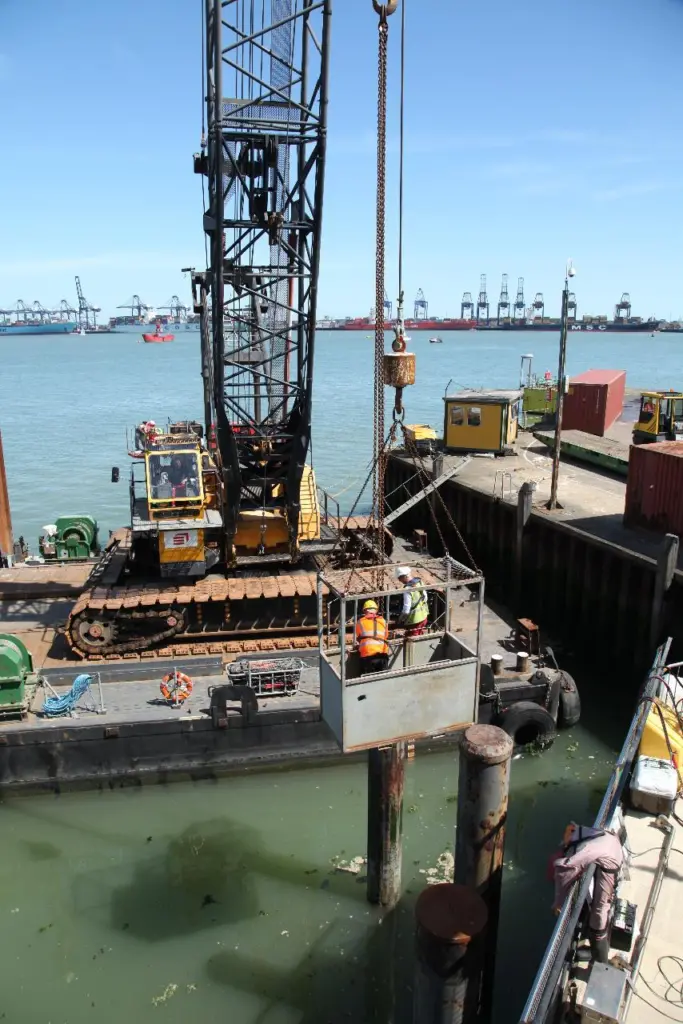
Harwich lifeboat station, which is one of the busiest in the Eastern region with as many as 100 shouts per year, has had a new pontoon installed. This enables the all weather Severn class boat to be moored alongside during all weathers.
QUICKER LAUNCHING
Although the boat has usually been kept afloat directly beneath the station boathouse, the 17 metre vessel, which is the largest class in the RNLI fleet, sometimes had to be relocated during strong north westerlies blowing down the Stour estuary, which would buffet it against the pontoon and make it difficult for the boat to break away when needed. Because of this the boat would be moved around the point to the shelter of the Harwich Haven pilot boat moorings, which meant a four or five minute delay in responding to a shout, and a more laborious task for crews doing routine maintenance.
With the new configuration of the berth the boat will be pointing directly into the nor’westerlies and the ebb tide making it less vulnerable to damage and easier to deploy. As before, the pontoon is double-sided with space for a boat to be moored on each side, with the second berth often required by visiting lifeboats on passage or casualty vessels.
The original pontoon was installed as part of the purpose-built lifeboat station opened in 2003. Plans for the new pontoon, drawn up by architects Arup, called for removal of two of the existing piles and the existing pontoon and involved cutting back the raised concrete quay wall, which houses the fuel store and the crane used to lower the inshore lifeboat to a separate pontoon running parallel to the shoreline.
PILING IN
The concrete apron is up to 3 metres deep and once it had been cut away and the original pontoon removed from the site, a crane barge arrived carrying the two new 32m piles. The tug Wilco-B towed in the barge Waasland, owned and operated by Herbosch-Kiere, equipped with a 300-tonne capacity crane to remove the existing piles and install two new ones. Herbosch-Kiere is a Belgium based marine contractor with particular emphasis on piling works necessitating floating cranes, jack ups and pontoon vessels. The UK arm, Herbosch-Kiere MC Ltd, had previously worked in Harwich Haven supplying and installing a mooring pile, platform and bollard at Harwich International Port in 2012, and removing a 400-tonne linkspan from a redundant ro-ro berth. The company was also subcontracted by Costain for the demolition and removal of the old Oil Jetty, the North and South Dock Piers and the mooring Dolphins at Felixstowe South reconfiguration. It has also been involved in several projects on other RNLI stations around the coast. The crane barge was picked up in Antwerp and towed slowly across the North sea while another vessel was occupying the berth at the Navy Yard quay.
A CLASSIC TUG
The tug Wilco-B which towed the crane barge belongs to the Dutch family firm of Bouwman and was crewed by the eponymous Wilco, and his brother Andre who also has a tug named after him in the family fleet. Wilco-B is an immaculately kept vintage tug built in 1963 by Bodewas and powered by a Bolnes 10KVL engine of 1,000hp. The 26.5 m tug with a bollard pull of 12 tons has previously worked for Herbosch-Kiere on civil engineering and crane barge contracts. For 40 years it was a harbour tug in Vlissingen. Bouwman bought the vessel in 2006 and a major refit in 2011 saw it fitted with a 510 hp power pack to run the bowthruster and a new hydraulic system. It is now UK flagged and registered in Ramsgate as an MCA coded workboat. The tug’s first job for Herbosch-Kiere was installing a pontoon at the LNG terminal at Milford Haven assisting the William-B, one of their larger tugs.
The piling stage of the Harwich job took less time than expected but was dependent on wind conditions. There was also a council moratorium on piling during Sundays but once the original piles had been pulled like rotten teeth out of the sticky London clay with a 65 tonne vibrating pile driver, the installation of the new ones was straightforward.
Then followed a delay while waiting for the pontoon to be finished, painted and delivered. This arrived by road in July and was placed in position by the local harbour tug/workboat Roerdomp. The 26.5m pontoon is ballasted with 25 litre water containers. It is fixed to the two piles by pile gates which can be unlocked to allow the structure to be swung around on the axis of the either pile to give room for the whole berthing area to be dredged by plough or water injection dredger.
By Graeme Ewens
Related Articles
 OTHER NEWS
 FEATURES & VIDEOS
 MARINE CIVILS