![MaritimeJournal[Seawork]](https://www.maritimejournal.com/wp-content/uploads/2026/09/MaritimeJournalSeawork.svg)




Olympian ideals aid construction waste transport
A new class of hopper barge developed to operate on Londons sometimes restricted waterways has made it possible for waste to be transported from multiple sites within the city to bespoke recycling facilities.
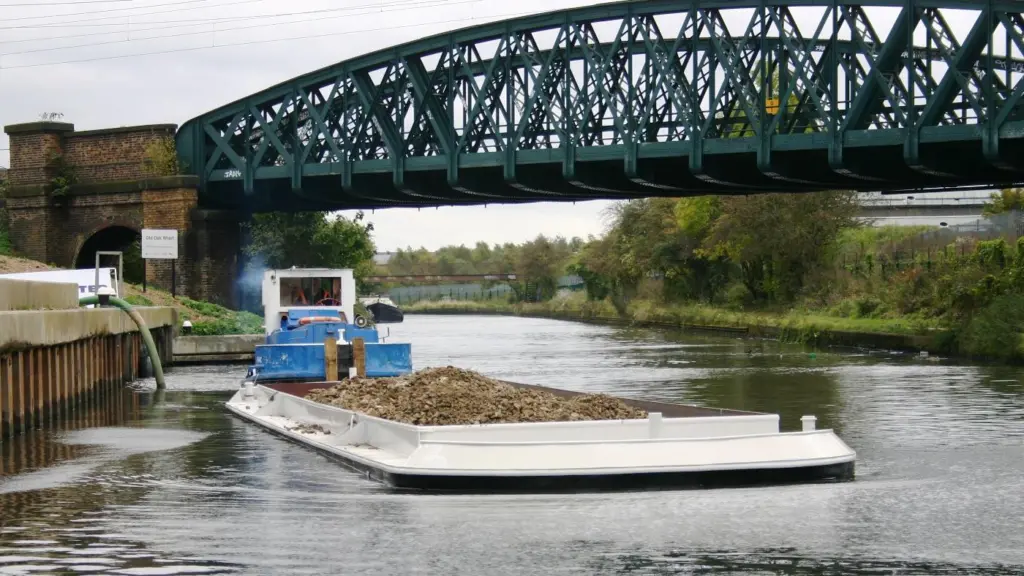
With the canal network passing though the East London construction site for the 2012 Olympics, the aptly named Olympic class barge could help to relieve the pressure on contractors to reduce traffic and pollution in the capital by enhancing the capabilities of freight transport by canal as a viable alternative.
Over recent years various interested parties have been taking a serious look at how the canals and waterways could once again be opened to freight transport. The high profile launch, by British Waterways in 2003, of a scheme using barges to transport 450,000 tons of sand and gravel between Denham and West Drayton near Heathrow Airport, thereby removing 45,000 lorry loads off the road over a seven year period, went some way towards illustrating that it was indeed possible for a return to carrying freight on smaller waterways, albeit with limited applications.
However, over the last five years, huge steps in the development of water transport has been made and British Waterways’ partner in the Denham project, Land & Water Group, has now designed and built the high capacity Olympic barge which makes freight transport on canals an environmentally and financially viable alternative to road haulage.
A framework dredging contractor for British Waterways since 2001, Land & Water was instrumental in the design and ongoing management of the entire Denham project from launch to the current day. It has first hand experience of the limitations of operating on inner city canals and many lessons have been learnt since the launch of the original barges designed to carry the sand and gravel quarried in Denham.
Traditional barges are limited as to the weight they are able to carry due not only by the depth of the canal, but also the amount of water a fully loaded barge displaces. In order for freight by water to be a viable, cost effective option, a special barge had to be designed and built to cope with the unique conditions found in the waterways around the UK.
The waterway profile is reduced from that of its original commercial cross section. By using a high displacement barge the vessel can suffer from ‘Restricted Water Syndrome’, a phenomena first identified on the approaches to locks on the Panama Canal, where high displacement vessels ‘hogg’ or ‘squat’ onto the waterway bed, as water cannot freely reach the propulsion at the stern of the vessel.
Land & Water developed the new Olympic class hopper barge to operate on waterways that may suffer the same syndrome. The new, lightweight vessel is extremely shallow drafted, taking advantage of Land & Water’s lightweight hull and single skin floor design, and with a bow and stern that adopts the Denham hopper barge principle. Land & Water can now carry in excess of 85 tons at an operating draft of under 1.37m.
To provide a truly integrated transport solution, Land & Water has designed the vessels to be rafted in groups of up to six, and when loaded to 75 tons capacity each, they are In-Class for navigation up and down the tidal Thames and other similar category tidal waters. This eliminates the need for expensive transhipment, and opens a variety of avenues for multi-modal and multi-material transport. There is even provision within the hold of the barge for a grillage to carry ISO container boxes.
The Olympic Barge is being pressed into immediate action in a partnership with Powerday plc, one of the UK’s largest waste management companies. Over the last two years Powerday has invested over £12m in a state of the art recycling center, based at Old Oak Sidings, Park Royal, on the outskirts of London, which is able to convert all forms of industrial and domestic waste into a series of reuseable materials.
Once separated, the various waste constituents are all processed, making the site one of the very few in the country which can genuinely claim to usefully recycle and reuse every constituent which comes through its gates. Waste wood is chipped and used at Slough power station to produce energy, nails are sold as scrap metal, plastics are separated and shredded before being processed for waste to energy, concrete is reduced to reclaimed aggregates and waste soils are recovered for re-use as a restoration soil at a remote landfill site, which is accessed directly by train.
The recycling center is based on the Grand Union Canal, and Powerday has installed a 75m long quay to accept barges up to 90 tons fully laden. The combination of a custom designed barge and waterside recycling plant has made the concept of canal transport a genuine commercial option. Land & Water and Powerday have formed a commercial agreement to jointly market and develop their multi-modal and sustainable solutions for waste streams and building materials in Central and West London.
The longer term potential could exploit the Regents Canal links with the Grand Union, which passes through the heart of London, which in turn joins up with the Olympic site in Leytonstone in East London. It is already possible for all forms of waste to be loaded into the barge at various collecting sites across the capital and transported along the canal network to the processing plant at Old Oak Sidings.
Land & Water has entered into partnerships with marine towage specialists GPS Marine Contractors Ltd for tidal vessel movements on the Thames, and with S. Walsh and Sons (landfill and recycling operators in the East Thames Corridor) and a number of landfill operators in this area to provide a one stop shop for East London and Thames side projects.
Related Articles
 FEATURES & VIDEOS
 MARINE CIVILS
 OTHER NEWS