![MaritimeJournal[Seawork]](https://www.maritimejournal.com/wp-content/uploads/2026/09/MaritimeJournalSeawork.svg)


Piling success boosts pier maintenance project
Worthing Borough Council on the UK south coast is currently performing essential maintenance to the timber framed landing stage that surrounds the end of the West Sussex town’s approximate 150 year old Grade II listed pier.
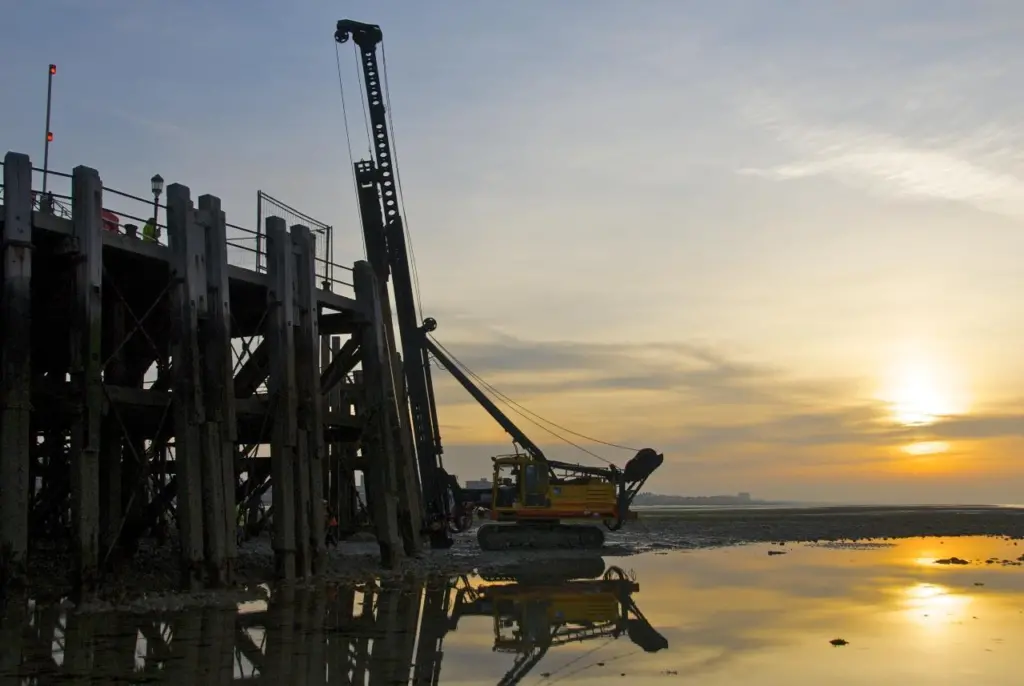
Special strength testing of the timbers has revealed that some of the main support piles have deteriorated and suffered wear from the constant movement of seabed material at beach level and need replacing.
The Council’s long term pier maintenance contractor Paine Manwaring Green Ltd is carrying out the work as part of its current contract, which started in 2002. PMG, based in Worthing, has been maintaining and repairing the approximately 300m long pier for the past 30 years and this current phase involves dismantling part of the landing stage, extracting and replacing piles and reassembling the timber bracing and walkway.
The landing stage consists of an inner row of vertical piles and a front row of rakers, all interlinked with bolted walings, struts, kerbs, deck beams and bearers and topped off with open chequered cast iron deck gratings. PMG had to replace two of the inner and one of the outer piles at the southeast corner of the landing stage. However, the company does not have any piling capability. PMG searched the internet for marine piling contractors and found Aarsleff, which had previously installed thousands of timber piles for new groynes on Eastbourne beach.
Aarsleff visited site and, to ensure that the piles were installed square to the existing grid pattern and gain access for its Banut 700 piling rig, proposed that seven piles be removed and replaced; four in the back row and three front rakers. Worthing Borough Council’s engineers accepted Aarsleff’s proposal and PMG awarded Aarsleff the £25,000 contract to install the new 12m long Greenheart piles.
PMG first removed the existing piles prior to Aarsleff installing their replacements, which could only be done during approximate one hour working windows at the extreme of the low tides. Aarsleff had to track the rig back and forth 300m from the shore to the pier head at each low tide. Working at beach level on a navvy mat working platform, Aarsleff had programmed to install one pile during each consecutive low tide to a depth of between 3.5m to 4m into the underlying chalk.
Aarsleff started on the back row of the vertical 300mm square section piles first and as predicted completed the first pile within the tight time frame. However, the beach subsequently proved to be strong enough to support the piling rig without the working platform. Aarsleff’s site team managed to complete the three remaining vertical piles on the next low tide and the three 350mm square section front row piles, sloping at 8.5°, on the following low tide and finished the job nearly 60% ahead of schedule.
‘Aarsleff has been absolutely fantastic, brilliant, I can’t fault them, said PMG works director Alistair Ktori. ‘There was only one week where the low tides would allow us to work on the beach and install the piles. Aarsleff didn’t need the working platform as the beach was able to support their rig and they completed the piling in just three tides, instead of the seven predicted. The line of the installed piles couldn’t be better and will help us when we come to reassembling all the additional timber bracing.’
On completion of the timber piling PMG will follow on working within the tight tidal windows, reinstalling the walings, bracing, bearers and cast iron deck gratings and aiming to reopen the landing stage to the public by the middle of August.
Related Articles
 FEATURES & VIDEOS
 MARINE CIVILS
 OTHER NEWS