![MaritimeJournal[Seawork]](https://www.maritimejournal.com/wp-content/uploads/2026/09/MaritimeJournalSeawork.svg)




Plain Sailing for Pennine in Spain
The decision of defending Americas Cup Champions, landlocked Switzerland, to stage the 2007 event from the Spanish Port of Valencia has led to an explosion of port development and housing works which are transforming the city itself as well as the nearby coastline from where many thousands will watch the racing.
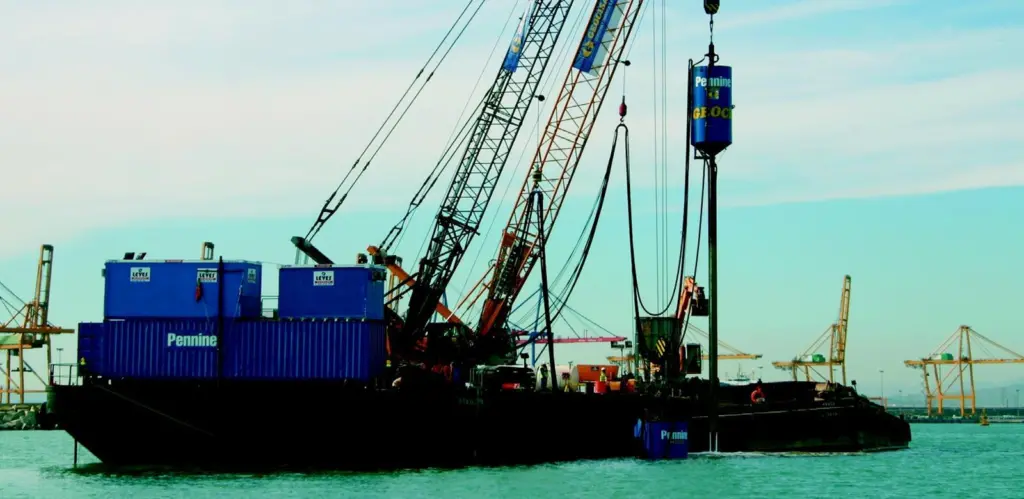
Working with Spanish contractor Geocisa, ground improvement specialist Pennine laid the foundation for a substantial extension to the port with a harbour bed improvement project which was part of a £135m spend. UK based Pennine had to overcome difficulties such as unpredictable fluctuations in the weather, the dangers posed by passing port traffic, poor visibility in the murky waters, and even the requirement to remove fish stuck in machinery in order to complete the project.
‘It was a race against time to meet our deadline, said Pennine’s managing director Arwel Williams.
‘But with two operating teams working 24 hours a day, six days a week, I’m delighted to say that we completed the job on time and to budget. We devised technology and strategies to overcome the numerous obstacles and introduced special equipment designed exclusively for this job.’
As Pennine was working in an open shipping lane, it was vital that operating equipment could be quickly assembled and disassembled. It was taken apart when a tanker entered port, reconstructed for continuing work while the ship was alongside, then removed again so the ship could sail.
Considerable thought went into the stone column design, resulting in larger diameter stone tubes than Pennine had ever used before. Two 160ft floating cranes, each fitted with the company’s own specially adapted HD130 Vibroflot, the Pennine Aquacaster, were then used to load the new columns to design depth.
Like all Vibroflots, the Aquacaster is a giant poker which uses a combination of gravity and vibration to shake its way through the ground. The difference is that the Aquacasters had a hopper on the top fitted with a delivery tube to take crushed stone right to the nose of the system. A waterjet at this position delivers a powerful blast to clear surrounding material.
Two piles can be sunk with each hopper load, improving the efficiency of the system.
When the second pile has been poured, the Aquamaster is lifted from the water and brought alongside the barge, where a travelling 15m 2hopper which is continuously replenished reloads the Aquamaster hopper.
Pennine drove the Vibroflot to a depth of 10m below the seabed, where ground conditions were soft to firm silty clay overlaying very dense gravely sand. As the poker was slowly removed, the crushed stone column was left behind. Correct placement of the column would have been difficult in the murky water so each cab was fitted with a GPS fully integrated with the stone column computer monitoring system. Using GPS to locate the columns meant operators could work day and night without the quality of the work being affected.
MJInformation No: 22201

Related Articles
 OTHER NEWS
 OTHER NEWS
 FEATURES & VIDEOS