![MaritimeJournal[Seawork]](https://www.maritimejournal.com/wp-content/uploads/2026/09/MaritimeJournalSeawork.svg)




Replenishing the beach at Felixstowe
Coastal defence work has started to replenish the beach and construct a series of groynes at Felixstowe Beach in Suffolk UK.
The £10m plus works, which extend from Landguard Fort to a point 200m north east of Felixstowe Pier, are expected to last up to four months and will include repairs to the promenade sea wall. The first deposit of rocks for the groyne construction was made in early April.The start of the beach replenishment works was delayed, first by bad weather and then by the discovery of an unexploded WW2 bomb which Royal Marine divers located close to the beach and then mislaid, before they were able to destroy it with a controlled explosion.
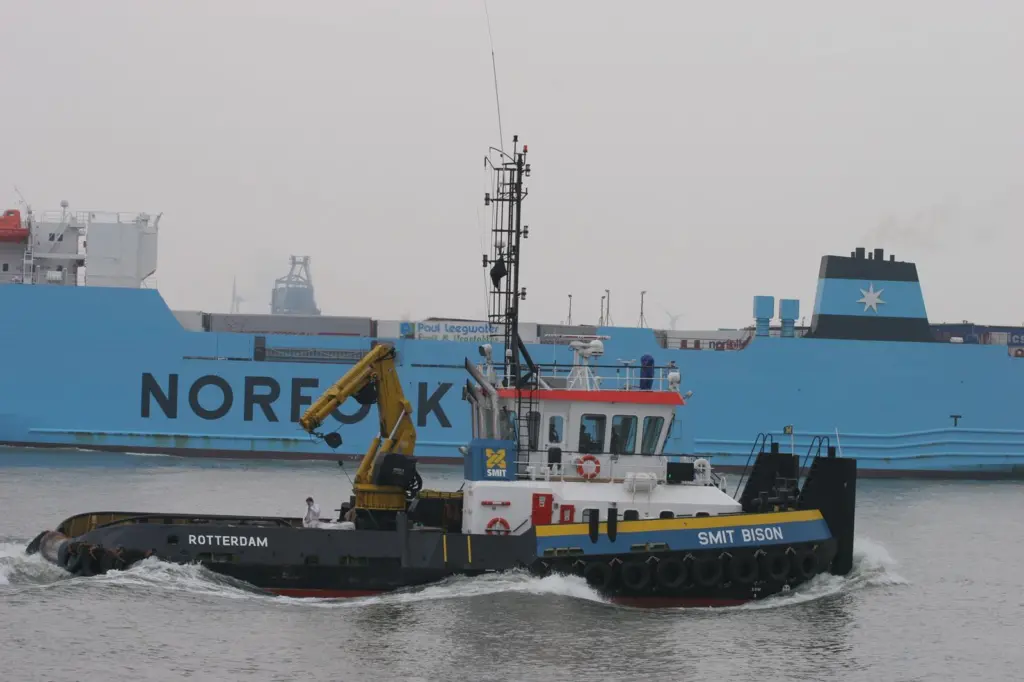
The beach replenishment involves pumping shingle to the beach through a 1.1 nautical mile long, 800mm diameter steel pipeline via a floating booster station which is to be moored in a fixed position. The station/dredger is Van Ord’s 1973 built, 1,605gt Sliedrecht 27, which was towed over from Rotterdam by ‘Multratug 7’. The pusher tug ‘Smit Bison’, which is assisting with the operation, also came over from Holland.
The 2006 built, 230gt Smit Bison collected the pipeline from Skegness and returned with it on 9 May. It was then placed on the seabed at a position indicated in the Notice to Mariners. During that procedure four guard boats patrolled the area to keep out or intercept ‘rogue vessels’.
Smit Bison has marked the pipeline with yellow buoys every 200m and navigators have been warned that the depth of water in the area of the pipe will be 1m less than chart depths. Vessels have been warned not to approach closer than 300m to the Sliedrecht 27
The Cemex operated sand dredgers ‘Sand Harrier’ and ‘Sand Weaver’ are supplying the shingle, with the first load delivered to the site on 17 May by the Sand Harrier.
Farther east along the beach, from south of the Pier to Manor End, 20 ‘T’ shaped rock groynes are to be built. The groyne construction involves depositing rocks on the beach from the stone dumping vessels ‘Ville’, ‘Jopi’ and ‘Topi’. These Finland flagged shallow (1.7m) draft vessels load rocks from the stone carrying ships ‘Mari’ and ‘Rakel’, which are Netherlands flagged but with Finnish management.
The smaller vessels then run up onto the beach where the load is dumped via side discharging buckets. The operations take place two hours each side of high water, with the initial movements happening at night. Mari was the first vessel to supply rock from Boulogne. At the time of writing, Rakel and at least one of the hopper vessels were working at Portland Harbour.
By Graeme Ewens
Related Articles
 FEATURES & VIDEOS
 MARINE CIVILS
 OTHER NEWS