![MaritimeJournal[Seawork]](https://www.maritimejournal.com/wp-content/uploads/2026/09/MaritimeJournalSeawork.svg)

Rotterdam LNG developments proceeding apace
The GATE terminal, the very first Dutch LNG import facility, which is now being constructed on Maasvlakte’s former ‘Papegaaiebek’ location is proceeding rapidly.
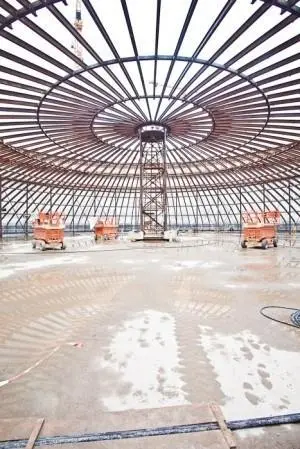
Built on 35ha of reclaimed land, the terminal will have an initial throughput capacity of 12bn cu/m (bcm) per annum when it opens in 2011 and will consist of three storage tanks and two jetties. Originally designed for 9 bcm and one jetty, the plans were expanded with four major energy customers coming on board.
There is room to increase throughput capacity to 16 bcm in the future. This will require about 200 shipments a year, two LNG jetties and four storage tanks. The tanks, each having a capacity of some 180,000 cu/m, will have a diameter of about 86m and will be up to 40m high at the edge and 52m in the centre. These are full containment versions with a steel inner tank, thermal insulation and a concrete outer tank.
Importantly, it is a ‘clean’ operation, hinging on receiving LNG which will then be regasified and stored under pressure at the terminal before it is supplied at a constant rate to the Dutch transmission network.
The jetties themselves have been designed to accommodate a future generation of larger LNG carriers and Qatar max vessels (with a capacity of some 250,000 cu/m, a length of up to 350m and a draught of about 12.5m). The current generation of LNG vessels can carry between 120,000 cu/m and 154,000 cu/m of gas, with a ship’s length up to some 300m.
Long term offtake contracts have been signed with major European energy suppliers Dong Energy, EconGas OMV, Essent and E.ON Ruhrgas for the combined throughput of 12bn cu/m of natural gas per annum. This will be enough to provide natural gas to all 7,000,000 households in the Netherlands.
However, there could be more to the LNG story, since the Port of Rotterdam Authority has started a study to develop the sites locally known as ‘Kop van de Beer’ and ‘Stenenterrein’, both along the western edge of the Europoort area.
Until recently the Liongas LNG terminal was planned to be realized at the port. Sjaak Poppe of Rotterdam Port Authority explained that although Liongas had an option on developing the ‘very popular’ location at Kop van de Beer, there was a delay and the company ran out of time. However, the Enecogen plant has still been given the go ahead, and the Port Authority has gained from knowledge garnered from the Liongas project, as some of it remains applicable to further developments.
Mr Poppe told MJ that the port authority is still looking at how to capitalise on the site’s 24m draught and useful location near the port’s entrance. LNG related activities generate ‘very strong interest from the market, especially the tank storage sector’ he said.
Related Articles
 FEATURES & VIDEOS
 MARINE CIVILS
 OTHER NEWS