![MaritimeJournal[Seawork]](https://www.maritimejournal.com/wp-content/uploads/2026/09/MaritimeJournalSeawork.svg)


: Scale of Ambition Defines Marine Civils Projects
Much has changed in the marine civil engineering industry since Maritime Journal was first published, but perhaps the most obvious trend or development is the scale of many projects.
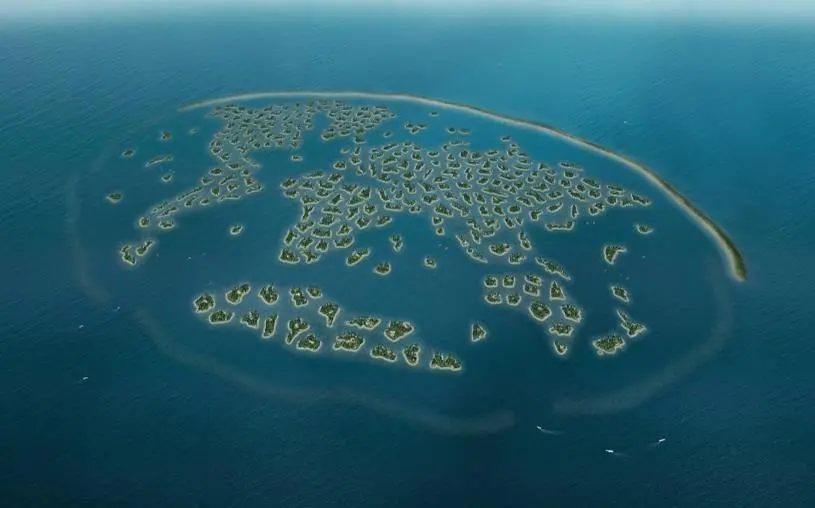
Enormous land reclamation projects have become almost commonplace in the Middle East, particularly in the United Arab Emirates (for which read Dubai), but the trend towards ‘island building’ projects really got under way in the Asia Pacific region, in densely populated countries such as Singapore, where the requirement for new land was – and is – at a premium.
Land reclamation has, of course, been used to provide much needed new building space for ports and harbours before, but the landmark project in respect of mega dredging and land reclamation was Chep Lap Kok, the largely reclaimed island on which the new Hong Kong airport was built. Opened in 1998,
required a massive land reclamation project to be completed before work on the construction of the airport itself could begin.
To build an area of land large enough to accommodate the new airport and its runways, the 302 hectare Chep Lap Kok and a neighbouring island of some 8 hectares, Lan Chau, were tripled in size through dredging and land reclamation into a single 1, 248 hectare site. Dredging and reclamation work for the airport were largely completed by 1995, but since then the success of the project has prompted the development of many others like it, culminating in ‘The World’ and ‘Palm Islands’ off the coast of Dubai.
As many dredging and marine construction companies will attest, demand for marine construction work is currently running at what is probably its highest level in a decade, driven by demand for infrastructure projects of all types, not least for the offshore oil and gas industry and for the now burgeoning LNG industry, for which a new generation of mega-terminals is under construction.
Marine civils challenges that have been with us for many years, such as the maintenance of sea defences, have become more demanding than ever in the last decade, partly as a result of global warming and concerns about rising sea levels, and partly as a result of the need to find new solutions to coastal defences that do not involve the tremendous cost, both fiscal and environmental, of ‘hard defences.’
Large areas close to the coastline in many countries lie below the level of the highest sea levels, so reducing the risk to people and property from flooding of such areas is the single most important objective of coastal defence policy. These risks have been heightened by rising sea levels and if, as is thought, global warming further accelerates the rate of sea level rise, prevention of flooding will become ever more of a technical and fiscal challenge.
Building new coastal defences, or improving existing ones, is particularly expensive and may not be economically justifiable, or sustainable in the long term. Where coastal defences can be justified, the appropriate standard of protection needs careful consideration. In Europe, and in the UK in particular, ‘managed retreat’ has become the watch-word. Often controversial, the concept of letting the sea inundate the land (where appropriate) has, in some cases, created opportunities for environmental schemes that would otherwise not have been possible.
Many other new challenges have arisen in the last decade. Accelerated Low Water Corrosion (ALWC) of steel structures such as piles has become more and more widespread, and more and more costly. Now much better understood as a process, the problem of ALWC is being addressed in a number of ongoing studies.
As infrastructure projects on land have increased in scale, so demand for marine aggregates has increased significantly, prompting widespread fears, which the marine aggregates industry believes to be unfounded, about the potential effects of excavating so much material from the seabed. But many of the problems to which solutions must be found are posed by our own heightened awareness of how new infrastructure projects affect the environment.
Design, construction and operation of development projects in the marine environment pose significant challenges, not least environmental challenges. As ever stricter legislation is introduced to protect the environment in the next decade, marine civil engineering consultants and contractors have to find new ways to build ports and harbours and maintain them, defend the coastline, and develop new infrastructure, in an affordable and sustainable way.
Marine journalist David Foxwell is MJ’s Marine Civils correspondent.
Related Articles
 FEATURES & VIDEOS
 MARINE CIVILS
 OTHER NEWS