![MaritimeJournal[Seawork]](https://www.maritimejournal.com/wp-content/uploads/2026/09/MaritimeJournalSeawork.svg)


‘Simple’ solution to ALWC problems
Accelerated Low Water Corrosion (ALWC) has taken its toll on the structural integrity of ports, harbours, marinas and commercial water frontage for many years.
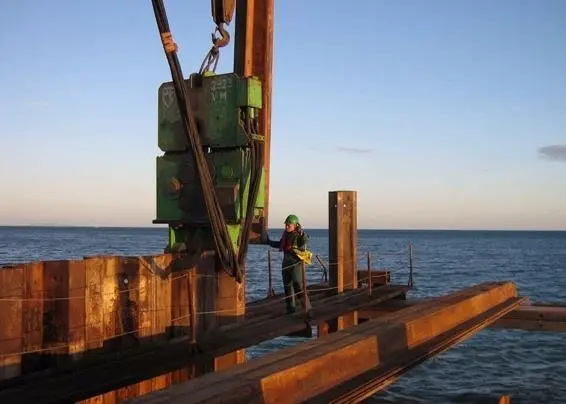
Although a salt water environment by itself helps turn steel back into its natural state, iron oxide, at a much faster pace than neutral surroundings due to the presence of chlorides and other elements, engineers usually build sufficient thickness and strength into their piling and reinforcements to accommodate the anticipated wear and tear.
What was not expected was the evolution of bio-films, the products of oil and industrial effluent released into the watercourse and the impact that they would have on the ecology and ultimately on the integrity of unprotected steel structures in the same location.
Once a bio-film has become established, it will often become populated with a sulfate reducing bacteria (SRB) which causes the corrosion process to rapidly accelerate. In simplistic terms, the SRB ‘feed’ off the sulphates and sulphites, converting them to hydrogen sulphide, a very corrosive gas. When dissolved in water, this gas forms an acidic solution which begins to attack the steel surface. The continued attack in localised spots will cause pitting and eventually perforation of the steel, requiring repair or replacement of the sheet pile at a considerable cost. The intertidal zone and the margin just above it are especially vulnerable as the salt water surface moves with regularity across the area.
One answer has been found in a new system developed by MGDuff International which combines traditional sacrificial anodes and an active zinc anode film, which provides comprehensive protection both above and below the waterline.
The anodes are produced with extended core bars which are welded onto the sheet piling above the waterline, positioning the anode at a depth where it is permanently submerged. Then, the ‘Zinga’ anode film is applied at low water to the area covered by the intertidal zone and above.
The advantage of this type of system is that it can be retrofitted. It requires no service power and is self regulating. The system can be designed to suit any service life and once installed requires almost no maintenance. MGDuff says, ‘One of the main reasons that the system works so well is its simplicity.’
Related Articles
 FEATURES & VIDEOS
 MARINE CIVILS
 OTHER NEWS