![MaritimeJournal[Seawork]](https://www.maritimejournal.com/wp-content/uploads/2026/09/MaritimeJournalSeawork.svg)






Southampton’s future proofing moves forward
Steve Garrigan of VolkerStevin, part of the Dutch Volker Wessels group, explained to MJ that the UK’s Port of Southampton is responding to the challenges of bigger ships, but this has meant dealing with everything from oversize piling to migrating salmon.
The idea is that the work will “future proof” operations, says Mr Garrigan. Associated British Ports (ABP) is bringing £150m of investment into the UK’s Southampton facility, for which there are two main areas of development, the deepening and widening of the approach, and the merging and upgrading of two older berths to give a ‘supersize’ capability, explains Dave Herrod, ABPs engineering project manager.
“When you look at the origins of berths 201/202 you are going back to the late ‘60s, says Mr Herrod. “Berth 201 was one of the first purpose built container berths in the country. These formed the start of the container terminal and we carried on with this development right up to the building of berth 207 in the 90s.” Interestingly, these quays saw the very first container vessel, Kamakura Maru, arrive in January 1972 at berth 201 over four decades ago.
But he points out that these early berths have, to an extent, been the victim of their own success: “Southampton is now one of the two major container terminals in the country, which means that 90% of the vessels calling are the Asia-Europe deepsea trade. These quays were only designed to accept the ships of the time, so they’ve been limited to non-containerised handling since the mid-80s.”
All this has had a knock-on effect. As the ships got increasingly longer, ABP found that there was a squeeze at the newer berths 204 to 207. “We were faced with the fact that four of the bigger vessels couldn’t come in at one time,” said Mr Herrod.
The most obvious choice was to update 201 and 202 to make one superberth. When finished, this new quay will have a length of around 500m and depths to complement this. The berthing pockets are being brought down by 5m to 16m below chart datum, 22m below the quay surface by VolkerStevin, the main contractor for the berth deepening part of the project. “This means moving around 165,000 cubic metres of dredge material from the pockets alone,” explains Mr Garrigan.
However, the existing quay wall wouldn’t have remained stable with this kind of deepening, adds Mr Herrod, so a new, deeper quay wall is being placed immediately in front of the old one. “This was a pragmatic choice for a number of reasons. Firstly, putting it directly in front means we can build it out from the land and avoid having to use a lot of expensive floating plant. Secondly, we need to maintain room on the water side for manoeuvring.”
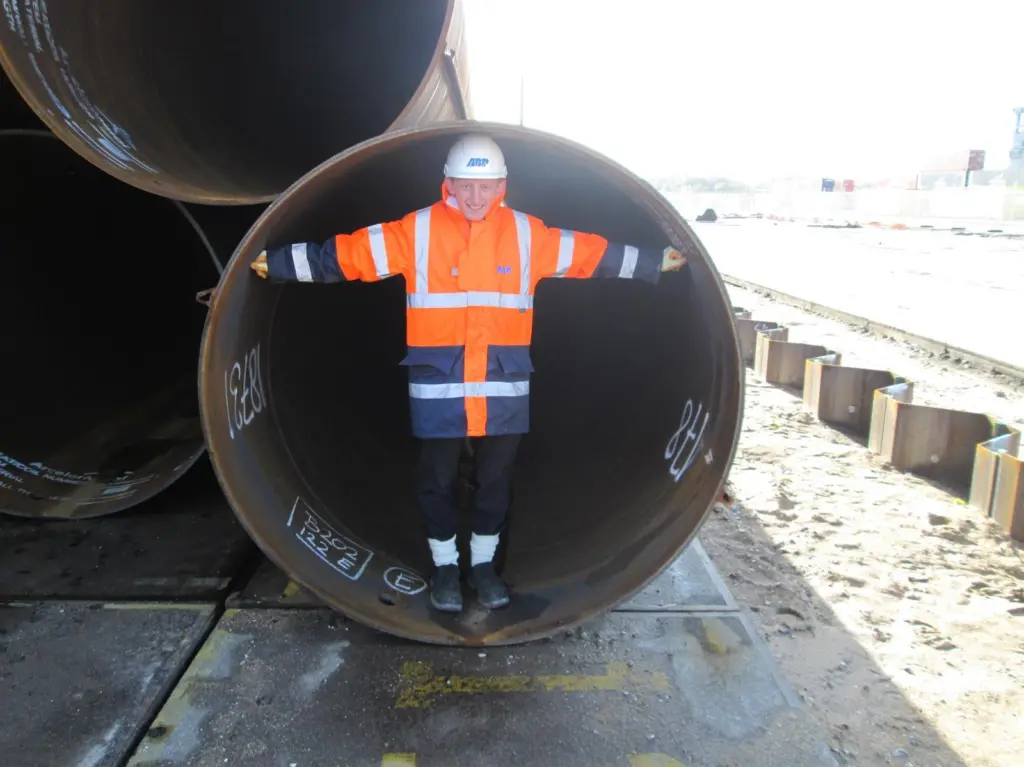
Mr Garrigan adds that the piling work has been challenging. “We have had to go well below the quay wall as it stands, and we know that previous piling had met difficult ground conditions. So, we have to use larger piles, rather than the more usual 24m lengths.” In fact these piles are over a third longer, being around 38m to 40m.
The percussive piling hammers needed to drive them in are larger than usual too, weighing in at around 70 tonnes. However, all this means that there are restrictions with noise, and they can only be used between 08:00 and 18:00 Monday to Friday. “It is reasonable. After all, I wouldn’t want to be listening to that evenings and weekends either,” says Mr Garrigan.
However, there was another restriction: “Salmon migrate through here so we are not allowed to pile between April and September. It meant we had to be finished before then.” Mr Garrigan adds that all in all there are 149 tubular piles, with steel infill panels between the tubes.
“There’s about 6,000 tonnes of steel in the wall,” he says, although it happened at quite a regular pace. With the piles being driven in at a rate of two a day there was some relief when the main piling of the quay walls were installed by the end of the window.
The next stage is the demolition and removal of the existing quay wall down to the 4m level. At this point a very large tie rod is installed which ties the new piles and sheeting into the existing structure. The material that gets taken out from behind the old walls, around 150,000m3 of it, will then get crushed and recycled to go back in as fill.
To make the most of this new quayside capacity, the port has also placed a £26m order for four new ship-to-shore gantry cranes which will have a reach 24 containers wide with a lift of 65 tonnes. Being built in Ireland by Liebherr, they will be shipped as separate components and assembled on site.
Consents for other dredging works at Southampton have finally come through. Mr Herrod explains that while an application for the complete dredging project was submitted quite a while back in 2008, there was a need to widen the navigation channel at Marchwood sooner rather than later so a separate application was given approval by the Marine Management Organisation (MMO) in November 2011 and work started immediately.
Mr Herod explains that some of it has been carried out by ABP ’s sister company UK Dredging which owns the UKD Bluefin. This trailing suction hopper dredger moved around 80,000 cubic metres over the period of around a month. Then it was the turn of the Boskalis backhoe dredger, the Manu Pekka, which is fitted with an eight cubic metre bucket that can dredge to a depth of 18.5m. The dredger was attended by four barges called in from as far away as Sweden and together they carried on with getting out the remainder of the harder dense sand and clay material at Marchwood, which accounted for the removal of another 270,000 cubic metres.
The rest of the total 11.6 million cubic metres of the Southampton Approach Channel Dredge (SACD) received its go ahead from the MMO in February. The SACD addresses “strategic sections ” of the approach channel to increase the access window into the port. It includes deepening the navigation channel at the Eastern end of the Isle of Wight by around 1.5m to get it to 14.8m and this is also matched with a major deepening and widening of the channel between the dock head and Fawley plus localised ‘smoothing’ of the channel to make access easier.
Getting permission hasn’t been easy: “There’s been a lot of hoops to jump through” admits Mr Herrod, but it looks like tender documents for the first phase of the project will be issued soon, so watch this space.
By Stevie Knight
Related Articles
 FEATURES & VIDEOS
 MARINE CIVILS
 OTHER NEWS