![MaritimeJournal[Seawork]](https://www.maritimejournal.com/wp-content/uploads/2026/09/MaritimeJournalSeawork.svg)


Terminal extension underway in the Port of Muuga
Danish contractor Per Aarsleff has been installing one of its longest combination steel pile retaining walls ever for the extension to the container terminal in the Port of Muuga on the Gulf of Finland south coast, 17km east of the Estonian capital Tallinn.
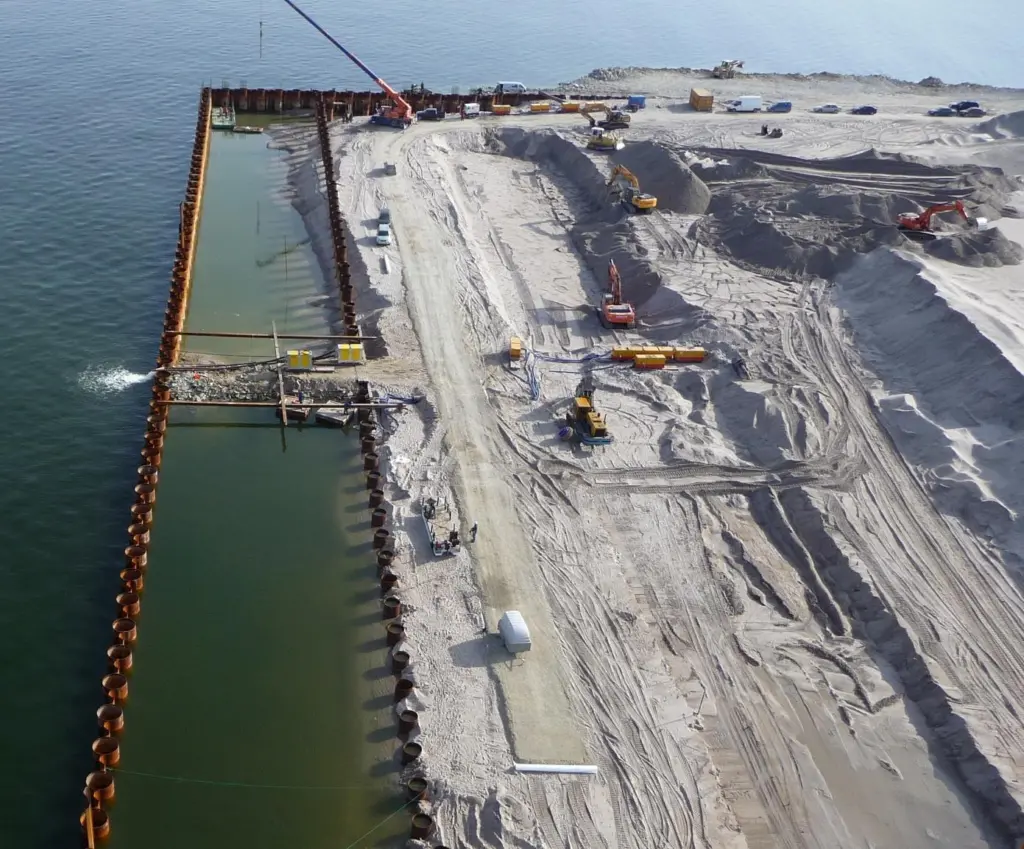
The site team, with its fleet of specialist marine plant, started the project earlier this year, coping with strong winds and rough seas at the exposed site to accurately drive over 420 tubular steel piles up to 1.67m diameter and 45m long into the seabed. Approximately two thirds of these piles, weighing up to 32 tons, will be linked together in combination with pairs of shorter steel sheet piles to form the main ‘combiwall’ quay frontage and a section of retaining combiwall running parallel with and alongside the terminal’s existing wharf. One end of the combi sidewall will link into the terminal’s existing quay, while the other end of the main quay will combine with a new 800m long breakwater joining with the existing natural coastline. The continuous peripheral combiwall and adjoining breakwater will form an enclosed basin, which is being filled with 1.5 million m3 of dredged sand to reclaim the new 180,000m2 extension to the terminal area. A second line of smaller diameter, equally spaced tubular piles is also being installed behind and parallel to the main berthing wall. Together they will provide the foundation support for the twin rail tracks to take the existing and new quayside container handling cranes.
Muuga Port is the biggest of the several harbours that make up the Port of Tallinn, which is one of the largest ports in the Baltic Sea region. Tallinn Port’s consulting engineers Merin Konsult produced a concept design for the Muuga Port extension, which was based on a twin combiwall of smaller diameter piles. However, Per Aarsleff, in a joint venture with the Estonian contractor KMG Inseneriehituse and the specialist Danish dredging contractor Rohde Nielsen, won the detailed design and construct project in open tender with its alternative design. This was produced by its Estonian consultant Estkonsult and based on a single continuous combiwall using much larger diameter tubular steel piles.
Initially, Per Aarsleff built up a stock of the huge spirally welded tubular piles, each complete with a pair of interlocking clutches welded diametrically opposite on the outside of the tubes. These were brought in from Holland together with pairs of the interlinking sheet piles from Luxemburg, which were all made and supplied by ArcelorMittal.
Piling for the 205m long combiwall running alongside the existing quay wall started first, and this section was constructed by a 130 ton Liebherr 1130 crawler crane and piling equipment operating from a series of platforms reclaimed behind temporary limestone bunds. A pair of temporary tubes was first driven with a PVE52 vibrator as deadmen to support a special piling template frame to accommodate up to five of the main tubular piles set at the correct spacing and inline orientation of the interlocks.
Each of the main piles was then pitched and driven to level by the PVE52 vibrator followed by pairs of the 10m long interlinking sheet piles. The temporary support piles and frame were removed and repositioned to repeat the cycle. Every tenth pile was then struck with a Delmag D62 diesel hammer to a predetermined set to check the required pile bearing capacity of 1,200kN.
At the same time Per Aarsleff started on the main quay frontage combiwall, but working in 4m to 11m depth of water from a 55m long spud leg barge equipped with a 200 ton Liebherr HS895 crawler crane. Using the same deadmen support and piling template frame concept, the site team pitched and drove the largest 1.62m to 1.67m diameter tubes to about 5m to 8m above final penetration level using a larger ICE1412 vibrator. The main template was then removed and replaced with a similar special frame spanning three piles to prevent the centre pile rotating when striking to final level with a hydraulically operated IHC S-150 accelerated hydro-hammer.
About 25 piles were each driven to completion in turn, leap-frogging the frame. If any of these piles did not achieve the required 8,000kN design bearing capacity, Per Aarsleff had to go back later and re-strike and recheck. Only when all the group of 25 piles had reached the design capacity could Per Aarsleff’s team install the 22m long pairs of interlinking sheet piles. The sequence is then repeated until completion of the main 480m long combiwall.
While one team is installing the combiwall another Per Aarsleff team is placing about 65,000m3 of material to build the breakwater in water depths up to 11m on a seabed slope of 1:2 at the coastline, dropping to 1:4 at the toe. The 800m long breakwater is being built round a central core of a geotextile faced limestone retaining bund, about 4m high. Sea dredged sand is piled up behind on the inner face while a 2m thick slope protecting rock armour layer is accurately placed on the front face, crest and to the top of the sand level. Armour placing follows closely behind the limestone core to minimise any erosion during construction.
During combiwall and breakwater construction Per Aarsleff’s joint venture partner Rohde Nielsen is using four different hopper dredgers Thor R, Magni R, Trud R and Gefion R to excavate sand from a designated area about 20 nautical miles from the port.
When the fill has been consolidated and the combiwall completed, Per Aarsleff’s other joint venture partner, KMG, will then cast in-situ longitudinal concrete capping beams along the tops of the two parallel rows of piles together with an adjoining post tensioned capping slab. Container crane rails will be fixed on top of the capping beams together with fixing the necessary berthing fenders and mooring bollards to the outer combiwall.
After completion of the concrete superstructure the final part of the project will involve the excavation and dredging of about 570,000m3 of material by Rohde Nielsen A/S from the seabed in front of the main combiwall, increasing water depth to 14.5m to accommodate the berthing container ships.
Despite some initial delays at the start of the project and the current loss of about 15% of the time due to poor weather, the joint venture anticipates finishing its 18 month contract on schedule in January 2010.
By David Foxwell
Related Articles
 FEATURES & VIDEOS
 MARINE CIVILS
 OTHER NEWS