![MaritimeJournal[Seawork]](https://www.maritimejournal.com/wp-content/uploads/2026/09/MaritimeJournalSeawork.svg)





The Netherlands and Flanders join forces to reduce flood risk
Completion of a large scale project to protect the residents of an area straddling both the Netherlands and Flanders has been marked with the signing of a new Declaration of Intent for further work in the area.
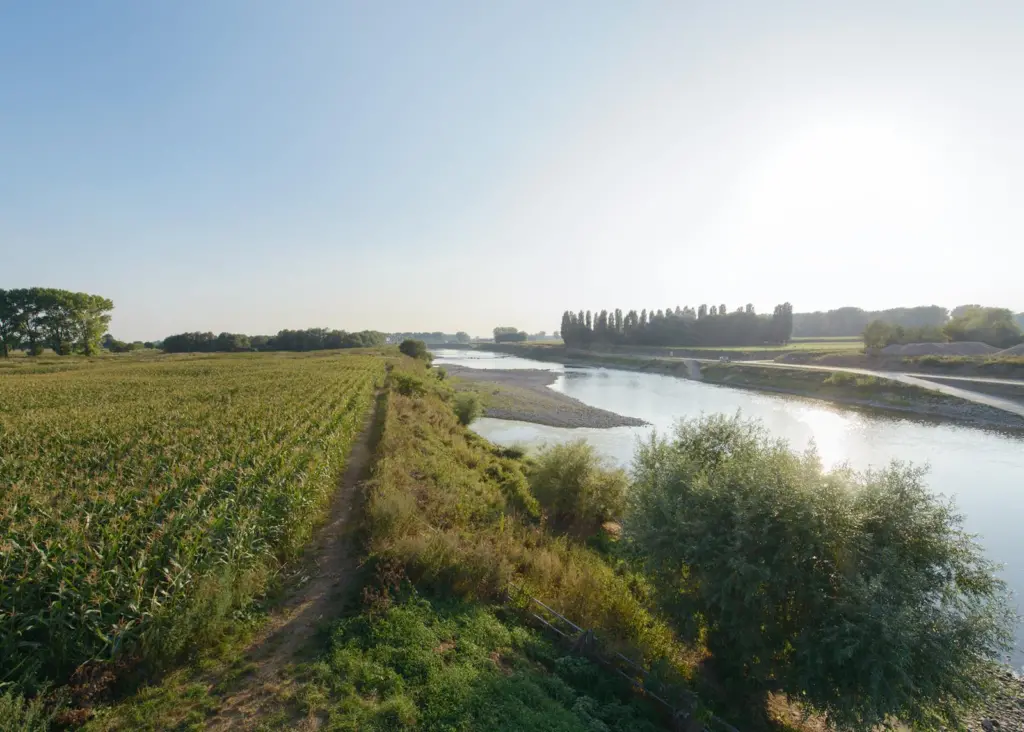
The governments of the Netherlands and Flanders have been working together for a number of years widening the (southern) river Meuse area, creating a new natural landscape and providing protection for residents in the region between Eijsden and Maasmechelen. Completion of this work was celebrated recently by Melanie Schultz van Haegen, Dutch Minister of Infrastructure and the Environment and Hilde Crevits, Flemish Minister of Mobility and Public Works. At the same time, the two ministers immediately signed a new Flemish-Dutch Declaration of Intent for the implementation of works in the northern Meuse area.
Rivers often form boundaries between countries and regions but of course the consequences of flooding, not to mention the prevention work carried out by respective authorities on each side of the river, will affect those living on both sides. Cooperation is important in dealing with what is a long-term issue and it is clear both the Dutch and Flemish governments are taking a joint approach to achieve benefits for people both sides of this ‘border’. As Minister Schultz says: “We have a Dutch problem – too much water – on the Flemish side. The awareness in the Netherlands that we can benefit more in terms of high water protection by making a financial contribution to tackling the problem at Flemish sites is a breakthrough. The fact that the same amount of money has had a greater impact on the level of water is a pure gain for all parties involved”. Minister Crevits echoes the words: “There is only one Meuse. It is a single river even though it has one bank in Flanders and the other in the Netherlands. Rather than a dividing line, it is a river that connects our respective Limburgs”.
The Flemish side of the Meuse has been widened considerably since 2007, lowering high water levels by as much as 30cm in some places on both the Dutch side (Eijsden, Maastricht, Borgharen, Itteren) and Flemish side (Smeermaas, Herbricht, Kotem). Work at the Flemish sites, known as Boertienlocaties have been completed, resulting in improved protection for residents at times of high water. Flood risk in Zuid Limburg has now been reduced to once in 250 years and work carried out in Flanders mainly used Dutch resources, the total cost amounting to €5m. This is in addition to implementation of the Dutch Maaswerken (Meuse Works) programme and Flemish investment programme for the Meuse. As regularly seen with such projects, particularly in the Netherlands, the opportunity has been taken to exploit benefits that present themselves with the planning. In this case the works have created several hundred hectares of natural landscape ideal for hiking, this area part of the cross-border Meuse Valley River Park.
MORE OF THE SAME
With the obvious success of the Dutch and Flemish joint works mentioned above, advantage is now being taken with the announcement (at the same time as marking the completion of the earlier work) by both minsters of the Declaration of Intent to “make every effort to implement the additional Bortien-plus measures together”. This is a reaffirmation of the principles of “Working Together on the Common Meuse” and involves additional measures in the northern part of the Border Meuse aimed at contributing to a more stable and wider river.
It was high tides during the winters of 1993 and 1995 that led the Netherlands to draw up concrete plans for the protection of the residents of the Meuse Valley. However, if the Netherlands wanted to protect Maastricht, Borgharen and Itteren it was clear that action had to be taken on Flemish side, particularly at the three Flemish Bortien sites from the Hochter Bampd up to Geneuth, projects that included, for example, additional soil protection or optimisation. The Netherlands invested in implementation of the projects that were situated on the Flemish side of the Meuse. Flanders funded the project preparation and made the necessary land purchases.
While the work is being carried out by Flanders and the Netherlands together, their respective water management authorities are also investing separately in infrastructure projects on each side of the river and there are four applicable principles in this regard: Allowing for water, the Meuse is being given room to store large volumes of water in a wider winter bed (reminiscent of the Netherlands Room for the River project – see MJ January 2013); Integrated approach, the measures take into account the effects during high and low discharges of water. The water levels during high discharges should fall, but should not fall when discharges are low. The water will be kept at the right level through construction of nine gravel banks in the river. This will prevent desiccation damage to the natural landscape and ensure the fresh water supply; Cross border coordination and intensive cooperation between Flanders and the Netherlands, creating synergy with other sectors/functions, developing additional natural landscapes and new opportunities for recreation.
Control and coordination of implementation of the measures for the Flemish Bortien sites is in the hands of the VNBM, the Flemish-Dutch Bilateral Meuse Committee established in 2005. River widening measures such as those above are just one example of the many areas of cooperation between the two river management authorities. VNBM integrated the originally independent Flemish and Dutch water monitoring stations for water quantity (discharge and water level), water quality (chemicals) and ecology to form a cross-border monitoring network. Both authorities now also use the same data and models and cooperate in many other fields, including during inspections and crisis management exercises.
By Peter Barker
Related Articles
 FEATURES & VIDEOS
 MARINE CIVILS
 OTHER NEWS