![MaritimeJournal[Seawork]](https://www.maritimejournal.com/wp-content/uploads/2026/09/MaritimeJournalSeawork.svg)





Tight timing ensures inter-tidal works success
Land and Water Services were contracted by Dredging International (part of the LORDI joint venture for the port construction) to complete two phases of the London Gateway Port project.
Works were conducted over a 13 month period that began in December 2011 and was completed in January 2013.
The inter-tidal habitat, approximately 500m upstream of Land and Waters’ work, is classed as an environmentally sensitive area. It was therefore important for Land and Water Services to consider the wildlife and water.
The first phase was the recovery of 52,500m3 of temporary rock revetment in order to allow the removal of a temporary sand berm, made to facilitate the quay wall construction, before dredging in front of the quay wall to expose the new quayside. Once recovered, the rocks were stockpiled for later re-use on the project’s permanent revetment, a measure designed by Dredging International to minimise waste and allow re-use of the rocks.
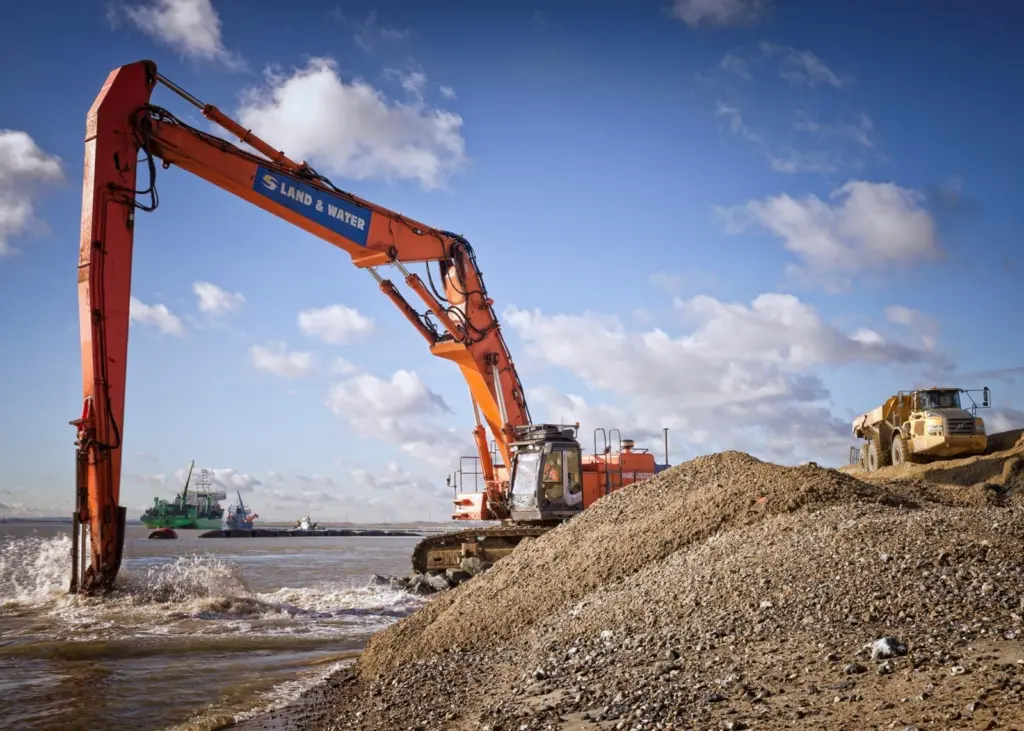
The second phase, made possible by the first, was for the removal of the sand berm, which was made up of in excess of 530.000m3 of sand and gravel. This was achieved using the largest long-reach excavator available in the UK, configured for a maximum reach of 17m (although the machinery is capable in a different configuration of reaching up to 27.5m). In order to recover the material, the operation had to be performed at low tide, which required work to begin as early as 03:00. The work was completely based upon the tides and was a highly complex logistical exercise.
Once recovered, the sand and gravel was then transported in articulated dump trucks, supplying raw materials for other contractors to carry out their own phases of work such as the reclamation of the low lying land areas to create development platforms. This meant that the work being undertaken by Land and Water Services was of importance to the success of the project as it helped keep the programme running to schedule.
The two phases of work involved a great deal of logistics, and planning for the removal of sand, rock armour and gravel. There were a number of sensitive aspects and strict controls that have to be adhered to. First, because the lower Thames Estuary has strong tidal currents and because the work can only be performed at certain times, the logistics of the project becomes, in itself, a major task. Making sure that machinery and people work on time in order to maintain constant production.
Second, when working between tidal zones, with machines that weigh between 80 and 115 tonnes (ZX670, ZX850 respectively), extreme care is required as is regular maintenance of equipment. It was of paramount importance that the machinery provided by Land and Water Services was in perfect working order. The operators had to be able to depend fully on the machinery that they were using to be as close to 100% reliable as possible. Land & Water Services made a significant investment into the machinery. The ZX670 and ZX850 on site were collectively worth in excess of £1m. Loosing any of this machinery to flooding would be financially disastrous. Even worse would be the environmental impact of any oil or fuel spillage.
It was of utmost importance that Land and Water Services were able to maintain the machinery. All planned maintenance took place outside of working hours, based around the tidal patterns in order to keep the machines in working order and running to a tight programme.
Specialised global positioning system software was retro-fitted to the Hitachi ZX850 and ZX670 long reach excavators to enable extremely accurate digging to a high tolerance, in order to ensure that all rock boulders greater than 250mm diameter were recovered from the foreshore.
Related Articles
 FEATURES & VIDEOS
 MARINE CIVILS
 OTHER NEWS