![MaritimeJournal[Seawork]](https://www.maritimejournal.com/wp-content/uploads/2026/09/MaritimeJournalSeawork.svg)




Troubled JWP looks to long term success
Despite teething problems and initial poor business, officials at Germany’s new €950m deepwater JadeWeserPort (JWP) container terminal are going ahead with a study into future expansion.
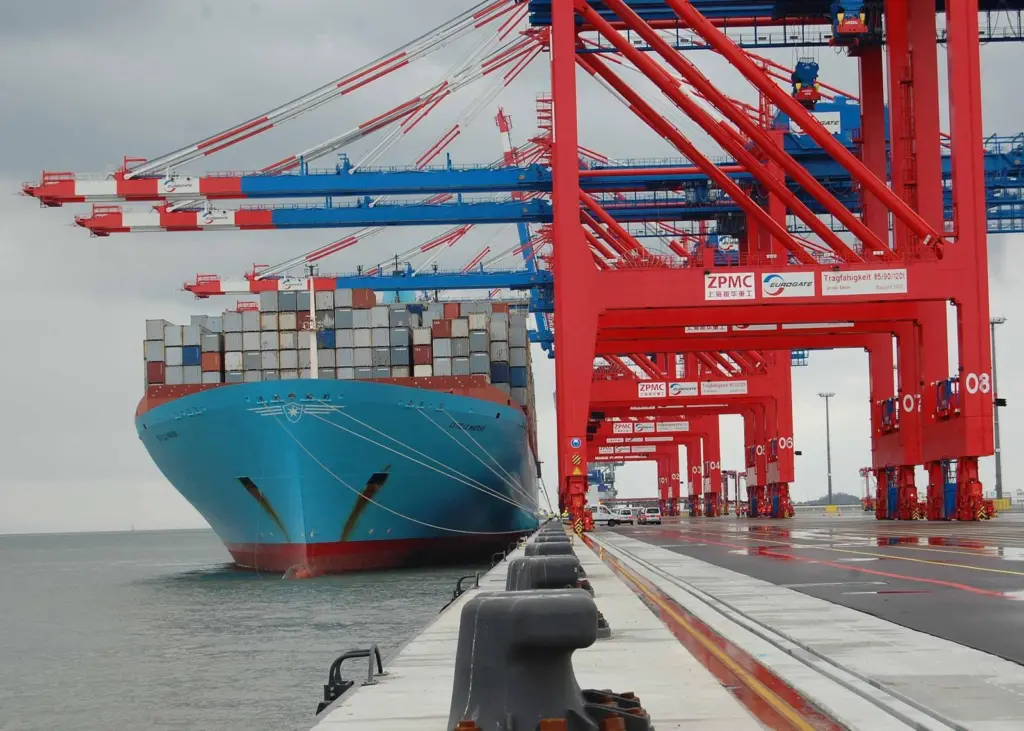
Some 1,000m of the terminal’s 1,725m quayside have been in operation on 18m of water since the JWP opened following delay last September. The remaining quay will open on 5 August.
Meanwhile the order for a feasibility study into a second terminal (JWP 11) adjoining the first has been published in the EU Official Journal. It is commissioned by the JadeweserPort Logistics Zone and will cost €2m, which the Government of Lower Saxony described as “a good investment”. It will review the technical and economic feasibility of a second terminal as a northern extension of the existing JWP.
Tenders are invited for nine lots. The technical investigations concerning the provision of the extended port area, relating in particular to sand production, quay design and adjacent road and rail connections to the public network, are all key aspects as are demand analyses and the planning basis for the extension.
The feasibility study will also consider the potential environmental impact of an extension, including noise generation, and will assess environmentally compatible port operations. For example, through the use of alternative energy sources and LNG.
There are as yet no technical details of JWP 11. Spokeswoman Susanne Thomas told Maritime Journal: “We are still very far off a start to possible construction. Early planning is, however, needed because public and legal planning permission processes in Germany take a long time to complete. Basically we think now is a good time to start moving forward.”
The results of the study will be presented in early 2015. JWP said they “will serve as the basis for further political decisions concerning dates and procedures in project planning and realisation”.
The move gives the JWP more time to put initial problems like inauguration delays and quayside construction problems behind it and complete its full operation schedule.
Designed for an annual 2.7m TEUs, the terminal also opened in a recession and needs time to recover from initial poor business. JWP chief Axel Kluth said “we need to be patient”.
Operators Eurogate also remain optimistic. Handling in the first full year of operation will fall well below the predicted 700,000 TEUs. However, the impressive 11,000 TEU Estelle Maersk, the biggest ship to call, has just made an unexpected visit and Eurogate MD Emanuel Schiffer says by the end of 2014 there will be no ships below 13,000 TEUs in Far East service.
They draw up to 15m and cannot access Hamburg so “we should be very pleased we have Wilhelmshaven”, he said, adding the JWP complements rather than competes with Germany’s other ports.
By Tom Todd
Related Articles
 FEATURES & VIDEOS
 MARINE CIVILS
 OTHER NEWS