![MaritimeJournal[Seawork]](https://www.maritimejournal.com/wp-content/uploads/2026/09/MaritimeJournalSeawork.svg)




A moving tale from Paris
A fundamental part of the business of cement, ready-mix concrete and aggregates supplier CEMEX involves moving significant tonnage of construction materials quickly and efficiently from quarries and cement plants to construction sites.
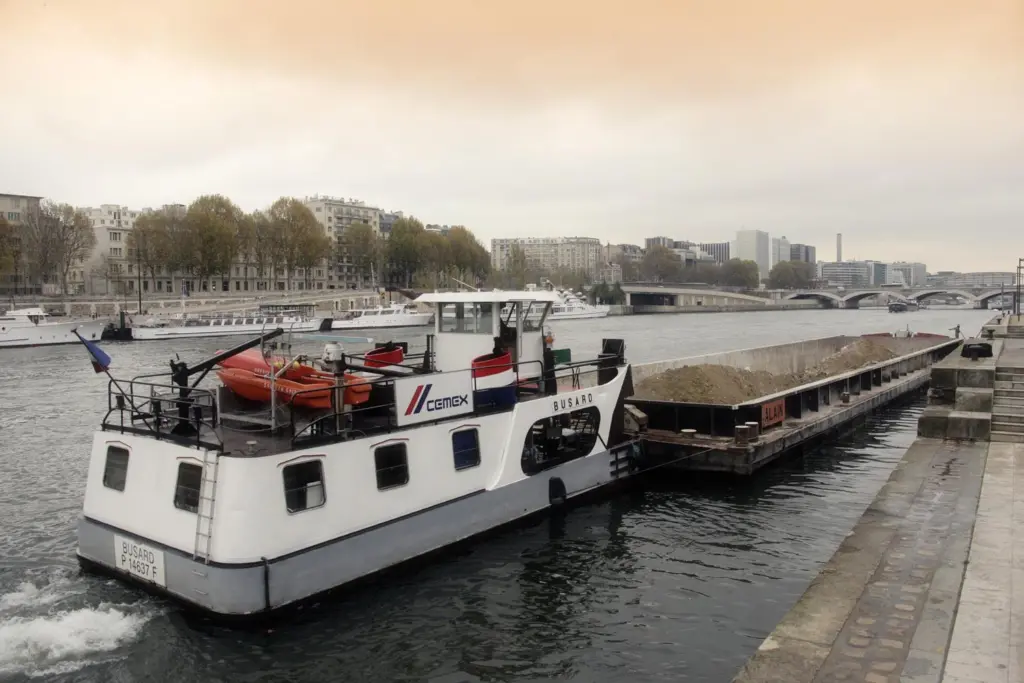
CEMEX France has three rivers at its disposal within the Paris basin and as far as the Belgian frontier; the Seine, the Marne, and the Oise. The company makes good use of these vital transport links. Not only is this more sustainable, logistically it is easier to use the waterways than the roads in the Paris region.
‘CEMEX focuses on sustainable development, and we see using barges as one aspect of this, said company representative Michel Bureau. ‘Eighty percent of aggregates destined for our concrete plants in France are carried by water. The barges then return with backfill and waste, helping ensure quarrying has minimal environmental impact. Just within Ile-de-France, we transport 10,000 tons of aggregate each day. Thats effectively 400 fewer lorries on the road, or a tail back of 7.5 km. And on the water there are no traffic jams.’
One of the two barge push boats CEMEX operates in inner Paris is the 5.73m LOA Le Busard. ‘Small boats like Le Busard will easily clock up 1,500 hours of engine use per year for some 10 to 15 years, adds Michel Bureau. ‘So when replacing the old engines, we wanted reliable engines that dont consume too much fuel, have low emissions, and are easy to maintain. As the boat operates in a city environment, we also wanted lower noise and vibrations.’
Chantiers de la Haute Seine (CHS) build and maintain the CEMEX fleet of 80 barges and 12 push boats. A CEMEX subsidiary, CHS is also one of Frances most important inland waterway shipyards. CHS has a good relationship with local John Deere dealer Agrinel and engine distributor M.I.L. Both recommended two PowerTech 6125AFM engines for the repower. The Tier 2 certified six cylinder engines generate 254 kW at 1,800 rpm. Agrinel and MIL also advised using isolated rather than solid mounting to reduce vibrations and noise. Clearly beneficial for workers on the boat, it is also better for the people who live and work nearby.