![MaritimeJournal[Seawork]](https://www.maritimejournal.com/wp-content/uploads/2026/09/MaritimeJournalSeawork.svg)





Another super-compact pancake motor
An American company Infinitum has developed a new concept of electric motor which they claim could represent the future for marine propulsion writes Dag Pike.
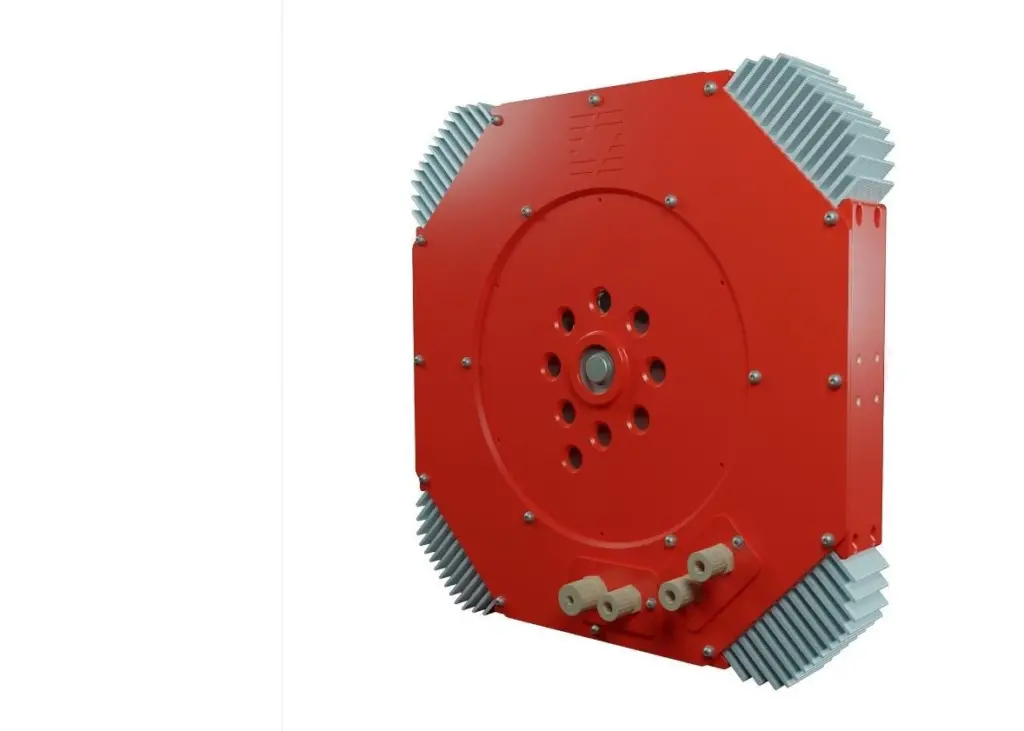
Currently there are versions of this advanced motor up to 15hp that are ready to be shipped but the company says that the next stage of development will be motors of 250kW that could be ideal as power units for electric vessels. These will offer a more compact and lightweight motor with the ability to design the motor to match the application. There is also the possibility of reduced costs per horsepower.
In these new electric motors that stator windings of traditional electric motors are replaced by a printed circuit board which the designers claim is both a cheaper solution and much more compact as well as being more efficient. Traditional electric motors use coils of copper wire for the stator, the fixed part of the electric motor whilst in the new type of motor the stator is a slim printed circuit board reducing both size and weight as well as improving reliability.
The CEO of Infinitum, Ben Schuler commented, “We are ‘strongly encouraged’ for an ARPA-E grant that will allow us to produce a 250kW propulsion motor. This would be the most power dense motor in the World and applicable to the majority of EV’s (electric vehicles including marine applications)”. ARPA-E grants are offered by the US Department of Energy for the development of electrical systems and applications.
The current range of Infinitum’s electric motors are mainly aimed at the fan and pump market sectors and Schuler claims that in the next 24 months over 7500 units will have been delivered. These will use a variable frequency drive and be cloud connected so that they can be remotely monitored. The compact size of these new motors includes the control system that is incorporated with the casing.
Texas base Infinitum is the second US company to be developing this new type of electric motor using printed circuit boards as the stator with Florida based ECM at a similar state of development with their motors.