![MaritimeJournal[Seawork]](https://www.maritimejournal.com/wp-content/uploads/2026/09/MaritimeJournalSeawork.svg)


Cat hybrid system
The French Caterpillar distributor Eneria has worked with the Italian transmission specialist Transfluid and gearbox manufacturer Twin Disc to develop a marine hybrid system suitable for a range of Caterpillar diesels. The configuration allows a vessel to operate under electric power from 8 kW up to 300 kW and offers considerable flexibility about the way it is configured.
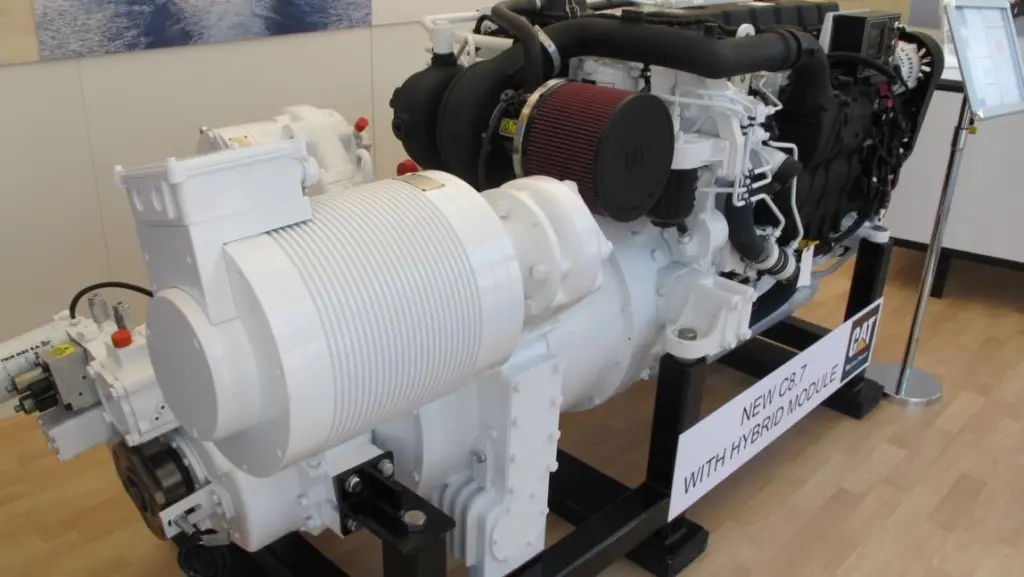
There are five main components in this hybrid system with the primary power coming from a Caterpillar diesel which can be rated from 250 hp up to 1600 hp, which are the C7 to C32 engines from the Caterpillar range. These engines are available in a variety of commercial craft ratings and can fulfil marine classification society requirements.
Directly coupled to the engine is a clutch unit that can be used to isolate the diesel engine when the vessel is required to operate under electric power alone. Next along the transmission line is the splitter box which has been developed by Transfluid and this is where the electric motors are coupled into the system. This splitter box features housings that can support two electric motors that are gear driven from the main drive and this unit comes in three sizes to meet different electric power requirements.
The electric motors are supported by the housing so the units are fully self-contained. The three sizes are the HM2000, the HM3350 and the HM6300 which are all similar in configuration with the electric motors cantilevered aft over the gearbox. The gearbox is the final unit in the system and this is a conventional Twin Disc unit offered ahead, reverse and neutral when diesel powered.
In operation the hybrid system has four operating modes. The straight diesel powered option uses the power of the diesel engine for propulsion and in this mode the electric motors can become generators to supply power to the batteries. With the clutch disconnecting the diesel power from the system the electric power can be used solely for propulsion giving quiet, emission free propulsion in sensitive areas such as harbours, inland waterways and some lakes and rivers.
Then there is the booster mode in which both the diesel power and the electric power can be combined when extra propulsion power is required. A further variation in the system can be to replace one of the electric motors with a hydraulic pump so that the system can be used to supply hydraulic power to vessels fitted with a deck crane or hydraulically power thrusters.
It is this flexibility built into the system that is likely to make it attractive to workboat operators. The three companies involved in this development are all highly experienced in their fields and can provide support and servicing for these hybrid systems.
By Dag Pike