![MaritimeJournal[Seawork]](https://www.maritimejournal.com/wp-content/uploads/2026/09/MaritimeJournalSeawork.svg)


CTVs cut emissions
Two of the UK’s first fully integrated hybrid electric crew transfer vessels (CTVs) offer 20% emission savings and flexible operation.
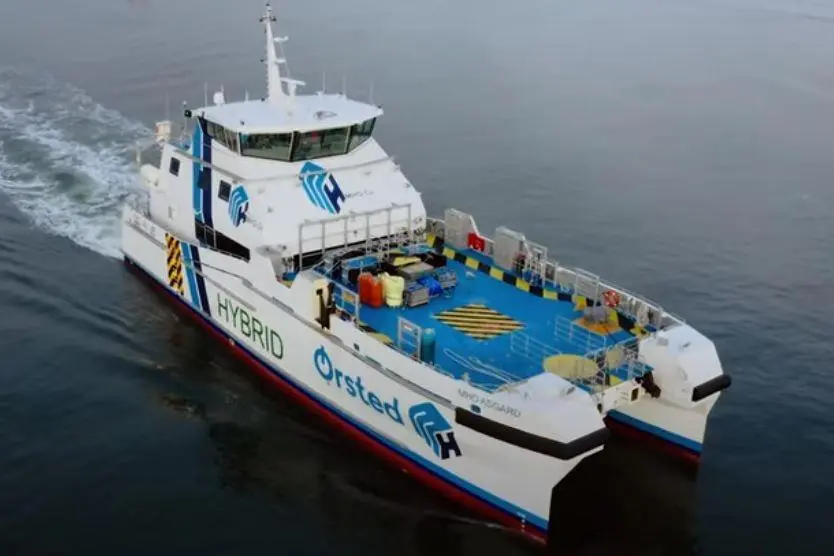
Volvo Penta, and Danfoss’ Editron division, have worked together to power MHO Asgard and MHO Apollo, which are being used by wind farm transfer company MHO-Co to service its offshore customer Ørsted’s Hornsea Project 2 offshore wind farm in the North Sea.
The hybrid vessels – both equipped with the Volvo Penta Inboard Performance System (IPS) – have both been in operation for just over a month.
“This new system gives us more flexibility and allows us to switch between engines and do maintenance when it fits our schedule, without affecting the service to our customers,” explained Mik Henriksen, CEO of MHO-Co. “We are also able to use just one small engine when idling in the wind park offering significant fuel saving and noise advantage when in waiting position. I think we have the best system possible with the technology that exists today.”
Cutting emissions and saving fuel
Volvo Penta IPS has already proven itself in delivering up to 30% reduced emissions with combustion engines – compared to traditional inboard shaft installations. By adding the hybrid factor, this system delivers additional fuel savings of 20.89% and reduces CO2 emissions by 20.96% compared to the already efficient conventional Volvo Penta IPS vessels in MHO-Co’s fleet.
Another major advantage of the hybrid vessels is the multiple power systems onboard, which Danfoss Editron and Volvo Penta have dubbed “the Power of Plenty”.
MHO Asgard and MHO Apollo have ferried over 50 workers and numerous supplies to the Hornsea Two offshore wind farm, which is located approximately 89km (55.3 miles) off the Yorkshire coast.