![MaritimeJournal[Seawork]](https://www.maritimejournal.com/wp-content/uploads/2026/09/MaritimeJournalSeawork.svg)


Ending in tiers
Reducing emissions from diesel engines has been on the engine development agenda for many years now. The initiative, with its various levels, or ‘tiers’ was started by in the US by their Environmental Protection Agency (EPA) and similar standards have been adopted by the EU and IMO, the latter being through their Marpol requirements.
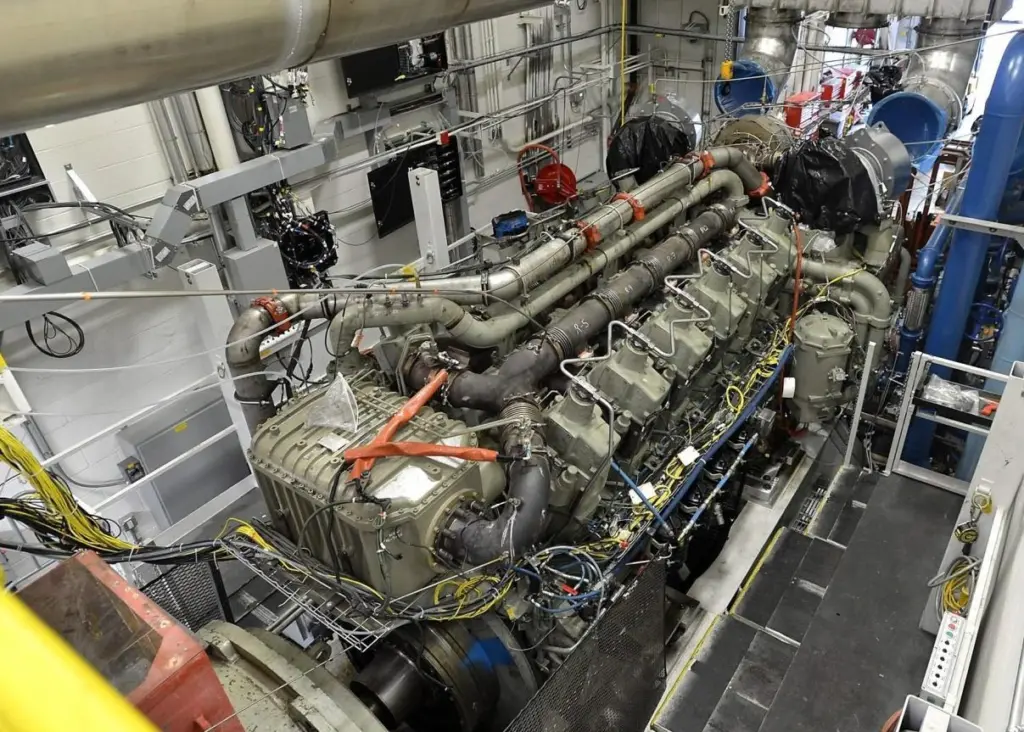
Basically the requirement has been to reduce the emissions from marine diesel engines and by implementing ever increasing standards for this reduction this has given the engine manufacturers time to develop and introduce new technology to meet the standards.
This reduction in diesel engine emissions started over 10 years ago with the introduction of firstly Tier 1 and then Tier 2 emission standards for marine diesels. These were relatively low standards and in general they were met by adding turbocharging and intercooling which allowed the fuel to be burnt more cleanly and at the same time to produce more power. Yes it added more cost to the engine but this was offset to a large degree by the improved fuel consumption and the lighter weight.
The next stage, Tier 3, proved more challenging for the engine manufacturers but it was common rail engines that came to the rescue. The introduction of common rail technology combined with the use of sophisticated electronic control systems produced considerable improvements in engine efficiency and the reduction of emissions to meet the Tier 3 standards. Marine engines of all sizes now have to meet this emission standard but there is more to come.
The main demand of Tier 3 was to reduce the emission of NOx and along with this was a requirement to use low sulphur diesel fuel in selected areas of the world such as European waters and the Baltic Sea as well as most of the North American coastline. The low sulphur fuel was to reduce the sulphur content in the emissions which formed sulphur oxides and using higher quality fuel was a relatively simple way of achieving this. For most workboats using high speed diesels this higher grade of diesel fuel was being used anyway and this requirement for low sulphur fuel was aimed mainly at larger workboats and shipping that was using heavy fuel oil.
So we are now coming up to Tier 4 requirements and these are being phased in for all marine diesels over 800 hp. For engines smaller than 800 hp the requirement for reduced emission levels has been put on hold and remains at the Tier 3 level with the focus switching to larger engines above 800 hp which applies to the engines used on a wide range of workboats.
After looking at various tables and talking with some engine experts, it is does seem that by 2017 all new engines above 600 kW (804 hp) will have to meet Tier 4 standards. Engine manufacturers seem to be confident that they will be able to meet these standards by using exhaust after treatment technology such as SRC and by incorporating diesel particulate filters in the exhaust.
To meet these higher Tier 4 standards it appears that engine manufacturers have found solutions. GE in the US was one of the first to announce that some of their engines meet the Tier 4 requirements and both Caterpillar and Cummins have engines able to meet the standards. A combination of selective catalyst reduction (SCR) technology which involves having catalytic converters and/or off engine scrubbing systems installed plus technologies such as exhaust gas recirculation and water injection are used. With SCR there has to be several sub-systems involved in mixing and injecting the urea catalyst that decomposes to form ammonia which absorbs the NOx gas. Some operators are turning to LNG as a fuel as another option for meeting emission standards.
These additions all add cost, weight and size to the engine with calculations forecasting a 1.7% increase in the overall weight of the vessel and an increase of 3% in the space required. So whilst manufacturers have the technology to meet the Tier 4 standards some designers and builders may look for alternatives particularly where fast craft are involved.
There has always been an advantage in using multiple installations of smaller engines because these engines are mass-produced on production lines rather than the one-off building used for larger engines. This can reduce costs considerably so that four engines of, say, 800 hp could be cheaper than two engines of 1600 hp. This is apart from the added weight and complexity of the larger engines which increases with Tier 4 conformity.
So for workboats such as wind farm service craft there could be considerable benefit in having a boat with a multiple installation of smaller engines that only have to meet Tier 3 standards. Multiple engines provide redundancy and flexibility in the way the craft can be operated with possible savings in fuel as well as in cost and at the same time providing increased reliability which can be an essential feature of many workboat operations.
By Dag Pike