![MaritimeJournal[Seawork]](https://www.maritimejournal.com/wp-content/uploads/2026/09/MaritimeJournalSeawork.svg)




European electric inland waterways potential explored
Two companies have pledged to work together to make the most of Europe’s inland waterways with what they say are ‘ultra-efficient passenger ferries’ as the European electric waterway transport sector grows.
Two companies have pledged to work together to make the most of Europe’s inland waterways with what they say are ‘ultra-efficient passenger ferries’ as the European electric waterway transport sector grows.
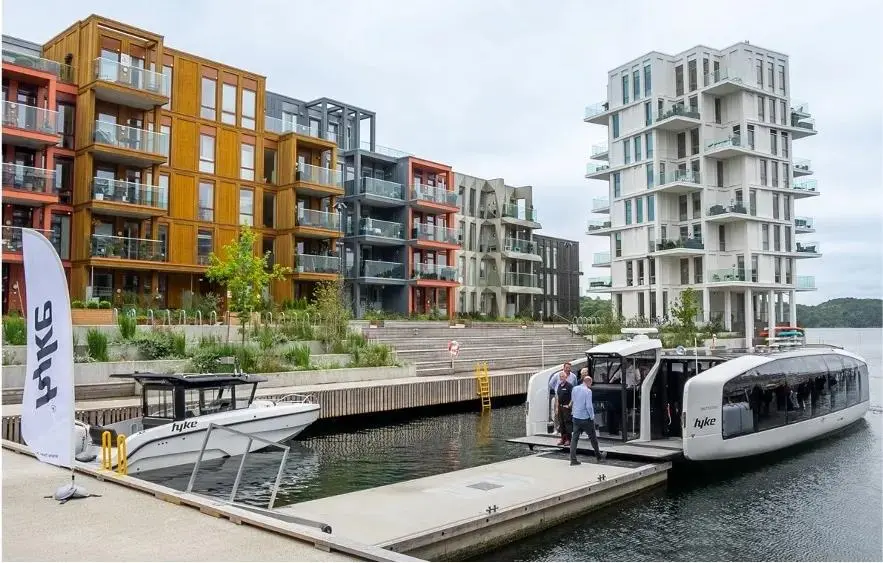
UK-based Aqua superPower will supply the fast-charging infrastructure to charge up passenger ferries by the Norwegian company Hyke to ‘unlock the potential of under-utilised waterways as sustainable transport corridors’.
However the firms believe the current system is too fragmented, with vessel procurement, charging infrastructure and route planning often developed independently.
“Many cities already possess a valuable transport asset that remains significantly underutilised: their waterways,” said Niels Astrup, Business Development Manager, Nordics at Aqua superpower.
“Electric ferries have the potential to provide clean, efficient, and attractive passenger transport while reducing pressure on roads and existing public transport networks. However, successful deployment requires more than innovative vessels or charging infrastructure alone. It requires both to be planned as part of a single transport ecosystem.
“Our collaboration with Hyke is about creating a blueprint that helps cities, operators and ports understand how to successfully deliver electrified ferry routes from concept through to operation.”
Under the agreement, Aqua superPower and Hyke will explore opportunities to collaborate on route assessments, feasibility studies, pilot projects, customer engagements and demonstration programmes. The companies will also share expertise to support public authorities and operators evaluating the transition to electric passenger transport.
“By bringing vessel and charging expertise together early in the planning process, the collaboration is intended to simplify project delivery and help customers move from concept to operation with greater confidence and less complexity,” the partners said.
European electrification
Several European cities are emerging as useful benchmarks for the electrification of urban water transport, particularly Amsterdam, Oslo, Stockholm and Copenhagen.
Each has combined electric passenger vessels with increasingly sophisticated shoreside charging infrastructure, although their approaches differ.
Amsterdam arguably offers the most comprehensive city-wide model. Its policy aims to make inland-waterway transport zero-emission, with more than 70% of passenger carriers already zero-emission when its 2023–26 implementation programme was published.
The city is also planning more than 300 additional public charging points at 29 locations, with the objective of having a charging point approximately every 10 minutes of sailing.
Oslo provides perhaps the strongest example of high-frequency electric ferry operation. Five fully electric island ferries operate on the Inner Oslofjord, each carrying a 1,012kWh battery and recharging in approximately three minutes during turnaround. Oslo Port has also installed a 4MW charging station for local ferries and dedicated charging for the island-ferry fleet.
Stockholm is demonstrating how electrification can improve services as well as reduce emissions. Its Candela P-12 electric hydrofoil has entered public transport service, cutting the Ekerö–Stockholm journey from around 55 minutes to 30 minutes.
Copenhagen has perhaps the most mature fully electric urban harbour-bus operation. Its five harbour buses were replaced with electric vessels in 2020, eliminating propulsion-related CO₂, NOx and particulate emissions. The city has subsequently continued expanding its electric transport infrastructure.