![MaritimeJournal[Seawork]](https://www.maritimejournal.com/wp-content/uploads/2026/09/MaritimeJournalSeawork.svg)


Fast electric ferry rides on air-support
Development is well underway with the world’s first fast electric air-supported commuter ferry that can operate on battery power alone.
BB GREEN is a three year and €3.2m project aiming at maritime innovative concepts that is financed by the EU’s 7th Framework R&D program. Investigations into efficient and environmental friendly waterborne transport solutions, to ease traffic congestion in and around cities and densely populated coastal areas, have lately become increasingly more common around Europe and beyond. BB GREEN is thinking outside the box, by applying and combining best technologies and solutions to design and demonstrate an innovative new fast ferry solution.
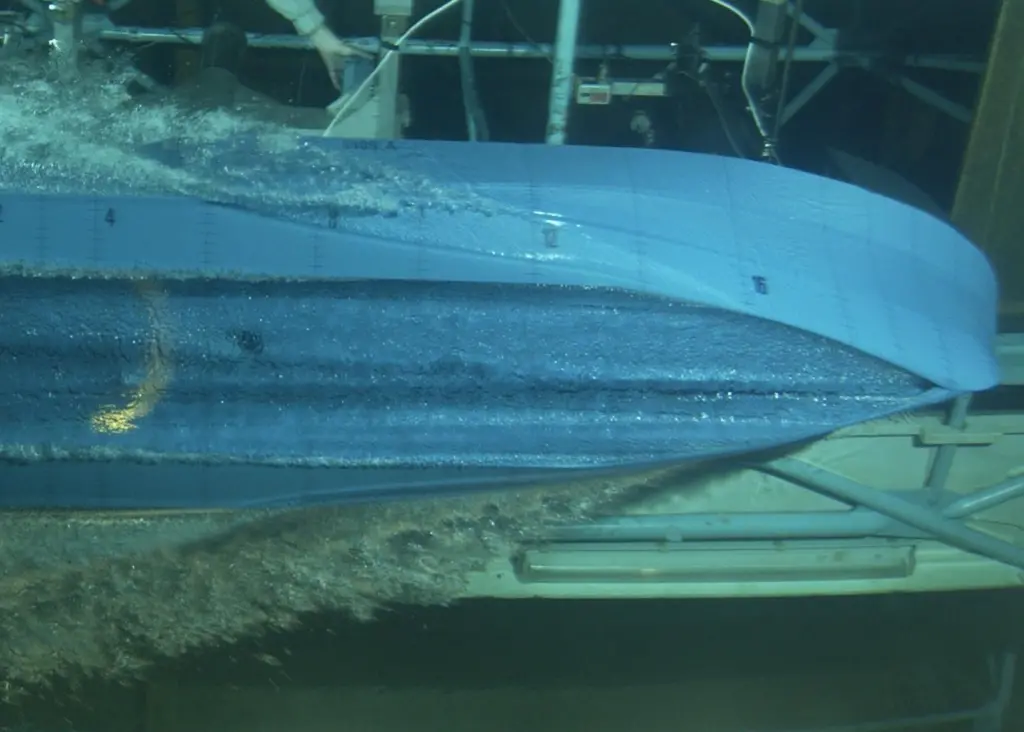
To succeed with the innovative approach, the team is starting out with a new hull concept. Norwegian Effect Ships International AS is the Air Supported Vessel technology provider. Subsidiary SES Europe AS is responsible for the hull form developments in the project and tank testing has taken place on two ASV hulls designs that correspond to ferries with a length of 20m and a beam of 6m.
The tank testing has been carried out at SSPA Sweden in Gothenburg. With a design speed of between 25 and 35 knots, these two concepts, one a catamaran and one a monohull, are extensively tested in both calm waters and waves that represent conditions that might be experienced on planned routes. These ASV hull designs have been compared with modern planing hull designs and have been used as benchmark for evaluating hull resistance and onboard motion data.
The favoured ASV Mono design demonstrated a reduction in hull resistance of approximately 50 % over a wide range of speeds. The fan power needed to obtain these massive benefits in calm waters was as low as 3% to 6 % of total power consumed. Another very interesting discovery has been that the efficiency improvement starts at speeds. Even at 10 knot to 15 knot speeds the hull resistance reductions are significant. One of the key parameters for reducing the hull resistance is a significant reduction in wetted surface area and efficient planing surfaces contributing to the efficiency boost at speed.
During operation, the new type of commuter vessels will have quite frequent stops. Therefore fast and efficient acceleration from standstill to cruising speed will be important, not only for maintaining the time table but also to keep overall energy consumption and wake wash generation down. The reduced hull resistance at ‘hump’ speed for the ASVs enables a fast transit to cruise speed with less power consumed and less wake wash generated.
Typical operations for BB GREEN ferries will be in relatively sheltered waters, exemplified with routes into and out of Rotterdam and surrounding suburbs. Here relatively low and short waves are dominant. For successful operation it is important that the onboard comfort level is good. ASVs are typically supporting up to between 80% and 85% of the total operational displacement on a cushion of pressurised air, and this air cushion is having a motion reducing and motion damping effect of the ride. With the hull design now developed, attention is focusing on developing the detail of the ferry design and the electric propulsion system.
By Dag Pike