![MaritimeJournal[Seawork]](https://www.maritimejournal.com/wp-content/uploads/2026/09/MaritimeJournalSeawork.svg)



Ferry concept targets fuel efficiency for Greek island services
A new ferry concept designed for Greece’s domestic passenger market aims to improve fuel efficiency and reduce operating costs by focusing on lower operating speeds and a simplified vessel design.
Developed by Foreship, the naval architecture and marine engineering company within the RINA Group, the concept has been created in response to the operational demands of Greece’s extensive ferry network, which connects more than 200 inhabited islands and carries around 50 million passengers each year.
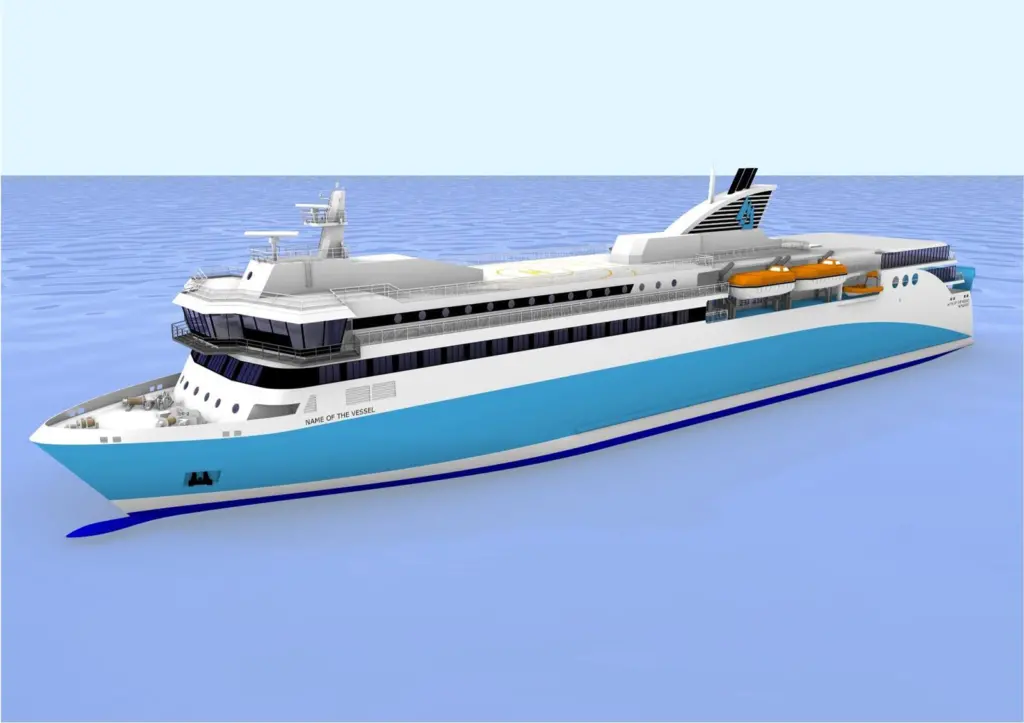
The 124m LOA x 20.5m design can take up to 1,540 passengers and 331 cars. It places particular emphasis on energy efficiency by optimising the vessel for moderate operating speeds rather than the higher speeds traditionally associated with many Greek ferry services. The company says this approach is intended to reduce fuel consumption while improving overall operating economics.
“The state-of-the-art hydrodynamics, optimised damage stability resulting in low beam and design principles, resulting in low, light weight, enable this,” said a spokesperson for RINA. “Additional energy efficiency solutions can be incorporated depending on route and owner preferences.”
Alongside changes to the operating profile, the concept incorporates updated European stability requirements that are influencing the design of passenger ferries. These regulations, the EUROSOLAS requirements of EU Directive 2009/45/EC for Class A and B passenger ships, affect factors including vessel dimensions and passenger capacity, and have been considered from the earliest stages of the design process.
Simple engineering for lower costs
The vessel has also been developed with a simplified engineering approach intended to reduce both capital and operating costs. Rather than incorporating additional complexity, the design focuses on the systems considered necessary for routine ferry operations, Foreship says.
“This new vessel concept has been developed in response to the specific challenges of the Greek market, with a focus on optimising both capital and operating expenditure,” said Ari Huttunen, Marine Design & Engineering Projects principal consultant at Foreship.
“The design integrates all essential functionalities for safe and reliable operations, while avoiding unnecessary complexity, resulting in a robust and economically sustainable vessel.”
The base version has two engines with mechanical drive and CP propellers. Hybrid machinery with battery energy storage and/or methanol dual-fuel machinery are optional, depending on client preference.
The concept has been developed against the backdrop of an ageing Greek ferry fleet and increasing pressure on operators to improve efficiency while maintaining services. Ferry companies also face seasonal fluctuations in passenger demand, regulated fares and rising operating costs, all of which influence investment decisions for new vessels.
While the design has been tailored to the Greek domestic market, it reflects wider trends across the ferry sector, where ship designers are seeking to balance regulatory compliance, energy efficiency and lifecycle costs as operators prepare for future fleet renewal.
“We are engaging with a range of stakeholders to refine the concept and assess market interest,” said the spokesperson.