![MaritimeJournal[Seawork]](https://www.maritimejournal.com/wp-content/uploads/2026/09/MaritimeJournalSeawork.svg)



First high performance production diesel outboard to be launched
Over the years there have been many debates when comparing the benefits and drawbacks of various marine propulsion systems with numerous alternatives developed and launched.
Users need to consider the initial purchase price, running costs, ease of use, service intervals, accessibility, serviceability as well as life expectancy and subsequent unit replacement.
“There has been a never ending search for better solutions to meet demanding operational conditions. IPS units, shaft drives, stern drives, V-drives, surface drives and water jets all have their inherent strengths and weaknesses,” says Pim Polesie, Cimco Marine Diesel vice president.
“The market is in need of combining the benefits of the inboard stern drive solution with the benefits of the outboard solution. However the combination of inboard reliability and strength, together with outboard manoeuvrability and flexibility is a complex and difficult task for manufacturers to achieve in a single product.”
But says Mr Polesie, Cimco which is based in Sweden, has achieved the ‘Holy Grail’ and combined the best attributes of both stern drives and outboards, marrying them together in the OXE Diesel, specifically developed with the commercial market in mind.
WORLD FIRST
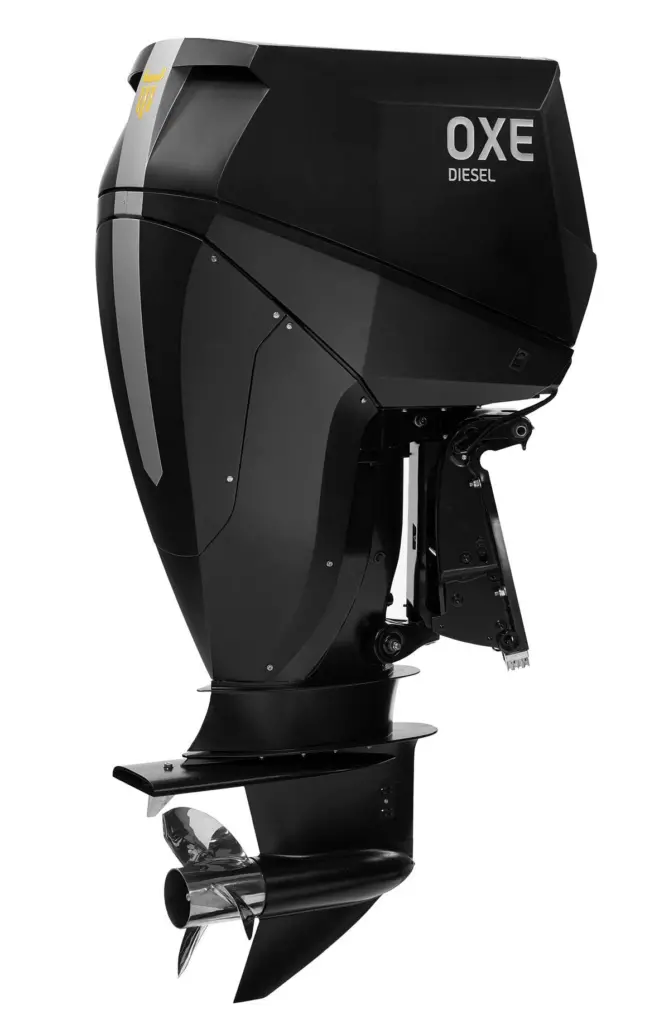
Billed as the world’s first 200hp production diesel outboard motor, the powerhead is based on a marinised General Motors 2-litre turbo diesel engine with a closed circuit coolant system. It will be available on the market later this year.
“Outboards are the oldest and most traditional form of petrol boat power and have been well proven over time,” explained Mr Polesie. “The OXE Diesel is a triumph of technology and reflects years of marine experience by dedicated technicians and engineers within the Cimco team and is the first self-contained belt propulsion unit on the market.”
The General Motors engine was chosen as although it is not the lightest or most efficient, it is a ‘masterpiece’ of engineering and well proven over hundreds of millions of miles. The need to change from petrol to diesel was seen as necessary to reduce any fire hazards, provide a longer and more reliable product life with longer service intervals of 200 hours with a major overhaul at 2,000 hours for heavy commercial use, a greater range of 43 litres of diesel per hour at full throttle and the increased geographical availability of diesel.
“Commercial users demand increased safety, performance and reduced operating costs,” explained Mr Polesie. Handling diesel is safer for the board crew and allows the diesel powered boat to refuel from mother ships or other floating platforms. The OXE Diesel complies with the NATO Single Fuel Directive and the latest stringent emission standards.”
The OXE Diesel uses a modular design, built using conventional technology with the bevel gears replaced with a self-contained belt propulsion unit. The gearbox is mounted separately under the engine with two hydraulically operated clutches and designed to withstand crash stops with 68 crash stops tested so far. It also allows for clockwise and counter clockwise propeller rotation.
There are also two multi-plate clutch packages allowing for high torque and power transfer. Low engaging speed is allowed for allowing the prop to run from 1rpm to 400rpm allowing the engines to be used for low speed and high speed applications.
A horizontally-mounted engine block allows for easy servicing and the primary belt transmission pulleys can be changed to alter the gear ratios if required. The powerhead has been redesigned to arrange all service points at the front of the unit so maintenance and servicing can be performed on the water.
It has also been fitted with a dry sump system to allow for rolling in heavy seas, tilting and trimming.
FUNCTIONALITY
“I come from a military background instructing high speed navigation to governmental services around the world under the umbrella of Spectre Marine and am often surprised that the products being used are pleasure craft products and not fit for their purpose,” explained Mr Polesie. “The guys I teach always worry about product failures. The OXE Diesel is purposely designed to change this fact and supply the commercial market with more reliable units.
“In a marine market complexity is an unfortunate development. The OXE Diesel has been built for safety, durability, performance and ease of service. If you’re a pleasure craft user, it doesn’t matter as much if your boat is out of action. In commercial use, functionality could be a matter of life or death.”
The product has been under development by CIMCO since 2012 with internal testing carried out throughout 2014.
As Mr Polesie points out: “We’ve been trying to break it for a year but haven’t succeeded so far.”
The engines are now being shipped out to chosen commercial users in four countries worldwide in different climates for external testing in extreme environments to further ensure reliability, robustness and strength. The company is also hoping to create a SOLAS version in the near future.
By Katina Read