![MaritimeJournal[Seawork]](https://www.maritimejournal.com/wp-content/uploads/2026/09/MaritimeJournalSeawork.svg)


H2 vessel with a 2,400nm range
California has “a great need for a new research vessel” said Bruce Appelgate of the Scripps Institution of Oceanography.
However, while these ships are often notably innovative, the resulting concept is still a surprise. “Just a few years ago there were three that were dedicated to conducting local research in California waters – but two of them have been retired and the third is limited because of its size.” It’s just 38.1m, and sadly, he added “this too is reaching the end of its service life”.
However, a new ship brought with it a new question: “Could we build and operate a research vessel that wasn’t powered by fossil fuels at all?” After all, as Appelgate pointed out “diesel’s downsides” included emissions, noise and pollution risk.
Collaboration with Sandia National Laboratories and naval architect Glosten resulted in a novel answer: a hydrogen-powered design that has little in common with previous ferry or cargo developments.
“The Zero-V has very different performance needs to a high speed ferry: it must be able to complete 13 distinct science missions, its desired calm water speed is 10kn, the range had to be at least 2,400 nautical miles with an endurance of 14 days,” explained Robin Madsen of Glosten.
TRIMARAN SOLUTION
Tough call. And although the teams started looking at conventional hulls, it quickly became apparent that keeping the fuel tanks inside the B5 requirements (within 20% of the breadth of the vessel) just didn’t allow them to be large enough to meet the necessary range.
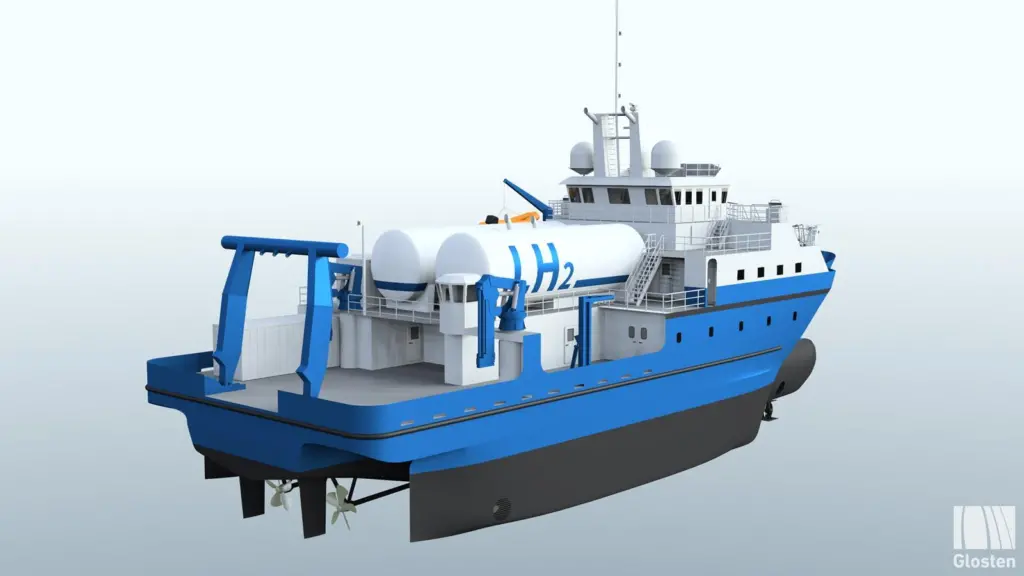
So, the teams moved the hydrogen tanks from inside the hull to above deck – not an unusual solution for gas-powered vessels – and switched to a 3.66m draft trimaran, the maximum size for the intended ports of call. This configuration allowed enough room for a pair of 110m³ C-type hydrogen tanks, yielding a 15-day endurance, meeting the specified range at the desired cruising speed. “We just about got there,” admitted Madsen, “but not much to spare”.
All this added complexity in design as the weights and space demanded an aluminium hull, but it “makes a very capable research vessel”, he said.
Part of Zero-V’s charm is down to its 51.8m length and 17m breadth; “It’s quite wide,” added Madsen, but this gives room for an aft deck with 165m2 of space while the side deck has a 48.7m2 area. There is also a main 76.65m2 laboratory, a wet lab of 53.4m2 and computer station of 16.2m2, plus accommodation for 20 scientists and 11 crew.
The propulsion plant, which lends the design its ‘Zero-V’ name, is interesting. Liquid hydrogen is led from the tanks to a cold seawater vaporiser, and from there to the fuel cells.
SIX MODULES
These have been designed around Hydrogenics HyPM HD30s, with six modules on each of ten racks, giving 1.8MW of installed power. For safety, “everything is split port and starboard: two tanks, two vaporisers, two fuel cell rooms, so we have full redundancy and if one side needs to be shut down you still have half your propulsion power to get back to port safely”, explained Madsen. Further the racks have full-ventilation, gas detection and automatic shutdown, plus a clean-agent suppression system throughout the twin rooms.
Other potential issues were analysed, especially position keeping. Usefully, it can maintain position in a couple of knots of beam current, along with wind and waves at most headings “although in certain conditions the vessel has to be orientated in a certain way” said Madsen.
There were further needs to address: “On a small vessel like this it becomes quite challenging to manage the hazardous areas… it would be unreasonable to expect the scientists to source safe equipment,” he concluded, especially considering the experimental nature of their work. So, the design has clustered the hazardous zones around the tanks, leaving little outside.
Finally, discussions with hydrogen suppliers has shown that the vessel could be bunkered by truck using established technology. As Lennie Klebanoff, of Sandia National Laboratories underlined, there was no real barrier when it came to the harbours likely to see the research ship: those port managers received the Zero-V concept and the fuelling operation “enthusiastically”.
By Stevie Knight