![MaritimeJournal[Seawork]](https://www.maritimejournal.com/wp-content/uploads/2026/09/MaritimeJournalSeawork.svg)


LNG breakthrough with European Ro-Ro ships
Rolls-Royce Marine reported a strong financial performance for 2008 at a media presentation held in London last month. Some £ 2.2bn in revenue fulfilled expectations, an order book standing at £ 5.2bn was more than triple that of 2005, and profits were up 62% on 2007.
With its propulsion systems and/or equipment on over 30,000 vessels, Rolls-Royce continues to deliver mission critical products and systems allied to lifetime support.
The company can now provide up to 60% of all equipment by value for an anchor handling tug and commands a very large market share for deck machinery. Last year Rolls-Royce acquired the diesel-electric solution provision company Scandinavian Electric, which is carrying out research on magnetic rim-drive thrusters.
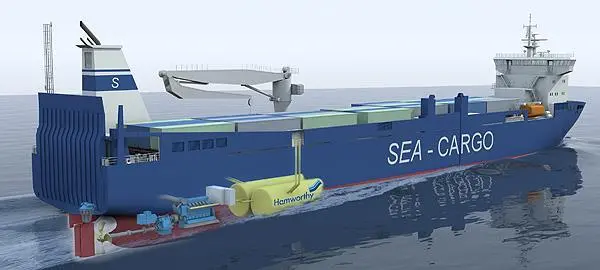
With Europe as the largest vessel owning market in the world, Rolls-Royce Marine continues to focus on the development of complex, specialist vessels for it. The client for one new design is Sea-Cargo AS, which operates a fleet of multi-purpose Ro-Ro vessels primarily on North Sea routes linking the west coast of Norway, mainland Europe, and the UK.
Sea-Cargo has defined its next generation of vessels by ordering four multi-purpose Ro-Ro ships that will be built at the Bharati shipyard in India for delivery in 2009 and 2010. These are believed to be the first cargo vessels in the world fuelled solely with liquefied natural gas (LNG) and with a simple mechanical drive propulsion system. Compared to a similar, conventional ship, these vessels will reduce CO2 emissions by 20% and NOx by 90%, with particulate levels negligible and sulphur oxide emissions zero.
The new 132.8m vessels will be able to carry 5,600 tons of cargo on a draft of 6m, with up to 94 TEU of containers on deck and 1,140 lane –metres of Ro-Ro capacity.
Rolls-Royce is responsible for the overall vessel design and will supply all the major equipment and systems, including main engine, reduction gear, propeller, shaft generator, tunnel bow thruster, rudder and steering gear, automation, and the LNG fuel storage and handling system.
The single Rolls-Royce Bergen B35:40V12PG main engine uses spark ignition lean burn combustion technology resulting in very high thermal efficiency and good load/speed control. It is classed for the load/speed operational pattern that comes with mechanical coupling to a controllable pitch propeller.
Cold LNG will be stored in two insulated LNG tanks, each of 240m3 capacity, forward of the engine room in a ventilated enclosure offset to one side to clear a vehicle ramp and minimising the impact on cargo capacity. The gas engine turns the propeller through a reduction gear and also supplies the vessel’s electrical load by means of a generator driven off the gearbox.