![MaritimeJournal[Seawork]](https://www.maritimejournal.com/wp-content/uploads/2026/09/MaritimeJournalSeawork.svg)


Methanol goes on tour
A new series of free industry seminars is touring the world promoting the use of methanol as a marine fuel.
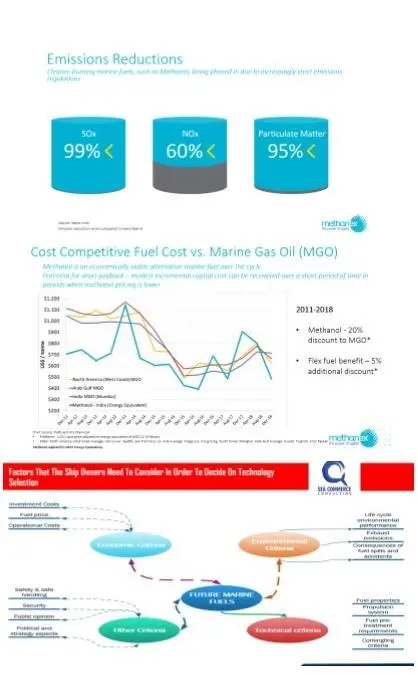
The most recent seminar in Mumbai was organized by Sea Commerce Consulting and Institute of Marine Engineers of India (IMEI) with support from FedCom, Methanex Corporation, Methanol Institute, along with the classification societies ABS and IRS.
Captain Saleem Alavi, Sea Commerce Consulting’s President said: “Methanol processed using natural gas as a feedstock has a similar emissions profile as liquid natural gas but does not need storing in cryogenic tanks like LNG”, said Captain Alavi. He also pointed to custody transfers for bunker suppliers being much easier for methanol versus LNG, the methanol being more readily available globally, as well as the ease of handling in the supply chain.
Methanol is already an industrial feedstock with a mature supply chain infrastructure, which would make the development of a bunker supply for shipping much easier than for LNG which has been singled out by critics for the difficulties in developing a suitable bunker supply network and the need to build dedicated bunker vessels.
One of the seminar sponsors, and a significant backer of methanol as a marine fuel, is Vancouver-based Methanex, the industrial methanol producer and owner of Waterfront Shipping, its ocean logistics arm which owns a fleet of methanol powered carriers.
Talking at the recent Mumbai seminar Methanex, Vice President Global Market Development Ben Iosefa highlighted the low environmental footprint of methanol, as well as the attractive capital and operational costs.
Methanol is a colourless liquid that can be produced from natural gas, but importantly in an industry facing the challenge of halving its CO2 emissions by 2050, can be produced from renewable sources and even from CO2.
The relative dollar tonne cost benefits of methanol, compared to gas oil, is one important factor, as is the ability to convert existing bunker tanks on tonnage to store methanol, and engines to operate off the fuel.
More of these seminars are planned in key maritime areas during 2019.
By Jake Frith