![MaritimeJournal[Seawork]](https://www.maritimejournal.com/wp-content/uploads/2026/09/MaritimeJournalSeawork.svg)


New generation Navigator launch at Europort
Germany based propulsion specialist Schottel is due to launch a new generation of Navigators with the NAV 200 at the end of this year and a propulsion unit of this type will be on display at Europort.
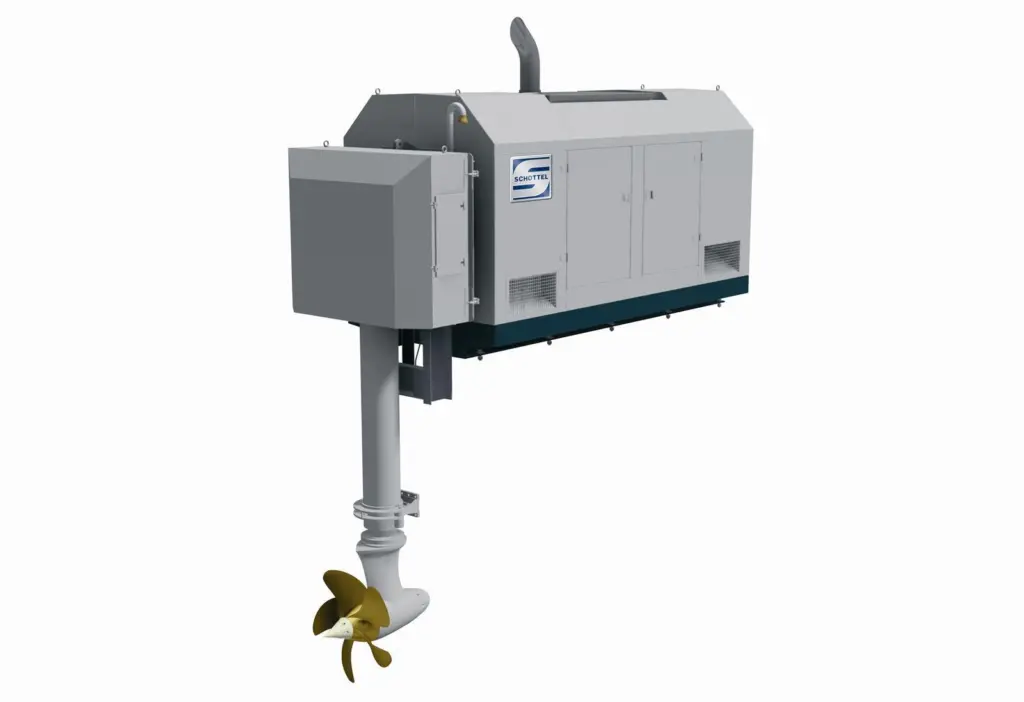
In principle the NAV is an adaptation of the Schottel Rudderpropeller with an engine and related equipment. The base frame accommodates the daily fuel tank and has a capacity of some 600 litres on the NAV 200.
A diesel engine is used as the prime mover and the switch cabinet includes electrical and electronic monitoring elements. The clutch between the prime mover and the Rudderpropeller transmits the power through a flexible coupling and a universal shaft. The propeller can be raised and lowered in vertical direction and also pivoted to the rear.
Maintenance is easy due to the mobile installation of the construction. The Navigator merely has to be bolted onto a foundation prepared by the shipyard. Another advantage is the flexible applicability. The Schottel Navigator can be used in almost every kind of floating object, especially in barges, ferries, workboats or floating cranes.
Schottel also offers various product variants with the new generation of Navigators. These include the NAV Basic, NAV Offshore and NAV Soundproof. The Offshore and Soundproof versions can be combined. The canopies are galvanized in all versions and the Offshore and Soundproof models have forced ventilation. The Rudderpropeller of NAV Offshore is also protected by an additional cover. Modern and reduced emission diesel engines from MAN or Caterpillar supply the input power to the propeller, ranging from 190kW (NAV 0320) to 746kW (NAV 550).
The Schottel Rudderpropeller (SRP) was developed and built in 1950 by Josef Becker, the founder of the present day Schottel Group. The specific characteristic of this propeller is the 360° rotation, which means that the full input power is available for manoeuvring and a rudder is not necessary. Rudderpropeller and engine operate together in the NAV and have long been a popular addition to the multifaceted applications of the Rudderpropeller.