![MaritimeJournal[Seawork]](https://www.maritimejournal.com/wp-content/uploads/2026/09/MaritimeJournalSeawork.svg)

Powering from Seawork to Arctic climes
There’s a growing interest in outboards for workboat applications as their flexibility gains enthusiasts.
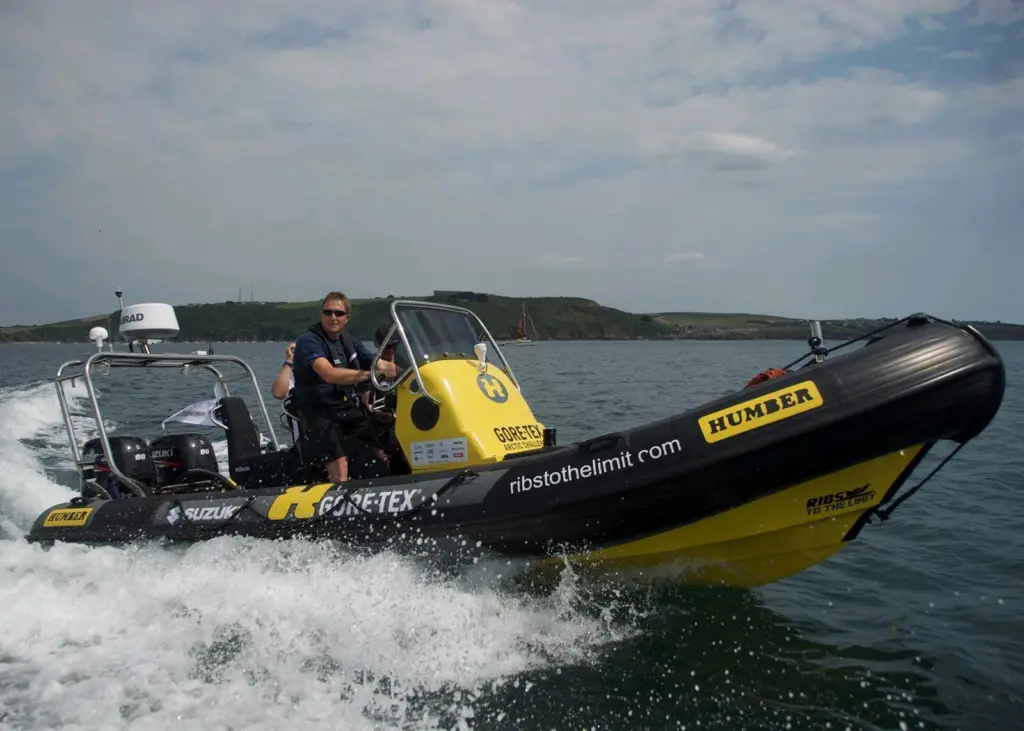
To prove the point, the Suzuki powered Gore-Tex Arctic Challenge has kitted out two 6.3m Humber RIBs to battle the North Sea right into the Arctic Circle.
It is the first time that this voyage has been attempted in small family sized RIBs and the challenge (co-sponsored by Gore-Tex) has been devised to demonstrate that with a standard RIB and the right kit, you can go just about anywhere.
Mark Beeley of Suzuki first experienced RIBs while serving in the armed forces. Over the last 15 years he has taken part in many RIB adventures and is one of a small group of RIB users that has completed a 2,000 mile trip in these hardy craft. Mr Beeley will be there to keep a parental watch over the four outboards. While he says that although from a mechanical point of view his presence isn’t really necessary, he’s been determined to get onto the Arctic trip since hearing about it.
The team of eight adventurers set out at the end of June, with the RIBs each fitted with two Suzuki DF90 four-stroke outboards. Like the DF40/50 in the Seawork Innovation Showcase, they are particularly light and compact, as well as being quiet. The four cylinder DF90 engine weighs around 155kg while the three cylinder 40/50 is only 104kg, weighing in at less than a low emission two stroke engine.
Both the 40/50 and the 90 have Suzuki’s Lean Burn technology. This gives the whole fuel to air mix over to computer-management, which can vary the draw incredibly quickly. “Micro-adjustments take place many times every second, and this enables the boat’s engines to step fuel intake down a notch while maintaining speed”, said Mr Beeley.
Talking at the Seawork exhibition in Southampton last month, Mr Beeley said, “There’s a ‘sweet spot’ that takes place between 1,500 and 5,000rpm. This means that, while a normal draw would show roughly a straightish line between speed and fuel consumption if sketched out on a graph, the lean burn technology actually shows, after the start-up peak, pretty much a level draw. So you get an increase in speed for a fractional rise in fuel.”