![MaritimeJournal[Seawork]](https://www.maritimejournal.com/wp-content/uploads/2026/09/MaritimeJournalSeawork.svg)


Scania launches new range at Seawork
Scania introduced a new range of marine propulsion units consisting of engine,transmission and type approved instrumentation at the Seawork exhibition inSouthampton UK last month.
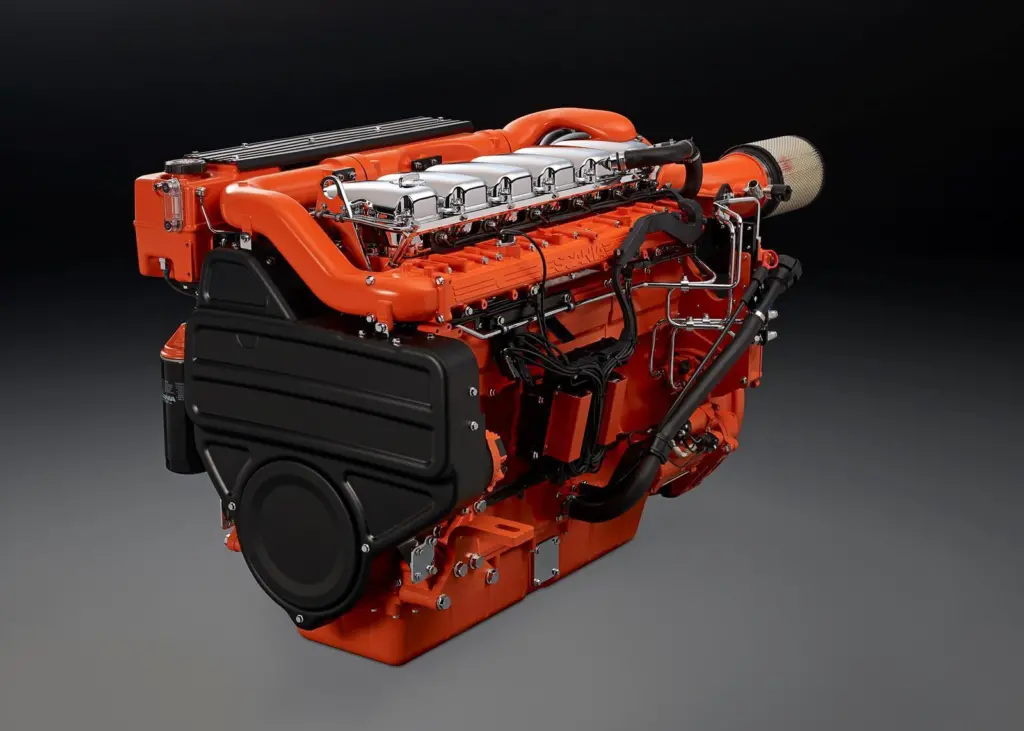
The new 13 litre marine engines range from 400 hp for continuous use up to 750 hp for patrol craft use. This Scania marine engine solution is the first in a new line of engines for propulsion and auxiliary use designed for maximum reliability and durability, as well as low operating cost.
The engine is based on Scania’s new modular engine platform that has found successful use in industrial applications, trucks and buses. Torque ratings have been increased on the new range, making it easier to maintain favourable operating speeds even in high seas or with a heavy load.
Single circuit keel cooling is used to simplify installation and reduce cost. The service life of pistons and liners is enhanced by the so-called Scania saver ring, a ring placed at the top of the cylinder liner to reduce coke deposits and engine wear.
For marine auxiliary use, the Scania 13 litre engine is designed to handle large stepload variations with short recovery time. The top version achieves its top output of 426 kW at 1,800 rpm. Output has been increased, yet exhaust emissions are low.
The engine also features Scania EMS, an in-house developed engine management system that is outstandingly flexible when it comes to tailoring engine performance to individual customer applications. The new 13 litre marine engines complies with emission standards IMO II, EU Stage IIIA and US Tier 2.
Scania also launched a new type approved instrumentation according to the standards of classification societies such as RINA, DNV, Germanischer Lloyd, American Bureau of Shipping and Lloyd’s Register.
The new instrumentation is easily installed and, via a user friendly and flexible web interface, the marine operator can adapt the information on the panels and choose any required data. The panels have prepared layouts for water temperature, engine speed, oil pressure and fuel consumption. The operator can also connect and configure a gauge indicator for transmission monitoring and for fuel or fresh water levels.
The master panel is equipped with a flexible input/output (I/O) with ten digital inputs, two 4-20 mA inputs, two PT100 inputs and seven digital outputs. The system is expandable with an unlimited number of slave panels via standard Ethernet.
The flexible I/O makes it easy to install surveillance and alerts of seawater flow or fuel consumption. Increased idling makes the manoeuvring of a hydraulic pump forpowering winches or cranes uncomplicated. Connection for throttle is available via all standardised interfaces (0-5 V, 4-20 mA and CAN).
The new engine platform is a completely new design, yet it retains traditional Scania characteristics like individual cylinder heads, camshaft located high in the block, and rear mounted timing gears, as well as the familiar cyclone oil filter. Bore and stroke have been slightly altered and swept volume increased compared to previous Scania engines.
Important features for the marine engine segment are reliability, high uptime, generous torque at low revs, good fuel economy and prompt engine response. The cylinder block and other structural components have been redesigned for additional strength. The saver ring at the top of the cylinder liners removes the residual carbon from the edge of the piston crown and reduces cylinder liner wear. Maintenance and oil change intervals have been extended to 500 hours.