![MaritimeJournal[Seawork]](https://www.maritimejournal.com/wp-content/uploads/2026/09/MaritimeJournalSeawork.svg)



Singing prop mystery solved?
A joint research project carried out by Finnish propulsion company Wärtsilä and City University London has succeeded in identifying the specific design parameters that create the risk of singing propellers.
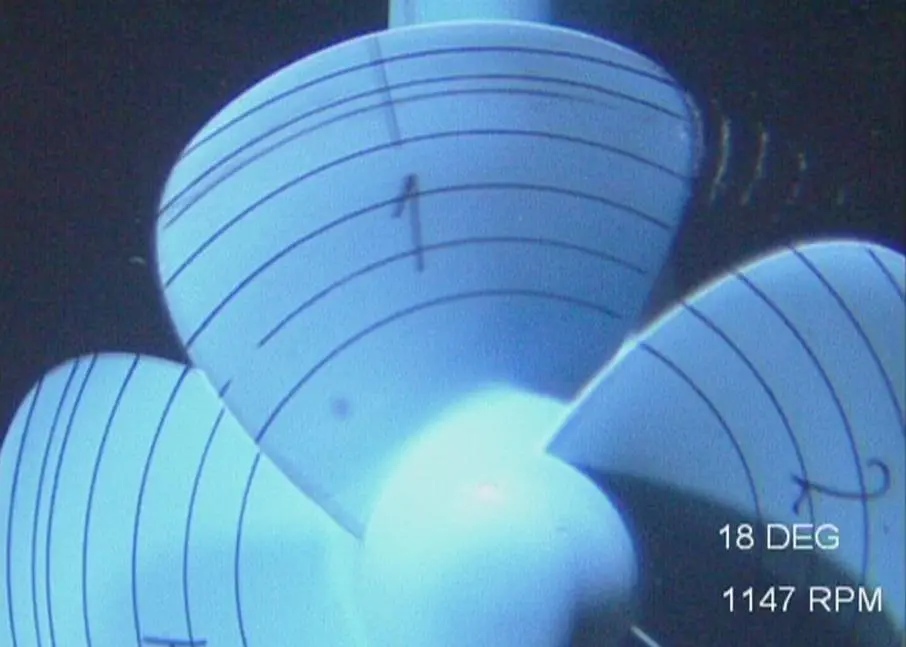
Though rare, ‘singing’ is nevertheless an annoying problem that occurs as a strong tonal noise originating from the propeller, thus causing a negative effect to onboard comfort levels. The research programme reached its conclusions in December 2015.
The problem has long been recognised in the marine industry. While the general perception has been that the frequency of the propeller blades’ vibration mode coincides with the frequency of the hydrodynamic excitation forces at the trailing edge of the blades, the current research indicates that there is more complexity and sensitivity to this hypothesis.
“Our research has shown that the ‘singing’ phenomenon can be controlled by selecting the proper main parameters of the propeller blades, by careful attention to the flexural modes of the propeller blades, and by careful attention to the specific geometry at the trailing edge of the blades. It has shown that all these aspects are interacting and can prevent the ‘singing’ of propellers,” said Arto Lehtinen, Vice President, Propulsion, Wärtsilä Marine Solutions.
Finite Element Method (FEM) analysis tools have been used in the identifying of the risk indicators related to the main propeller design parameters. By correctly adjusting these parameters, the response side risks can be minimised. Similarly, Computational Fluid Dynamic (CFD) technology was used to analyse the vortex shedding behaviour of the trailing edge design. The results indicate that a proper design of the trailing edge details reduces the shedding and, therefore, also the excitation forces. Wärtsilä has used CFD in its hydrodynamic design processes for some 20 years.
By Jake Frith