![MaritimeJournal[Seawork]](https://www.maritimejournal.com/wp-content/uploads/2026/09/MaritimeJournalSeawork.svg)

How a fatal allision exposed unseen risks of complex docking
Inadequate tug power, poor communication, lack of joint risk assessment and a failure to coordinate simultaneous operations led to the death of a welder in Rotterdam’s Botlek harbour, a report has found.
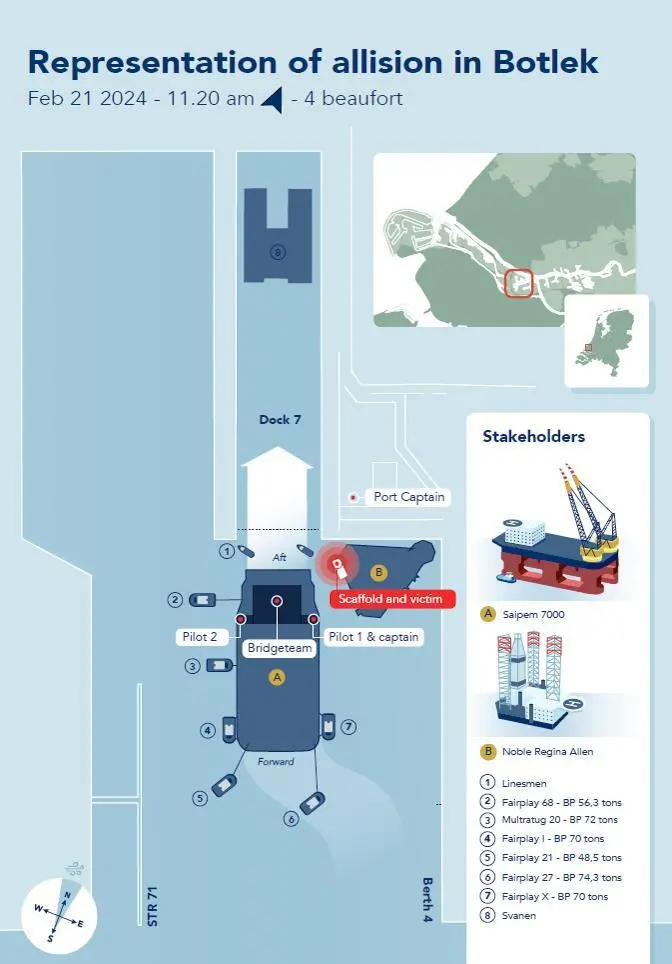
A Dutch Safety Board investigation was launched in 2024 the Bahamas-flagged semi-submersible crane vessel Saipem 7000 was being manoeuvred into drydock assisted by six tugs.
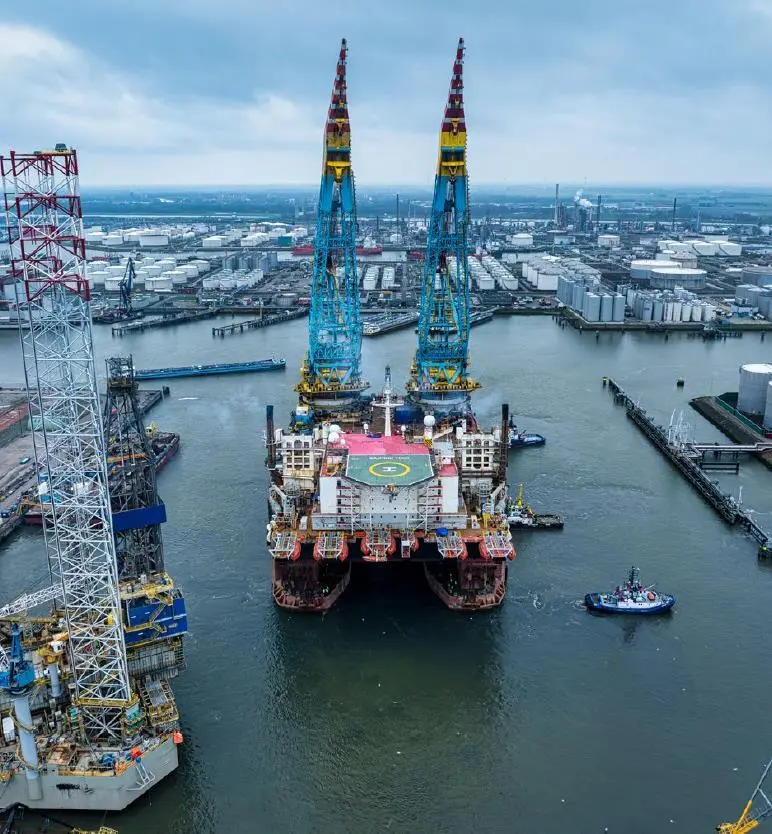
Next to the dock entrance, work was being carried out on the Liberian-flagged jack-up drilling rig Noble Regina Allen. Scaffolds were suspended on the outside of the vessel to allow outboard repairs to be carried out.
While manoeuvring towards the dock entrance Saipem 7000 veered off course, ending up at an angle to the dock. While correcting the course it swung ‘too far to the other side’, hitting the rig where a welder was working on one of the scaffolds.
The 59-year-old was trapped by the badly damaged scaffold until the crane vessel came free of the drilling rig and he fell into the sea. The docking operation was stopped and an immediate search started but it was several weeks before the welder’s body was recovered from the water.
Complex operation
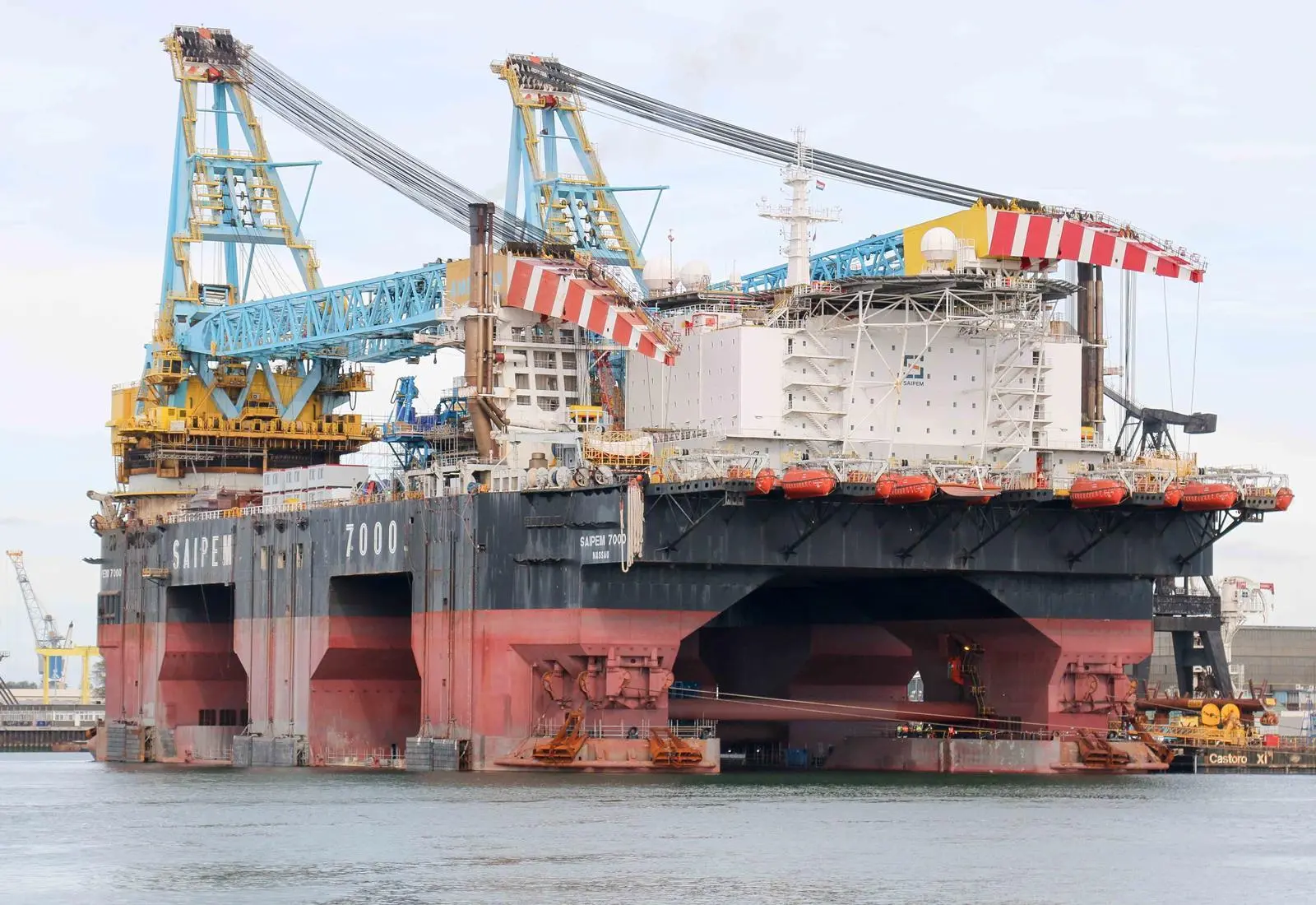
Saipem 7000 is a formidable vessel with a semi-submersible, twin-hull arrangement. At 98m in length, 87m beam,10.3m draught and 118,812GT, it has 10 azimuth and two bow thrusters. It was due to enter drydock for a 39-day maintenance period.
Noble Regina Allen, meanwhile, is a three-legged jack-up drilling rig of 102m length and 84m beam. It has no propulsion and following work in the drydock was positioned on its legs next to the drydock entrance to complete the work.
The docking procedure for Saipem 7000 included a step-by-step plan for the six tugs that would manoeuvre the vessel stern first into the dock, involving a 50cm clearance between its keel and the dock’s keel blocks.
The first attempt at docking was aborted due to a reduced tide window and the second attempt, scheduled for three days later, saw one of two pilots and vessel captain positioned on the port bridge wing, the same side as the drilling rig.
The second pilot was on the starboard bridge wing, four Italian officers manned the bridge operating the thrusters and DP, and none of them was informed that workers were present on the rig’s scaffolding.
The rig’s proximity meant that the tug due to be positioned aft on the crane vessel’s port side had to be relocated to its starboard side, midships.
Initially the vessel lay stable in front of the dock entrance but soon began swinging to port towards the rig. With mooring lines brought to the vessel from the dock, the forward port side tug was ordered to pull three-quarters then full power to correct the swing, and the rig’s thrusters were also used.
Aided by Saipem 7000’s thrusters and the tugs, the bow swung back to starboard with its stern swinging to port where it allided with the drilling rig and it became clear there had been a fall.
The timeline shows the docking being aborted 34 minutes after the start of the operation.
The accident demonstrates how manoeuvring such large ‘minimal’ vessels, carried out safely and on a regular basis, needs close liaison and communication between all parties involved, including the shipyard, which in this case drew up the docking procedure for the vessel.
Background and analysis
The docking procedure for the crane vessel from 2017 was used on this occasion, the document specifying the preparations and responsibilities along with communications and restrictions.
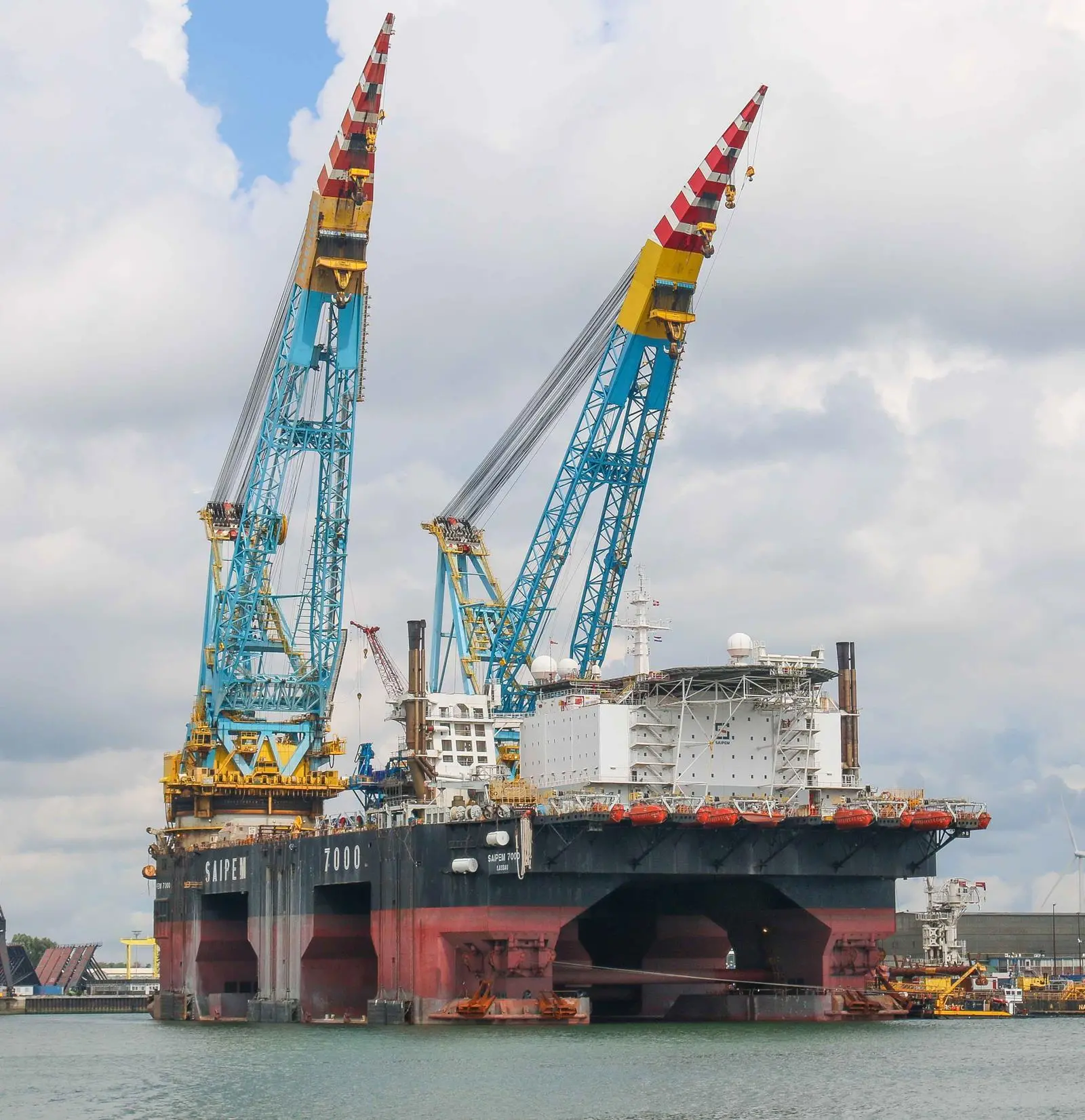
Earlier view of Saipem 7000 with its cranes raised
The 2017 procedure also specified the bollard pull of the six tugs dependent on their position, and totalling 390 tonnes. The 2024 plan only described the tug distribution and while the actual bollard pull of each tug varied on this occasion the total bollard pull was almost the same.
On this second attempt there was more wind than allowed for in the docking procedures but the parties involved did not consider this to be problematic, with sufficient tug power and the vessel’s own propulsion available.
The report says it would have been favourable to have a tug with greater pulling power on the starboard side (aft), given the tug intended for the port side aft was relocated to midships on the starboard side.
The use of the Dutch language for pilot/tug/linesmen/shipyard communications also created ‘an even greater challenge for the bridge team to keep engaged with the pilot’s actions’.
The report also states that as the parties involved took the presence of the rig as a given fact and that prescribed wind limits were exceeded, they took the decision to proceed ‘without any substantial risk assessment, meaning that robust risk management was not in place’.
It also suggests that information from the pilots’ portable Marginal Vessels Navigator was not ‘optimally utilised’, the captain and pilot considering manoeuvring by sight close to the dock entrance more reliable.
“The consequences of the combination of the use of the vessel’s own propulsion and the tugs were insufficiently thought through; by using the bow thrusters to move the bow of the crane vessel away from the drilling rig, the aft of the vessel turned to port. The tug on starboard aft did not have enough bollard pull to counteract this turn,” says the report.
Coordination and conclusions
The report examines in detail the safety and risk assessment procedures surrounding work on the drilling rig and their implications when associated with the movement of the crane vessel, the risks of the docking operation being unknown to the welder, his colleagues and supervisors.
Coordinating separate activities, particularly during such operations, is also explored in detail. While the chance of an allision was considered to exist and assessed as high by those involved, “At no point in the process did the owner of the drilling rig, the owner of the crane vessel and the shipyard get together to discuss the risks associated with the operation,” says the report.
Activities with each vessel involved individual projects in close proximity to one another and while responsibility to take the lead lies with the shipyard, the report says this does not release clients from also shouldering their responsibility regarding risk management.
Following the incident the shipyard implemented measures to prevent future incidents, including where vessel movements are discussed as standard at morning meetings. Lookouts must be present at all times when employees are working in places where shipping passes by.
It is also undertaking action and safety campaigns to raise safety awareness among employees.
Finally, the investigation shows how important it is for the parties involved to: “continually communicate explicitly with one another during the operation about risks that they perceive, especially if unforeseen circumstances arise.
“The pilot has a leading role to play in this regard, not only by communicating explicitly with others about what he intends doing, but also by actively asking those others about what they perceive and requesting them to alert him to any risks.”