![MaritimeJournal[Seawork]](https://www.maritimejournal.com/wp-content/uploads/2026/09/MaritimeJournalSeawork.svg)

French bring a slick operation to Seawork
London based International Apparatus Consultants Limited will be on Stand 233 at Seawork 2009 providing information on HNS and oil pollution equipment, imbiber beads, and oil pollution control boats, including the Catamar Offshore Oil Recovery Vessel commissioned in April by the French DOE.
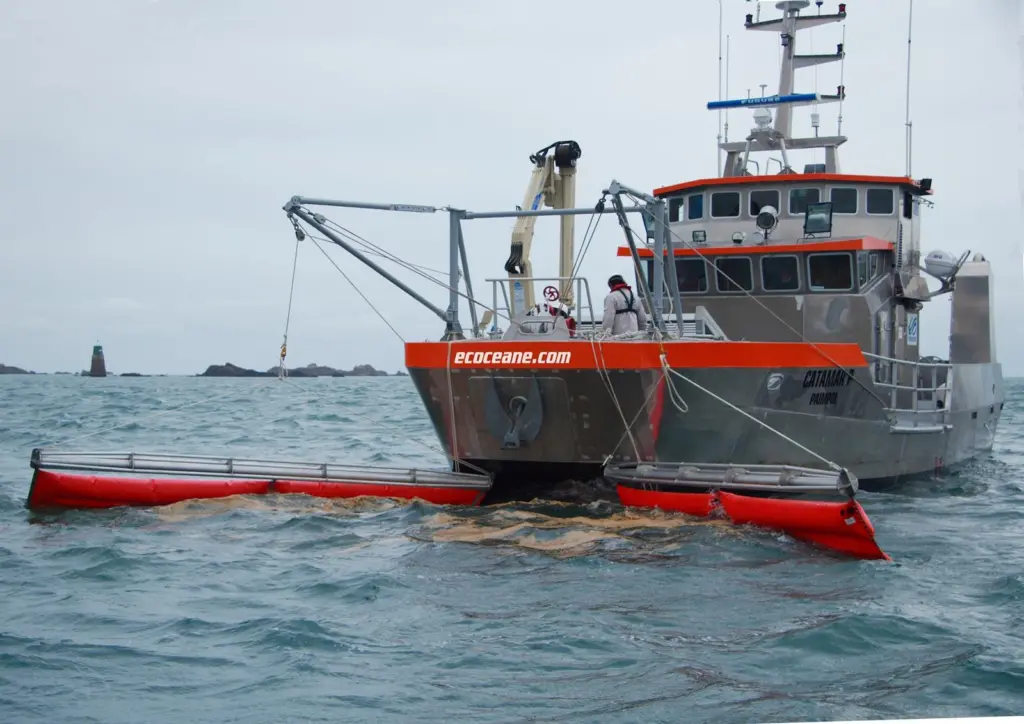
Catamar
and
Jumbo are high seas oil recovery vessels built by Ecoceane at Paimpol on the north coast of Brittany. Ecoceane works exclusively in research, development
and
the building of ships designed for the collection of hydrocarbons
and
solid waste at sea.
Ecoceane sees most oil spill response vessels as not primarily designed for clean-up operations. They are fitted with sweeping arms
and
pumps connected to skimmers, sailing into an oil slick with their arms deployed to increase the oil thickness. Pumping the hydrocarbons with the skimmers induces emulsification between the water
and
the hydrocarbons, with the emulsion containing up to 70% water. Such systems are limited to working in conditions below force 3. Use of the sweeping arms limits the speed of such ships to 1.5 knots in order to reduce the spreading effect of the bow wave. This limits intervention to calm sea states
and
also reduces the ability of such ships to manoeuvre.
Ecoceane pollution control vessels do not have such limitations. A turbine pulls a stream of water through a tank equipped with a mesh to filter out solid waste. The stream is then separated into two. With the first stream, the turbine pumps away the clean water. In the second stream, surface water polluted with oil is channelled into a hydrocarbon separator where they are stored floating. Clean water within the separator joins the main stream
and
is rejected through the turbine.
Catamar
and
Jumbo can thus recover hydrocarbons from the sea at a rate of 100 m3 per hour. The vessels, which have a cruising speed of 15 knots, can work at 4 to 5 knots. Hyrocarbons are recovered
and
stored without emulsion. Keel cooling allows the vessel to navigate safely in a hydrocarbon slick.
Related Articles
 SEAWORK
 SEAWORK NEWS
 SEAWORK