![MaritimeJournal[Seawork]](https://www.maritimejournal.com/wp-content/uploads/2026/09/MaritimeJournalSeawork.svg)
Seawork winner perfects pioneering pontoons
Seawork Spirit of Innovation Award winner Marine Designs Ltd has confirmed another order for its innovative Windcat Pontoon, which will be delivered to the Lowestoft onshore base for what is to become the largest offshore wind farm in the world at Greater Gabbard.
This is the second order for this novel type of pontoon, specially designed for the offshore wind industry, and is a major coup for the Falmouth UK based company, which is part of the ship repair and conversion specialist A&P Group.The rapid development of offshore wind farms both in UK waters and throughout Europe, is likely to lead to further orders for Marine Designs Ltd, especially as this pontoon design has been described as the ‘industry standard’ for the onshore bases of ‘Windcat’ type vessels.
The Windcat Pontoon is the brainchild of Marine Designs director, Shane Carr and many of its unique features are the result of experience gained over his many years spent designing and building pontoons for the RNLI.
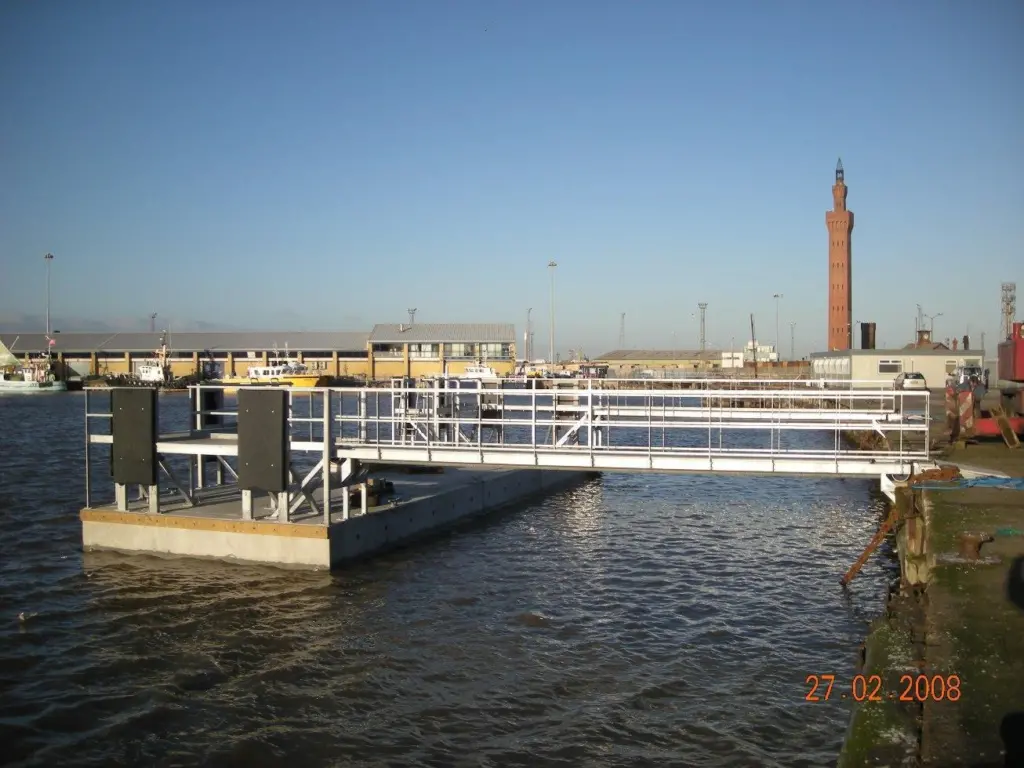
The Windcat Pontoon has several unique features. The Pontoon itself is the Marine Designs patented ‘Dockmaster’ Concrete Pontoon which won the prestigious ‘Seawork Spirit of Innovation Award’ in 2006. The vessel using it, the ‘Windcat Workboats’ Catamaran needs to be boarded at the bow but, as the bow is 2.5m above the water, no standard pontoon system is capable of enabling the task. The Windcat Pontoon allows workers to board the vessel quickly and in complete safety, and up to four Windcats can use the pontoon at the same time.
Other unique features are the two universally jointed ‘strut brows’, which hold the pontoon away from the quay, and the energy absorbing wide fenders which take the docking impact of the 1,500hp vessels.
Shane Carr said, ‘We offer a 50 year plus pontoon lifespan to our clients. To achieve this and to attain BS6349 maritime structures certification on our ‘Dockmaster’ pontoons, the concrete has to be a minimum of 150mm thick and 500mm at the corner stress points. As far as we know, this is the only pontoon available with such a high specification.’
The raised galvanised steel platform effectively makes it a double-decked pontoon, enabling smaller, low freeboard vessels to be boarded at the lower level. Therefore all four sides of the pontoon can be used at once.
Shane Carr added, ‘One of the great benefits to the client is that, as the strut brows are also mooring the pontoon, no piles or seabed attachments are required. This saves on both costs and permissions. The brows are universally jointed at both ends and also have built in energy absorption to take the high berthing loads of these powerful catamarans. If just one Windcat berths on one end of the 6m by 20m pontoon, the whole assembly moves so that the brows form a parallelogram of up to 25 degrees. This movement is dampened by heavy crossed-mooring chains led back to the bollards on the quay. However, as the pontoon displaces 110 tons, it does take a lot of moving”.
Grimsby Fish Market Enterprises (GFME), owners of the original Windcat Pontoon are delighted with its performance. Roger Smith of GFME said, ‘Marine Designs Ltd had already built an excellent concrete pontoon for us alongside the Fish Market and I asked them to come up with a bright idea for berthing the Windcats. This they clearly have.’
Marine Designs Ltd and Shane Carr have already made names for themselves with pontoons all over the UK, including three huge floating piers on the River Thames. One of these is the largest tubular steel pontoon in the world at the Millennium Dome (now the O2 Arena) in Greenwich.
Related Articles
 SEAWORK
 SEAWORK NEWS
 SEAWORK