![MaritimeJournal[Seawork]](https://www.maritimejournal.com/wp-content/uploads/2026/09/MaritimeJournalSeawork.svg)


Second speed reflects growing market for fast, commercial craft
The persistent rain failed to dampen the spirits of the assembled delegates at the second running of Speed@ Seawork high speed sea trials day.
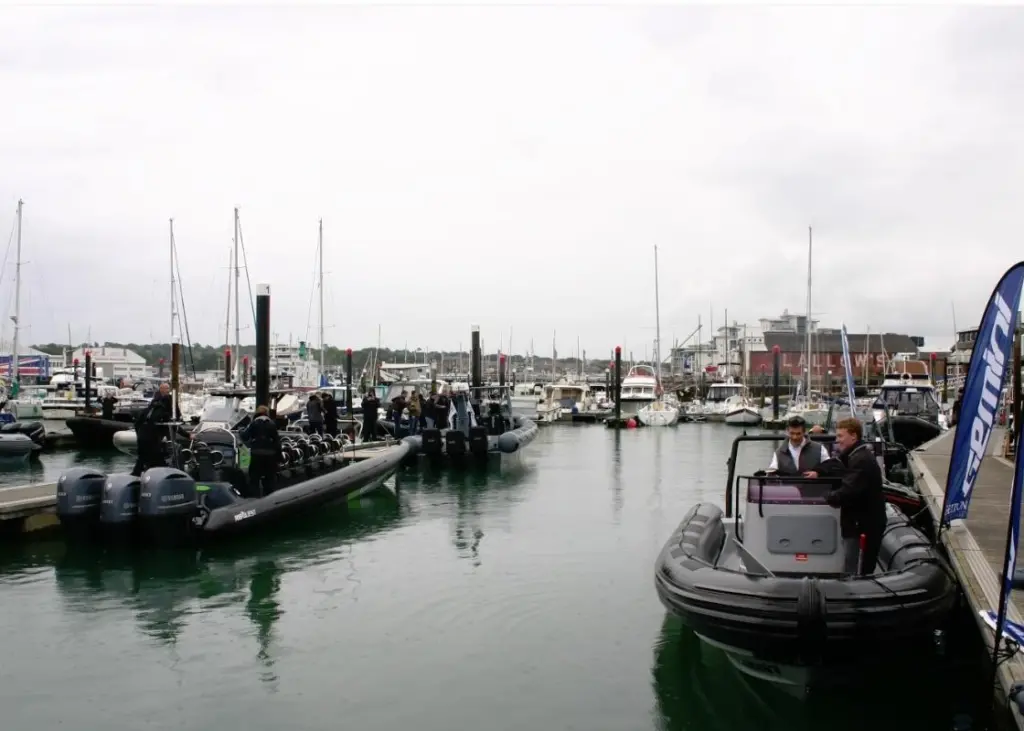
This event, which feels like it is becoming hugely established in the commercial marine calendar yet is still only in its second year showcases fast patrol and interdiction vessels from all over the world in the environment they are designed for; open sea conditions, rather than a cosy exhibition hall. With that in mind, for many of the potential buyers present, the grey skies presented more realistic testing conditions than the heatwave conditions we experienced the year before. These boats, almost by definition, are the sort that will be called into service in any conditions, and at a moment’s notice.
Fast vessels operating at high speed for security interventions and Search & Rescue are a significant specialist sector of the commercial marine business. Speed@Seawork is aimed squarely at facilitating growth and development for the design, build and operation of these specialist vessels.
Sea Trials day took place on Monday June 10 and was based in and around Cowes Yacht Haven on the Isle of Wight, UK.
From Maritime Journal’s point of view, these sort of high performance working boats, (at least two we trialled were demonstrated at over 70mph), will only ever present a small niche of the boats we cover. But the hull designs, propulsion packages and other technologies on show, are a great way to get an idea of the cutting edge and some clues to the technologies that will soon filter their way down into more workaday boats.
While last year, it was just about possible to trial every boat on offer in the course of the day, this year, the greater take-up by exhibitors meant that we had to be more selective and plump for the half dozen or so that we thought displayed the widest variety of what is on offer. So what follows below is a snapshot of my thoughts on a cross-section of the boats.
SeaAir flying RIB
This was the first boat I made a bee-line for. Hydrofoil motorboats have been around for 100 years, but nobody has really cracked it yet for small, trailerable craft. The French SeaAir though has solved a lot of the issues thanks to the recess that the main J- foils retract into for trailering, and by placing the rear T-foil on the cavitation plate of the standard (just longer shaft) outboard. Sadly for SeaAir, the clever computer stability control system was not functioning on the day, or for the rest of the Seawork show. Without this the boat tended to outward heel on the corners, which can be slightly, shall we say, disconcerting, for passengers. I saw immense potential in it though, and the day after Speed fought hard for this clever little boat to be rewarded for its ingenuity during the judging process for the European Commercial Marine Awards. In the end it was narrowly beaten into second place in this prestigious contest by a large European shipyard’s hybrid patrol vessel. In ten years, small motor hydrofoil boats will be a thing so I’m really glad I got the opportunity to experience the unique feeling of possibly the world’s first hydrofoil RIB.
Ring RP-M1050
Ring Powercraft need no introduction to anyone that’s ever had any involvement with the UK powerboat racing scene. This boat was described as a ‘Tactical RIB’ and it felt extremely surefooted on the water. You could tell that this boat had been designed by people who had spent a lot of time going fast in a variety of different sea conditions. It has a hull with ventilated steps, but as the company representative explained, these are a slightly shallower step than the aggressive steps that a racing powerboat of the same size would have. As somebody that’s seen close up the aftermath of a stepped hull powerboat that has swapped ends on a high speed corner, I was pleased to hear that steps have been toned down a little for these sort of vessels that have to carry a variety of loads and accommodate drivers who have not cut their teeth on the racing circuits.
RibQuest/ Velocity
RibQuest is an Anglesey-based company that (I assume) offers ‘Wild Ride’ type experiences to screaming holiday makers and cackling hen-nights. While I first wondered what their RIB was doing at an event like Speed@ Seawork, thanks to a really entertaining presentation by their joint founder Phil Scott, it all started making sense. RibQuest wanted to push the boundaries and have the fastest passenger RIB in the UK, so they worked with Velocity RIBs on the design, and waded through all the other aspects such as coding and insurance. It’s another RIB that’s come from powerboat racing designs, again with what I call ‘detuned steps’. The design they have ended up with is fast, (we did close to 70mph across a choppy Solent), but quiet, refined and fuss free. It turns out that the basic requirement of a safe, insurable, package that looks after its passengers is as desirable to the military as it is to RibQuest. The boat circumnavigated Anglesey in a new speed record time of a fraction over an hour, then returned a couple of hours later to taking paying guests on a trip.
Shock Mitigation is always a big part of discussions at Speed@seawork, so it was interesting to learn that this boat had Skydex seat cushions, rather than a more expensive mechanical suspension seat solution. Partly this was for cost and space reasons, but the fact that the hull was designed from the outset to minimise vertical accelerations, combined with the fact that passengers are only exposed for 30 minutes at a time, meant that there is still a place, even in a very high performance boat for non-mechanical seats. Skydex had an interesting display inside the event base too, where I was able to learn that this material is far removed from the blocks of seat foam that it is designed to replace; it really sits somewhere half way between a full suspension seat and the sad little bit of flat, waterlogged foam that I have on my RIB. Skydex was another runner up in the ECMAs the day after (in the Marine Equipment, electronics & Materials category).
Zodiac Hurricane Mach II 13m Interceptor
The largest RIB at the event, this monster even had a Seakeeper Gyro aboard. It was also, noticeably the driest, with even a session jumping and playing in the wake of a passing supertanker not letting much water over the gunwales. Powered by Quad Mercury Verado 350 HP outboard engines, this was a quick boat, but there was nothing the Solent could throw at it that it did not take in its stride. If I had to pick a boat to spend a day at sea in with lots of loitering and occasional dashes to apprehend maritime miscreants, it would be this one.
Safe Boats 35 MMI
Now represented by Diverse Marine on the Isle of Wight, Safe Boats International is a big US manufacturer. MMI stands for Multi Mission Interceptor, and while this aluminium-hulled boat was refined and comfortable in a straight line, its real party piece was its grip in fast turns. It has a pair of approx. eight inch deep bilge keels at either side of the planing surfaces, and while the horizontal rain and 55 knots of apparent wind stopped me from making any notes on what exactly Safe Boats would like me to call these hydrodynamic devices in this article, I can vouch for what they did to the boat’s handling. This would be the boat I’d want to navigate fast down a winding channel under heavy machine gun fire, should I ever find myself in this unlikely scenario. The cornering was tremendous; tighter turns than I’ve ever experienced in a monohull vessel, and an experience that will live with me for many years.
Ophardt OPH/1220/D
Ophardt Maritim is a German company specialising in aluminium hulled RIBs. 3x425hp Yamaha XTO Offshore motors provided the motive force and speeds in excess of 60 knots. But again, this was such a well-mannered design, it was hard to fault it, and were it not for the blast of rain in the face, you could have been doing 30 knots. A look over the shoulder at full speed at the large rooster tail arching behind suggested that this company knows how to set up and prop a boat and were clearly employing a driver who knew what to do with it.
What we learnt:
Ventilated step hulls are now well and truly in vogue for fast commercial craft.
Short of a tunnel hull race boat, nothing slaloms quite as fast as a Safe Boats 35 MMI.
If your job requires going fast at sea, one or two outboards seemingly won’t cut it any more. You’ll be wanting three or four!
At 70mph rain feels like gravel- pack ski goggles next year!
By Jake Frith
Related Articles
 SEAWORK
 SEAWORK NEWS
 SEAWORK