![MaritimeJournal[Seawork]](https://www.maritimejournal.com/wp-content/uploads/2026/09/MaritimeJournalSeawork.svg)






Cargo veteran gets make-over
Now approaching 60, the German museum ship Bleichen will soon complete extensive restoration at Hamburg’s Norderwerft – its first major overhaul since being saved from scrapping in 2007.
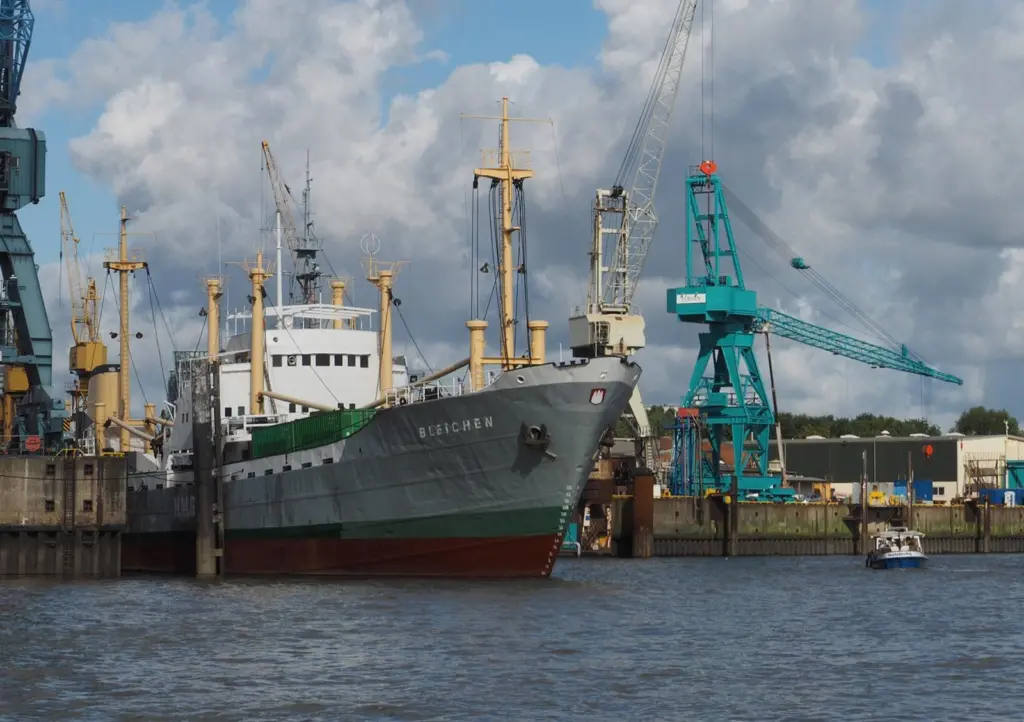
The 93.4m long and 12.3m wide cargo veteran was expected to finish its revamp around Christmas or early in the new year after docking for about six weeks for final exterior works.
The docking at Norderwerft – the Hamburg repair yard of the Lürssen Group – was originally planned for September after the ship had been towed from the museum berth where it has been moored for eight years. However this was delayed because of low Elbe water levels, Joachim Kaiser of the Hamburg Maritime Foundation told Maritime Journal.
Completed in 1958 by the Nobiskrug Shipyard on the Kiel Canal in Rendsburg, Bleichen is the fourth and last in a series of very successful general cargo ships for German shipowner Gerckens.
With a deck house amidships and engine room aft, the ship was saved from scrapping by the Foundation in 2007. The current major restoration, the ship’s first since then, has been funded by donations and by the German Parliament with a reported €3 million grant under a programme to preserve important monuments. The work is being carried out by volunteers.
Kaiser said that while waiting for dock availability the welded 1950s superstructure of the old ship had been repaired “piece by piece” at its berth.
The overhaul of the old 1950s Type RBV8M 366 Klöckner-Humboldt-Deutz four-stroke main Diesel with turbo charger also took place during this wait. The 8m long and 3.7m high 8-cylinder engine is of 1324kW and weighs 55 tonnes. In 1958 it was the biggest four-stroke Deutz engine. Also overhauled were Bleichen’s three A8M 157 Deutz auxiliary generators, also dating from 1958.
Kaiser said the whole engine room with its sub systems is still largely in its original condition, including a special hydrodynamic Voith turbo-coupling located between the main engine and the gearbox to prevent engine strain during operations in ice. Kaiser said in fact the ship operated a steel propeller plant in winter, probably from Zeise, and changed to a brass unit in summer service.
Docking work was including renewal of steel plating below the water-line, underwater coating and the inspection of the crankshaft and rudder. Asked why Norderwerft had won the work on Bleichen, Kaiser told Maritime Journal tenders for the restoration were invited throughout the country and that six yards had applied. Of these however only three made firm offers, of which that by the Norderwerft was the best, he said.
Kaiser added that Bleichen builders Nobiskrug were also among the three making firm offers, but was too expensive. He did not name the third yard.
By Tom Todd
Related Articles
 SHIPYARD NEWS
 VESSELS
 INDUSTRY NEWS