![MaritimeJournal[Seawork]](https://www.maritimejournal.com/wp-content/uploads/2026/09/MaritimeJournalSeawork.svg)




Clyde has as many attachments as a penknife
When Land and Water Plant Ltd had to find a replacement for its ageing river tugs the company knew it needed something as neat and flexible as a Swiss Army knife to help maintain variable, and often debris filled, rivers and estuaries.
The Surrey UK based marine civil engineering, dredging and remediation specialists needed a pusher tug which could transport barges on and around the waterways that surround the site for the fast approaching London 2012 Olympics.
Richard Maclean of Land and Water explained that sourcing ex-NATO boats meant the growing problem of relying on second hand parts. “All of our other machinery is modern, so the only weak links were these 20 or 30 year old diesel driven tugs which were becoming less reliable and more expensive to maintain”, he told MJ.
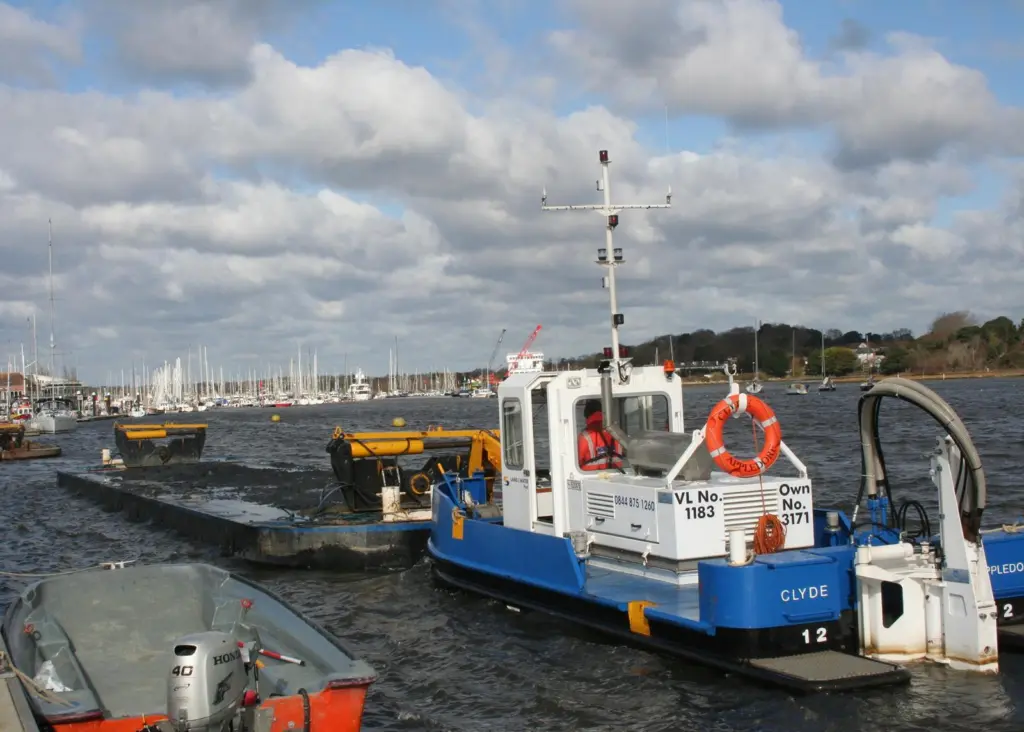
Land and Water’s design concept was for a small, highly manoeuvrable shallow drafted tug, built on a catamaran hull, to which various attachments could be easily added or removed from the front end depending on the task to be done.
Keel Marine got involved as naval architects with regard to hydrodynamics and stability considerations and drew up plans that allowed for multiple capabilities. The final design has a hull form that minimises wash over the bow and creates a flow between the two hulls, which is very useful for shallow water activities. The tug, which was then built by Manor Marine, is now in operation and named Clyde. It has push bars at the bow and an excavator arm with latching attachment for grabbing onto barges, enabling the tug and barge combination to be manoeuvred as one.
On the end of the latching attachment is a quick release coupler which enables forks to be put onto the front so the tug can take palettes like floating fork lift. It can also have a dredge pump attached for local dredging, a weed cutting head, and a debris collection basket.
“Anything you can put on a tractor that weighs up to a one ton, you can put on this tug”, explained Mr Maclean.
Land and Water’s old tugs’ propulsion units are being out-performed by a solution with a propeller on a hydraulic leg, giving a rotational arc of 130°. “It can go in an Instant from full ahead to astern, which makes it astonishingly manoeuvrable”, added Mr Maclean.
It can be raised to above the hull profile for the most usual shallow water work and dropped down below the hull for clear water cruising (giving maximising thrust). An ability to tilt upwards allows for daily inspection and removal of any debris which may have become entangled. A kick-up reflex should it hit an obstruction is intended to prevent or minimise damage.
Clyde is propelled by diesel hydraulic power pack, with a Sabre Perkins M250C engine specified because it exceeds the Tier 3 emission standards. This is an important consideration for Land & Water, which often operates in environmentally sensitive environments. For further versatility, the power pack and hydraulic propulsion unit can be deck mounted on other equipment such as pontoons and dumb barges.
Clyde’s first job saw it go straight onto the 2012 Olympics site and, having finished there, it is now working job in Lymington.
Fact Box:
LOA: 8.8m
Beam: 3.0m
Moulded depth: 1.335m
Power: Diesel hydraulic power pack – Sabre Perkins M250C main engine
Bollard pull: 2 tons