![MaritimeJournal[Seawork]](https://www.maritimejournal.com/wp-content/uploads/2026/09/MaritimeJournalSeawork.svg)


Eco-friendly ferry ready for service
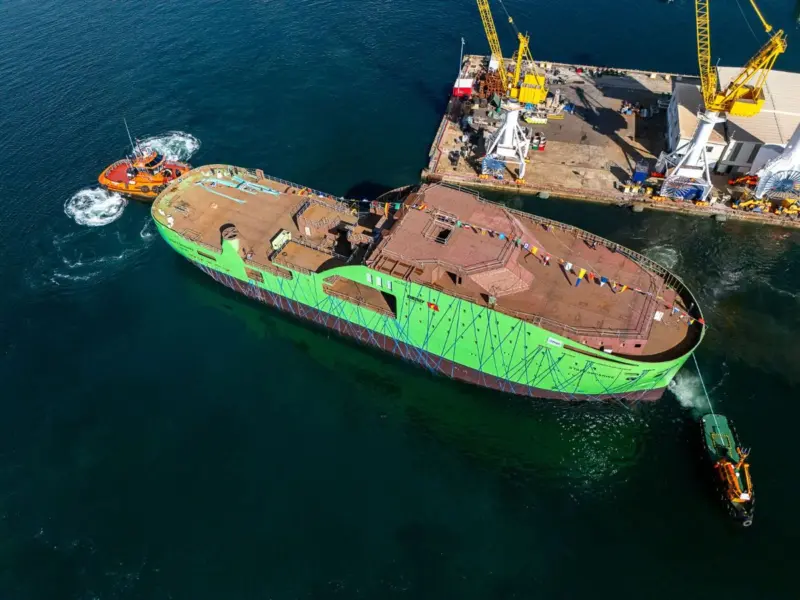
A new diesel-electric coastal ferry with emission-reduction technology said to be almost as efficient as LNG drive is going into service soon on the German North Sea coast.
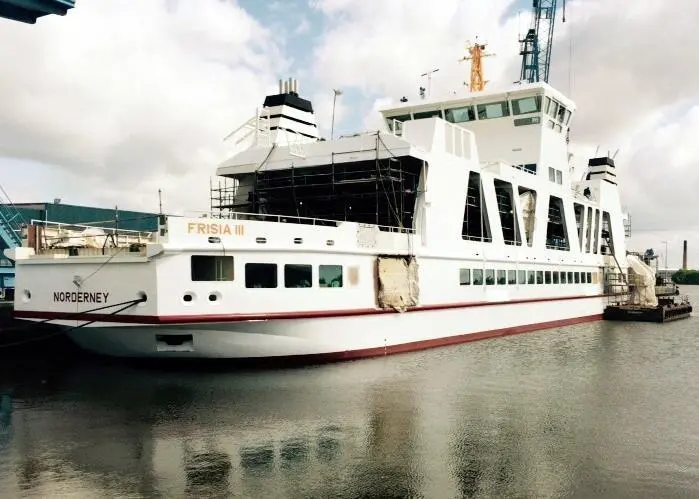
The 74.3m long and 13.4m wide double-ended Frisia 111 is being delivered mid to late July by Cassens Werft in Emden to local operator Reederei Norden-Frisia. The firm’s new flagship has been built to meet annually growing transport capacity needs between the German mainland and the Island of Norderney.
When it was ordered last year, its owners said it would be fitted with filter plant which would reduce emissions by up to 90% and particle emissions by up to 99%. “This means that almost the same emission values will be achieved as with a gas-driven vessel”, Norden-Frisia officials said.
Frisia 111 looks similar at first glance and has been described as a sister ship of Frisia1V, which Cassens delivered to Norden-Frisia in 2002. It is however different in many respects and resembles more the company’s 2010, Sietas-built, eco-friendly Frisia V111 than the earlier ship. However, Norden-Frisia told Maritime Journal that experience building Frisia 1V had helped shorten the building time for Frisia 111 and, along with a favourable price (reportedly about €20 million) had been among the reasons for choosing Cassens again.
Frisia 111 – which joins ten other ferries currently listed in the company’s fleet – is some 3.6m longer than the earlier 70.7m Frisia 1V – an increase required to house new eco-technology and safety installations. The deckhouse is also 1.8m higher than on the old ship and the newbuild also carries a fast new rescue boat on deck to meet the latest safety requirements. Frisia 111 also has an optimised hull design which is said to cut up to 10% off diesel fuel costs and also meets the latest emission standards.
Drawing maximum 1.75m fully laden, it is of 1,574gt and 325dwt and carries 1,348 passengers and about 60 cars. With a crew of 12 the ship is ideal for the shallow waters between the mainland and Norderney, the owners said.
Norden-Frisia’s Fred Meyer told Maritime Journal the newbuild’s fuel-efficientdiesel-electric propulsion system consists of four Mitsubishi marine diesel generators Type S6 R-2-T2-MPTK of 700 kVA and four Voith Schneider drives Type VSP 16 KG/100 each with five blades – the same units as installed on Frisia 1V. The newbuild’s scrubber, he added, is an SCR system from Kurre Abgastechnik with urea injection adapted to the bigger Mitsubishi plant. A similar plant is installed on FrisiaV111.
In 2012 Frisia V111 became the first German ship to win the coveted German environmental quality design award “Blauer Engel” and Norden-Frisia has said it hopes that Frisia 111 will win the same award.
By Tom Todd