![MaritimeJournal[Seawork]](https://www.maritimejournal.com/wp-content/uploads/2026/09/MaritimeJournalSeawork.svg)



French complete German pilots
German pilots have taken delivery of the beak-bow fast pilot tender Visurgis – last in a series of four monohull newbuilds tailor-made in France for service in Bremerhaven and Emden.
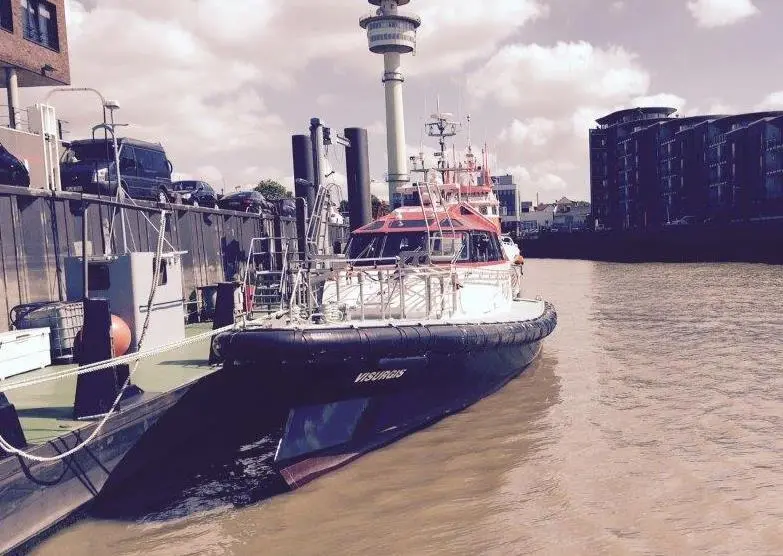
The 19.6m long and 6.3m wide Type ORC 190 pilot tender Visurgis was built by Chantiers Navals Bernard in Locmiquelic on the French Atlantic Coast. Drawing 1.8m it is powered by two MTU Type 10 V 2000 M 72 engines each of 900kW at 2250 rev/min which operate two propellers. It is capable of an impressive top speed of 30 knots.
In a report, the German engine builder noted it had supplied eight such engines for the German ORC 190 series since 2011 when the first of the four boats, Frya, was delivered. Since then the Germans have also taken sisters Fresena and Burkana into service.
Michael Maas, head of the Bremerhaven branch of the Lotsbetriebsverein (LBV) told Maritime Journal Bernard was “well-known for the quality of its GRP work”. Local officials said earlier the four German boats were particularly suited for local conditions.
Maas said the LBV also has two pilot station ships in operation – the 60.4m SWATHs Weser and Elbe as well as five SWATH tenders which cover rough coastal water and tidal estuary needs in the German Bight, Ems, Weser and Elbe Estuaries.
“The number of boats is sufficient for the foreseeable future” to cope with pilot transfer service needs in Bremerhaven and Emden”, Maas said. He noted that Hamburg pilots were also working with the boats in Bremerhaven as part of a pool to minimise operational costs.
Bernard won an EU-wide tender for the newbuilds, unusually for a sector often dominated by specialist north German and Dutch yards. A shipping and waterways office (WSA) spokeswoman told MJ at the time the French yard had put in “the most economical bid, which was also the best overall”.
The ORC 190s carry a crew of 2-3 and up to eight pilots. Their beak bow, unlike a bulbous bow, is above the waterline and the German spokeswoman said the beak and a chined, duck-bill shaped hull made the boats particularly stable and reduced roll and pitch as well as breaker spray. She also said the French boats were “very fast and manoeuverable” compared to others and easier to use with low-freeboard ships than SWATH tenders were.
The MTU report said speed, along with “outstanding directional stability” were the most important features of the new boats and that the monohull beak bow concept provided comfortable sailing at 22 knots in Force 5 winds
Even so the boats have not reportedly operated entirely trouble-free. In 2013 media said Frya had twice suffered engine problems and there were rumours that an engine was replaced.
By Tom Todd