![MaritimeJournal[Seawork]](https://www.maritimejournal.com/wp-content/uploads/2026/09/MaritimeJournalSeawork.svg)




From SWATH to SWASH and Beyond
The hand-over this autumn of a second 25.65m pilot tender to American owners is the latest in a string of firsts marking a ground-breaking year at leading German SWATH and SWASH production facility Abeking and Rasmussen (A&R).
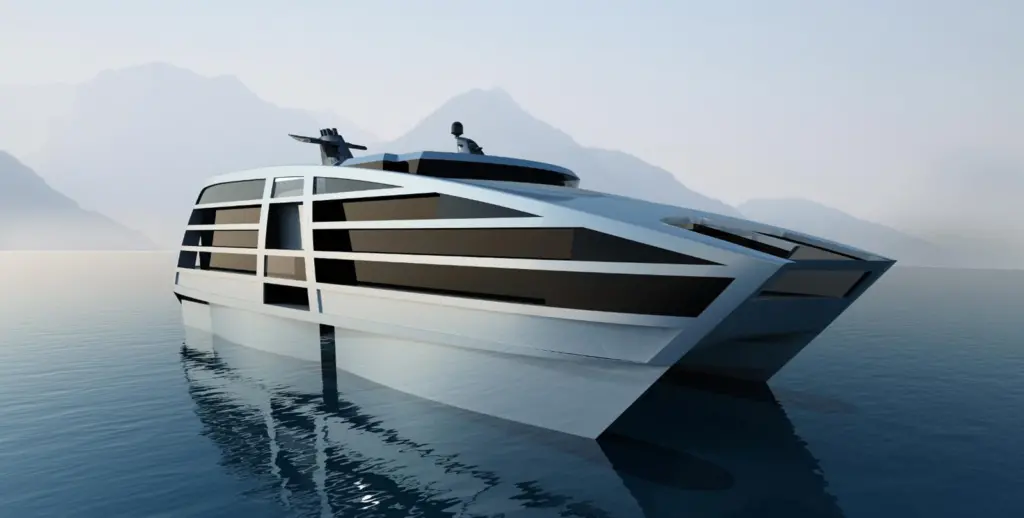
The completion of the two new SWATH (Small Waterplane Area Twin Hull) boats for Houston Pilots in Texas comes in a year which has already seen A&R’s first SWASH (Small Waterplane Area Single Hull) boat enter service and the unveiling of its first SWATH expedition cruise yacht design.
The benefits of SWATH technology – minimal resistance and maximum sea- worthiness using stable platforms – are now well documented and exploited. A&R was the first German facility to successfully market a reliable and commercially successful SWATH design.
Its most potent German rival, Nordseewerke in Emden, converted to other production in 2009 but earlier also turned out some impressively competitive SWATH vessels. They included what is still Germany’s biggest SWATH – the 73m naval research and equipment testing vessel Planet.
A&R’s success has been built on application variety – not only SWATH pilot tenders and station ships, but also hydrographic survey vessels, support boats and CTVs for the offshore and wind farm sectors, patrol boats, naval minesweepers, surveillance boats and even two SWATH yachts. It delivered the world’s first series of high speed 25.7m SWATH naval patrol boats to Latvia with 20 knot MAN D 2842 Diesels and supplied Germany’s first 25m research and survey SWATH to Estonia.
At last report the Lemwerder yard on the Weser had produced 26 SWATH vessels of 20m, 25m, 40m, 50m and 60m. All are backed by the A&R maxim that SWATH technology is useful almost anywhere where stability is important for the job at hand. And its latest developments demonstrate that the range of potential applications is far from over.
Houston Pilots in Texas were the first to recognise and support SWATH boats for pilot service two decades ago and they were the inspiration for A&R to build its own first SWATH boats. Now seeking replacements for their elderly original vessels, the Americans turned to A&R, impressed by its pilot boats operating in northern Europe.
Houston Pilots’ first 25.65m replacement boat from A&R – Houston – went into service in July, a year after its keel was laid at A&R Special Vessels. It was being joined by the identical Bayou City this autumn.
A&R told Maritime Journal the American tenders are 13m wide, draw 2.7m and provide 19.5 knots – although some reports put top speed higher. They have room for 12 pilots and a crew of four and are for service in an area which sees a reported 20,000 pilot transfer movements a year.
Neither Houston Pilots nor A&R had revealed any further technical or engine information about the two new boats as of late August so it was not known if the latest of the popular 25.65m series tenders would follow any earlier engine trends in the best-selling series.
The boats are in service mainly at home on Germany’s Elbe, Weser and Ems rivers but also in Belgium and the Netherlands. The earliest German 25.65m boats Döse and Duhnen and later boats of the same size had MTU 12V2000 series Diesels. Belgium’s pilot boats however were fitted with MODRF355L- 4bb electric motors.
A&R Marketing and Sales Manager Verena Henk told Maritime Journal when the keel for the first American boat was laid last year, that they would be “the first SWATH pilot tenders to be fitted with Diesel engines meeting the latest U.S. EPA Tier 3 emission regulations and driving fixed propellers via Reintjes reduction gearings”.
A&R Special Vessels MD Nils P. Olschner said he was proud of the Houston order, describing it as historic. “The wheel has come full circle”, he declared referring to the pioneering American support for SWATH technology. He recalled that: “The first ships of this type were put into service there and have proved themselves ever since”, he said, noting they served as models for Döse and Duhnen. The 14.26m wide Döse, drawing 2.7m had, at last word, demonstrated its reliability by carrying out some 130,000 pilot operations since its introduction in1999. Döse and Duhnen, with top speeds of 18 knots, served as the forerunners of all the other SWATHs from A&R over the years including, now, its latest optimised American boats. All of which lends real credence to Olschner’s “full circle” remark.
In early April A&R took a step beyond the confines of the original SWATH concept when it handed over Explorer – the yard’s first SWASH newbuilding – to the German Ministry of Transport and Digital Infrastructure (BMVI). In late summer, the BMVI told Maritime Journal that all involved with the operation of Explorer in the Elbe Estuary had been satisfied with its performance.
It is the first time that the SWASH single hull concept has been commercially implemented and the handover of Explorer ended more than four years of trials by the Elbe pilots’ association (Lotsenbrüderschaft Elbe) in challenging estuary conditions.
Prominent German marine engineer Peter Pospiech in a report for Explorer engine builder MTU, reported enthusiasm for the boat among pilots after the trials turned up “some outstanding results”.
Andreas Schoon, CEO of the central pilots’ body (Lotsenbetriebsverein) in Cuxhaven, could not have been more lavish in his praise. “The vessel’s manoeuverability is brilliant – extremely impressive”, he said. He added: “it was designed to allow secure pilot transfer to a moving vessel in rough and choppy seas, and that is exactly what the shipyard achieved”.
The development of the SWASH principle was motivated by commercial considerations. Pilots operating on the River Elbe needed a lighter and more economically efficient type of transfer launch than SWATH designs allowed – but they did not want to give up any of the positive features of SWATH.
According to A&R, SWATH boats cannot be much smaller than about 25m in length otherwise the submerged hulls would not be big enough to accommodate propulsion systems. Explorer – a 20.42m monohull, SWASH-design vessel with two trimaran-type stabilising outriggers – solves that problem. It is 12.3m wide, draws 3.1m and carries eight service personnel and a crew of two.
Pospiech quoted the yard saying the fact that the boat is about five 5m shorter than predecessor SWATH models “makes Explorer faster, more manoeuverable and, most important, more economical to operate than a SWATH vessel”. In addition, the vertical outrigger surfaces on the SWASH vessel can dock with ocean-going ships as well as with vessels with limited freeboard height.
A&R was reportedly so confident that the SWASH concept would meet requirements that it built the tender at its own expense and made it available to the operator for long-term trials.
Like its bigger sisters, Explorer has a diesel-electric propulsion system. The central compact hull cylinder accommodates a single MTU 10V 2000 M72 engine providing 900 kW and a special low-speed electric propulsion unit from Siemens. Maximum speed is 16 knots.
For pilot station operation, the electric motor means low fuel consumption and permanently improved CO2 balance. With this configuration the unusual trimaran can reach nearly 20 knots, more than adequate, say the experts, for transferring pilots to large ships.
Propulsion power is generated by a diesel-electric hybrid drive from Siemens. Housed in the buoyancy cylinder, this ‘EcoProp’ system is capable of diesel and electric modes that facilitate economic operation for every duty profile. When the vessel is powered by its MTU diesel engine, any surplus power is fed into a generator that supplies on-board electricity for the entire boat.
The BMVI told Maritime Journal in early autumn that all those involved with the operation of Explorer in the Elbe Estuary since its introduction in April were satisfied with the new boat.
“The particular sea-keeping and manoeuverability characteristics of the boat were decisive for its acquisition”, the Ministry said. “Its range of movement, even in rough seas, mean that when Explorer is used, pilot exchanges on the Elbe near Brunsbüttel can now be carried out quicker, more safely and without significant losses of journey time”
One reason for this, the Ministry told this correspondent, was that “during pilot transfer manoeuvres, the vessel ‘sticks’ to the ship’s side and remains stable, making transfer easier.”
In a final comment, the Ministry explained that Explorer had been acquired specifically to cope with conditions off Brunsbüttel. “There are at present no plans to acquire further SWASH boats”, it said.
The yard’s third major project of 2017 so far is also the most ambitious and a logical market development given its extensive experience in yacht design as well as SWATH technology.
Described as “daringly different”, A&R’s innovative new “boutique” luxury expedition cruise yacht concept was unveiled in March. It will involve the biggest SWATH ship ever built by the yard – at 95m – much bigger than any SWATH built so far in Germany.
It will also be the first SWATH ship designed by the company specifically for the cruise market. It “brings bespoke cruising to a whole new level” and introduces a ship that is “quite simply out of this world”, A&R declares.
The SWATH cruise ship concept provides for a ship 32m wide and drawing 8.5m. Of 11,500GT it will carry 166 passengers, all in a total of 85 spacious suites with private balconies and have a crew of 110 and a speed of 15 knots.
No further technical details of the SWATH cruise concept or orders for the new design had been reported as of autumn but there were interesting details and plenty of promises for it.
A&R said the typical double hull SWATH design will “radically minimise motion on board the passenger vessel to a quarter of the level of conventional ships” while “sea-keeping performance fully enables the dream of a luxury hotel on water to be turned into reality”.
The claim is reminiscent of what was once said about the A&R private SWATH yacht, the 40.5m long and 17.8m wide Silver Cloud, when it entered service in 2008.
It is modelled on A&R’s 49.9m pilot station ship Elbe from 2000 but was the first boat to take the SWATH sailing experience into the pleasure sector.
More to the point perhaps, an agent told this correspondent at the time that a main reason for choosing Silver Cloud was because the American owner’s wife suffered from sea sickness on conventional yachts. The owner also praised its performance and functionality and said it was spacious and comfortable.
A&R’s latest SWATH pleasure ship will no doubt boast similar and further attractive new features. The yard said a lift will take passengers to a below-surface NEMO Bar in one of the cylindrical hulls which will feature giant panoramic windows and submarine sea life views. A Dolphin Lounge in the bow will also have 180̊ water line panorama and close-up views of marine animals.
By Tom Todd