![MaritimeJournal[Seawork]](https://www.maritimejournal.com/wp-content/uploads/2026/09/MaritimeJournalSeawork.svg)



Goodchild’s Fast Pilot speeds to Seawork
Norfolk UK based Goodchild Marine Services will debut the first of two new ORC 171.P Fast Pilot Craft built for Estuary Services Ltd (ESL) at Seawork 2012.
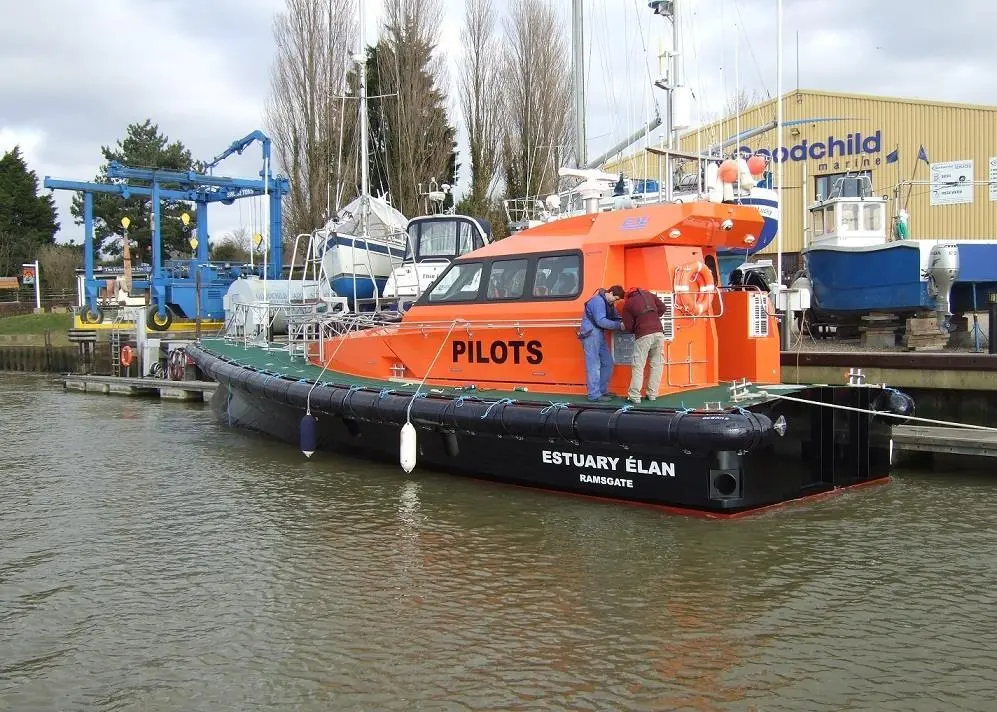
The pilot cutters at Sheerness and Ramsgate are purpose built craft operated by ESL, which is a joint partnership between the Port of London Authority (PLA) and Medway Ports.
Built to a design by French naval architects Pantocarene, the ORC 171.P features a double chine hull with a forward ‘beak’, which gives outstanding seakeeping.
The most efficient hull form to propel is a planing hull. However, for rough sea conditions this hull form tends to slam when head to sea and also has a tendency to broach in following seas. This is why conventional hull forms for pilot vessels adopt semi-displacement hull forms. The major difference with the ORC design is the use of a planing hull to achieve maximum use of available power with the addition of the beak bow. This acts by capturing heavy seas, which prevents the hull from lifting and slamming. At the same time, a fine entry prevents the heavy weather from stalling the hull when at speed. In following seas, the use of the skeg aft prevents yaw at the same time as minimising the drag factor associated with a conventional long keel found on semi-displacement craft.
These design differences help to provide exceptional fuel economy, which is further maximised by the use of modern GRP composite construction. Extensive use of woven roven laminate gives a strong yet lightweight construction, possibly 10% lighter than an equivalent vessel). This provides increased strength with great weight savings which in turn requires less power to achieve similar speeds.
The hull design has been optimised through tank testing and through experience in service to allow the ORC 171 Pilot vessel to approach and then stay alongside a ship at higher than normal pilot transfer speeds without using high engine power and then to break away easily at the end of the operation. This saves time and cost for both the operator and the ship owner.
The fender system is designed to absorb impacts and each section is manufactured by the calculated inertia to ensure the correct density of foam is used in its construction. The size is substantial and the way in which it sits into a moulded recess and is retained with web straps provides a very light and purposeful solution to problems associated with more conventional systems. Whilst this system is expensive to fit initially, Goodchild draws upon its own experience to suggest that substantial through life savings result from the high degree of protection this system offers, and the subsequently reduced likelihood of structural damage to the hull. If surface damage does occur, it provides the opportunity to rotate sections along the sides to present a fresh non-worn surface until the damaged section can either be removed for repair or replaced simply by releasing the straps and slotting the fender section out whilst the vessel is afloat.
Crew comfort was a major consideration during the design of these craft. This was achieved by adopting a resilient mounted wheelhouse to further reduce transient noise and vibration generated by the machinery and hull in heavy weather situations. The seating provides the ultimate damping and the four point harness systems ensure maximum crew safety and comfort at all times. This allows individual adjustment to the degree of dampening according to individual crew weight. Extensive use of electronic control systems further reduces transmitted noise to the wheelhouse accommodation whilst drastically reducing cable weight within the vessel, again contributing to maximum fuel economy.
The use of EmpirBus NXT allows optimised customisation and other benefits over more conventional electrical systems. The majority of heavy cabling is reduced overall as each watertight compartment has a module fitted with local wiring to each service. Each module is connected by a positive and negative power supply plus a NMEA 2000 bus cable which provides total control and monitoring of the entire system. Fuses or trips are replaced by programmable FETs, which provide instant visual and audible indication at the helm position if there is a fault. If it is a simple one, the system can be reset from the helm position, a major safety factor when at sea in bad conditions.
The system also provides so much integration that all systems onboard are monitored and any light failure or service which is not operating correctly is alerted to the helmsman. It is impossible to run with illegal lights as the system is programmed to ensure only those running lights which are legal can operate at once, optimising safety.
The transom of the ORC 171.51 is designed to accommodate a substantial recovery platform that is easily deployed by one person and follows a simple yet effective procedure to ensure the casualty is lifted from the water horizontally, a method that has proven to be beneficial in such rescue procedures to help prevent cardiac arrest.
Goodchild Marine is exhibiting on Stand B49 and Berth V26 at Seawork 2012.
Technical Specification
Length: 17.58m
Beam: 5.39m
Draft: 1.44m
Displacement: 24.5 tonnes
Power: Two Scania rated at 600 hp
Speed: 26 knots fully loaded