![MaritimeJournal[Seawork]](https://www.maritimejournal.com/wp-content/uploads/2026/09/MaritimeJournalSeawork.svg)






Hull Vane claims 12.5% fuel saving
According to a study using computational fluid dynamics (CFD), the fitting of a transom mounted Hull Vane from Netherlands-based Van Oossanen Naval Architects could save up to 12.5% in fuel costs in an offshore patrol vessel.
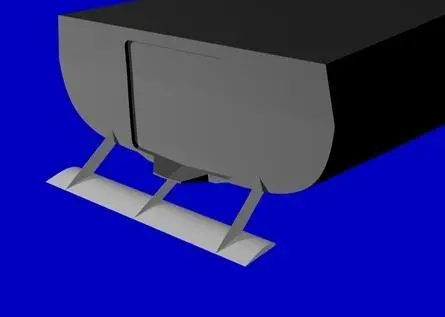
The CFD study was carried out by the DMO (Defence Materiel Organisation) of the Royal Netherlands Navy on a 108-metre Holland Class OPV. Based on the operational speed profile and the power curve of the ship, it was determined that the most fuel is consumed per year at speeds between 15 and 20 knots, in spite of the fact that the ship sails 86% of the time at speeds below 15 knots. The Hull Vane was therefore optimised for a speed of 17.5 knots.
As the vessel has a pronounced trim wedge – incompatible with a Hull Vane – the trim wedge was partially modified to the limits set by the DMO. Subsequently, CFD runs were done to determine the resistance at 5 knots, 12.5 knots, 17.5 knots and 22.5 knots, showing resistance reductions of 1.3%, 13.7%, 15.3% and 11.1% respectively. Multiplied by the operational speed profile, this results in an annual saving on fuel and emissions of 12.5%. The amount of CO2 emissions avoided will exceed 1.000 tons per ship per year, making the Hull Vane an extremely cost-effective CO2 abatement measure, as the investment will be paid back many times over during the lifetime of the ship.
For the influence on the operability of the vessel, a seakeeping analysis was done in a typical wave condition. This showed a reduction of the pitching movements of 7% and a reduction of the vertical accelerations on the helicopter deck of 13%. As the vertical accelerations are the limiting factor for helicopter operations, this will enlarge the operational envelope of the vessel.
The turbulent wake zone behind the stern was reduced by about 50%, making the launching and recovery of the RIB through the stern slipway safer and easier. Finally, the range of the vessel will be increased by 17% from 5.000 to 5.850 nautical miles.
As the savings are greater and the costs lower in the case of a newbuilding, the DMO has indicated that they will also consider the Hull Vane for their future newbuilds. A paper written about this study was presented at the FAST 2015 Conference in Washington DC, in September.
Hull Vane BV is a sister company of Van Oossanen Naval Architects. The Hull Vane has been successfully applied to a 30 meter passenger vessel, a 42 meter superyacht and a 55 meter fast supply vessel. Originally, the system was developed during research for a monohull sailing yacht competing for the America’s Cup. The Hull Vane is applicable to fast displacement ships, such as ferries, roro vessels, naval & coastguard vessels, superyachts and certain offshore vessels. The Hull Vane has been nominated for the Maritime Innovation Award, which will be handed over on November 2nd during the Maritime Awards Gala in Rotterdam (NL).
By Jake Frith
Related Articles
 SHIPYARD NEWS
 VESSELS
 INDUSTRY NEWS