![MaritimeJournal[Seawork]](https://www.maritimejournal.com/wp-content/uploads/2026/09/MaritimeJournalSeawork.svg)



Innovative asymmetric CTVs promise 30% fuel savings
Offshore wind crew transfer vessel operator and Seawork regular, High Speed Transfers, has confirmed its order of two BARTech 30 CTVs.
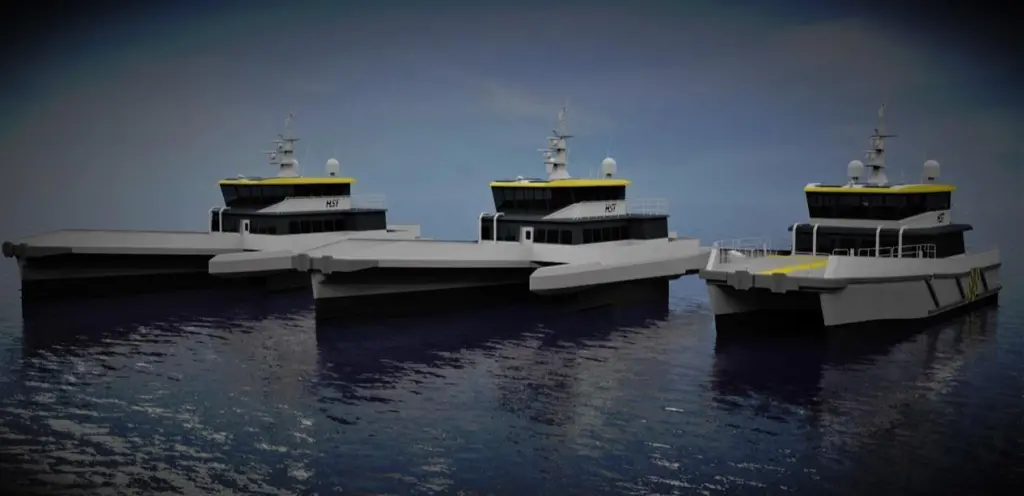
The orders have been placed with simulation-driven marine engineering consultancy, BAR Technologies, along with an additional hybrid Chartwell 24, with BAR Technologies’ Foil Optimised Stability System (FOSS), from Chartwell Marine, a pioneer in next-generation vessel design. The vessels will be built at Diverse Marine, on the Isle of Wight, UK.
The BARTech 30 CTV is a completely ground-breaking and unusual looking design, with its two, unequal length hulls and an advanced active foil stabilization system.
As offshore wind technology continues to evolve, and projects are developed further out to sea, the operational profiles that wind farm operators require have become diversified. Versatile fleets have become increasingly prized in the race to scale the sector in new markets. Equally, as decarbonising the vessel supply chain becomes a key imperative for wind farm owners and operators, BAR Technologies’ CTV is set to provide HST with fuel – and therefore emissions – savings of up to 30%.
The two BARTech 30 vessels will offer HST the flexibility to operate year-round, benefiting from a significant reduction in vertical acceleration to ensure optimal performance.
HST’s order will ensure that the business is able to continue to provide the highest standards of comfort for passengers during voyages to wind farms even in regions that typically see higher sea states such as the US. The proven Chartwell 24 vessel formula will be further enhanced with BAR Technologies’ FOSS, offering improvements in seakeeping and boosting efficiency.
Crucially, the vessels will all have the same layout of the console, seating and bridge, adhering to HST’s strict safety specifications and ensuring operational familiarity for crew and passengers. All three vessels will be equipped with Reygar’s BareFLEET technology to give HST a granular view of fuel use and operational efficiency, delivering savings to clients and using data to demonstrate the concrete benefits of the vessel platforms to wind farm operations.
Tom Nevin, CEO, High Speed Transfers, said: “Offshore wind owners and operators have shown a real appetite for efficient, low-carbon vessel platforms. It is exciting to work with vessel designers such as BAR Technologies and Chartwell Marine who understand what the industry needs and have the expertise to deliver next-generation designs without overcomplicating the vessels. BAR Technologies’ FOSS is fast becoming a ‘must have’ and we are keen to demonstrate the capabilities of our new vessels to the market.”
By Jake Frith