![MaritimeJournal[Seawork]](https://www.maritimejournal.com/wp-content/uploads/2026/09/MaritimeJournalSeawork.svg)



LNG ferry duo go into service
Two ground-breaking LNG ferries enter service in Germany soon after a total investment of some €43 million – the biggest in the history of local operator AG Ems.
Spokeswoman Corina Habben told Maritime Journal the car and passenger ferry Ostfriesland, was expected to enter service on June 17th. She is converting to dual fuel LNG propulsion and is billed as the first German-flag ferry to undergo the €13 million conversion.
Habben said the maiden voyage of the second ship, the ocean-going Helgoland costing more than €30 million has been postponed to mid July to give builders more time to sign off systems. That ship is the first in Europe to be built with a propulsion system based on LNG and is for service with AG Ems subsidiary Cassen Eils.
Looking ahead, Habben said “we cannot say at the moment whether we will fit LNG propulsion plants on further existing ships or on newbuildings because we would like to gather experience with both projects first”.
In a reference to delays in completing the ships, Habben added “since these two projects also represent the biggest investment ever in the 170 year history of our firm, a little patience is called for”.
The conversion of Ostfriesland was originally due for completion in June last year. It was put back to November to allow summer ship usage, then moved to March and now to June this year. Helgoland had originally been due into service this spring in any case so the delay on that ship has been minimal.
However the delays have not worried AG Ems which has stressed the pioneering and innovative nature of the two projects and said they demand time, care and patience. Habben also praised what she called “the good work” so far from builders BVT in Bremen.
Discussing Ostfriesland she said the construction requirements of what was for Germany a brand new technology had initially been underestimated such that the original time-table proved untenable.
Habben also noted that many technical system components had to undergo individual acceptance scrutiny, which had added further time to the work.
She reported that as of late May, the engine plant on Ostfriesland was being tested at BVT. The plant consists of two retrofitted duel fuel Wärtsilä 6L DF 20 engines, each of 1,150kW, and two Mitsubishi auxiliary engines Type GS6R of 350 kW. The ship also boasts Schottel pods and develops 15.5 knots.
In parallel work the ship has been lengthened from 78.7m to 94.07 to house the new propulsion plant. That has also increased vehicle capacity from 55 to 70 although passenger numbers remain unchanged at 1200.
Ostfriesland, which will continue to serve on the River Ems and North Sea coastal waters between Emden and the island of Borkum, is already 30 years old. It was built in 1985 at Martin Janssen Schiffswerft in Leer. When it went to BVT last autumn for the LNG conversion it was of 1,860gt and drew 2.56m. Its now replaced engine plant consisted of two MaK 6M332AK engines each of 956kW developing 15.5 knots.
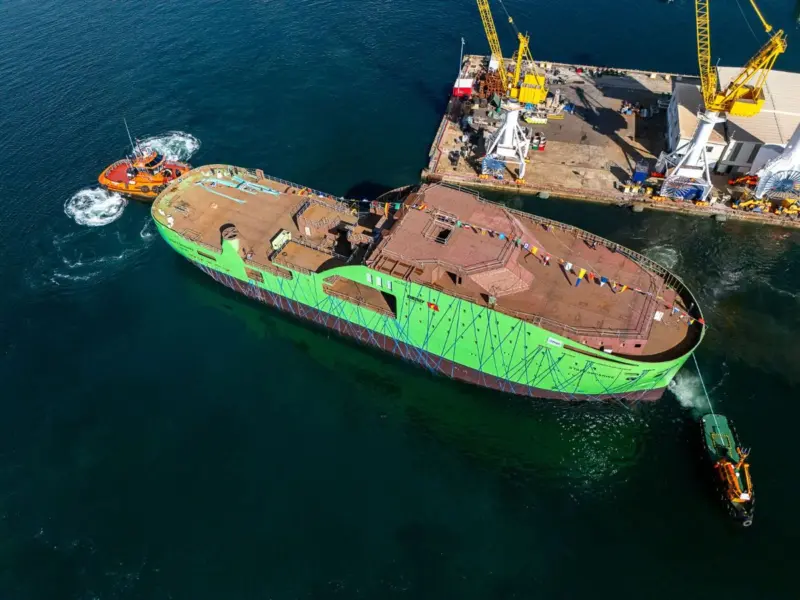
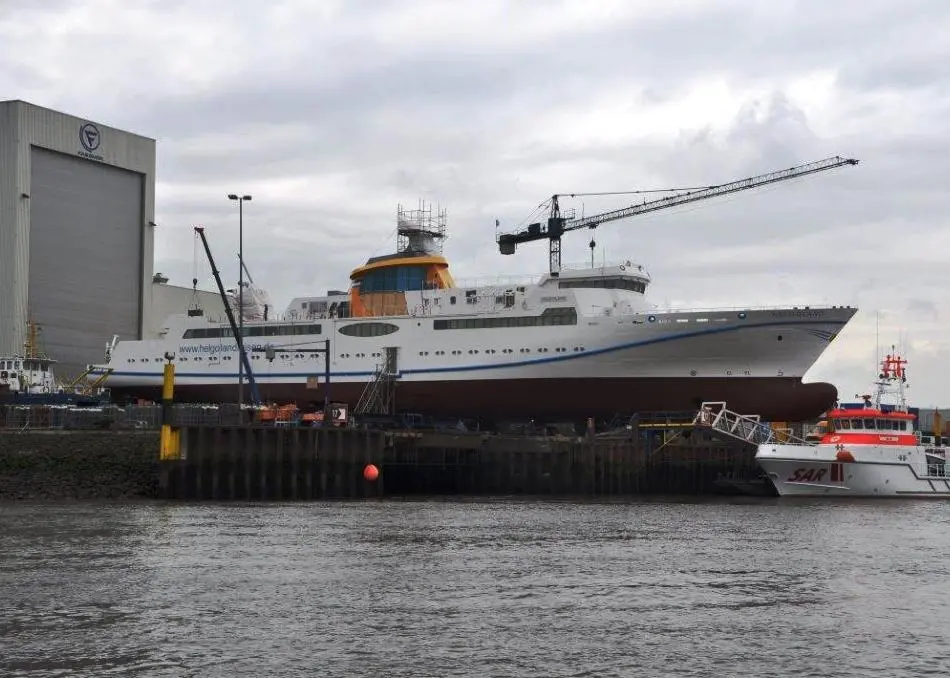
Now being fitted out and tested after leaving the building dock at busy Fassmer Werft in Berne near Bremen looking remarkably complete is the 83m long and 13m wide newbuilding Helgoland, drawing 3.6m.
That ship is not only being delivered just a little later than the original timetable called for but her specifications have also changed a bit since building began. Fassmer chief Harald Fassmer revealed recently that the ship was 4m longer than the 79m design on the first contract plans. He also noted that moulded breadth on Helgoland was also now 20cms greater than first planned.
Cassen Eils and Fassmer reported late May that after about nine months of building, further upper deck structures still had to be added. Components of the 5,000kW, 20 knot LNG propulsion system also still had to be tested before the newbuilding enters service. Like Ostfriesland, Helgoland has two 9-cylinder Wärtsilä 20DF medium-speed engines using LNG as the main fuel.
Corina Habben said the owners were “well satisfied with Fassmer which carries out not just building but also good project work”. She added that the yard “has earned a name for itself world-wide and its work on this ship can only add to that”.
Habben also acknowledged that the LNG propulsion system on Helgoland had been “a challenge because it requires so many individual systems-relevant components. Even though these have led to some delays, we are convinced that this new propulsion system is the way to go. After all, clean fuel is good for both the environment and the engine”, she declared.The new ship, completed on a hull built by Polish shipyard Hullkon in Szczecin, seats 1180 passengers. It also transports up to ten 10ft containers as well as breakbulk cargo and its own on-board crane from Heila Cranes lifts a ten ton load.
Helgoland is for regular service between the German mainland and the German island of Heligoland and is already scheduled to make its maiden 150 kms trip out of Hamburg. Cassen Eils MD Peter Eesman said interest was great because of “the standards being set by the ship in both outfitting and technology”. The new ship’s captain, Ewald Bebber, added that the Helgoland LNG pilot project had already drawn enquiries from Australia, Japan and the US.
The EU has contributed €7.2 million towards the German LNG ships. Under the TEN-T programme it has funded half the €8.35 million cost of the LNG system on Helgoland, which it described as “a pilot for a new generation of green ships”. It also paid €3.07 million towards the cost of the LNG system on Ostfriesland and the creation of an associated port operational infrastructure.
By Tom Todd