![MaritimeJournal[Seawork]](https://www.maritimejournal.com/wp-content/uploads/2026/09/MaritimeJournalSeawork.svg)






Polar research vessel Sir David Attenborough hits construction milestone
A major feat of engineering has seen the stern section of the new Polar research vessel Sir David Attenborough leave one British shipyard for another in the next step of its construction.
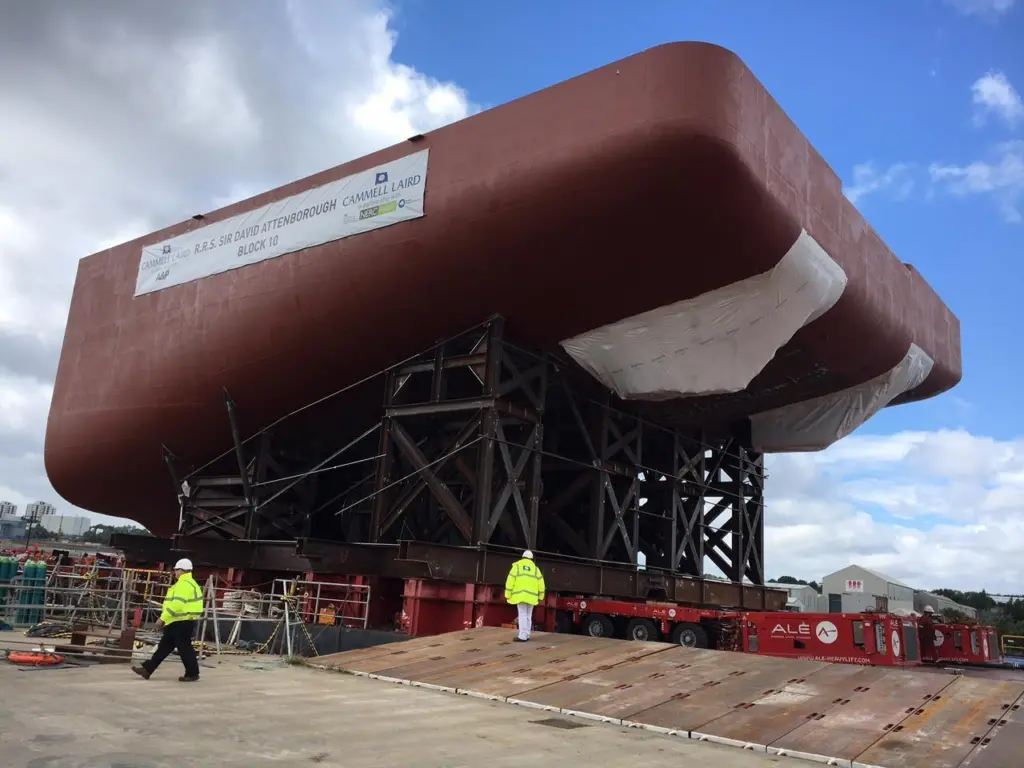
The ship’s stern has left A&P Tyne’s Hebburn shipyard, part of A&P Group, bound for Cammell Laird in Birkenhead.
“This project is the very epitome of how the UK’s ship building industry can work together to not only deliver the best in class engineering and fabrication but to hone and nurture the very best talent and skills too,” said David McGinley, group managing director of A&P Group.
During the first stage of the vessel’s construction, A&P Tyne’s specialist team of engineers and fabricators have invested more than 175,000 man hours in the fabrication of the 899-tonne steel stern, also known as Block 10.
Block 10 is the equivalent weight of 71 London double decker buses and more than 23 meters long and 24 meters wide.
During Block 10’s load-out from Hebburn, it was loaded onto a barge using self-propelled modular trailers by heavy transport and installation contractor ALE.
It was a complex operation involving hydraulic ballast pumps to keep the barge level while the heavy load moves onto it from the slipway. The block was secured by specially-designed sea-fastenings during its five-day transit to Cammell Laird travelling south through the English Channel.
This ‘load-out’ operation is the outcome of a collaboration between A&P Group and Cammell Laird and is a clear demonstration of the benefits that a flexible and co-ordinated effort brings to the construction of the RRS Sir David Attenborough and to the UK ship-building industry.
“The construction of the blocks by the A&P Group, as a contractor to Cammell Laird, is a tremendous showcase for British shipbuilding and engineering,” said John Syvret CBE, chief executive officer of both Cammell Laird and A&P Group.
“Whilst both organisations are fierce competitors who very much ‘compete where they must’, they also on an arm’s length commercial basis ‘cooperate where they can’.”
Mr Syvret pointed out that this is a business model that proved to be very successful in the building of Queen Elizabeth Class Aircraft Carriers, where both organisations undertook the construction of circa 20,000 tonnes of large sections of flight deck modules for the two ships.
He added that it’s also precisely the kind of collaboration that can help rebuild the commercial shipbuilding industry and provide thousands of highly-skilled jobs.
When completed in 2019, the RRS Sir David Attenborough will be one of the most advanced polar research vessels in the world. The new polar ship is commissioned by NERC, built by Cammell Laird to a Rolls Royce design and operated by British Antarctic Survey.
By Anne-Marie Causer