![MaritimeJournal[Seawork]](https://www.maritimejournal.com/wp-content/uploads/2026/09/MaritimeJournalSeawork.svg)




Power to Maas: inland shipping turns to H2
Maas is a typical inland container vessel running up and down the Rhine, but what makes it unusual is that it’s aiming at a full zero emission future.
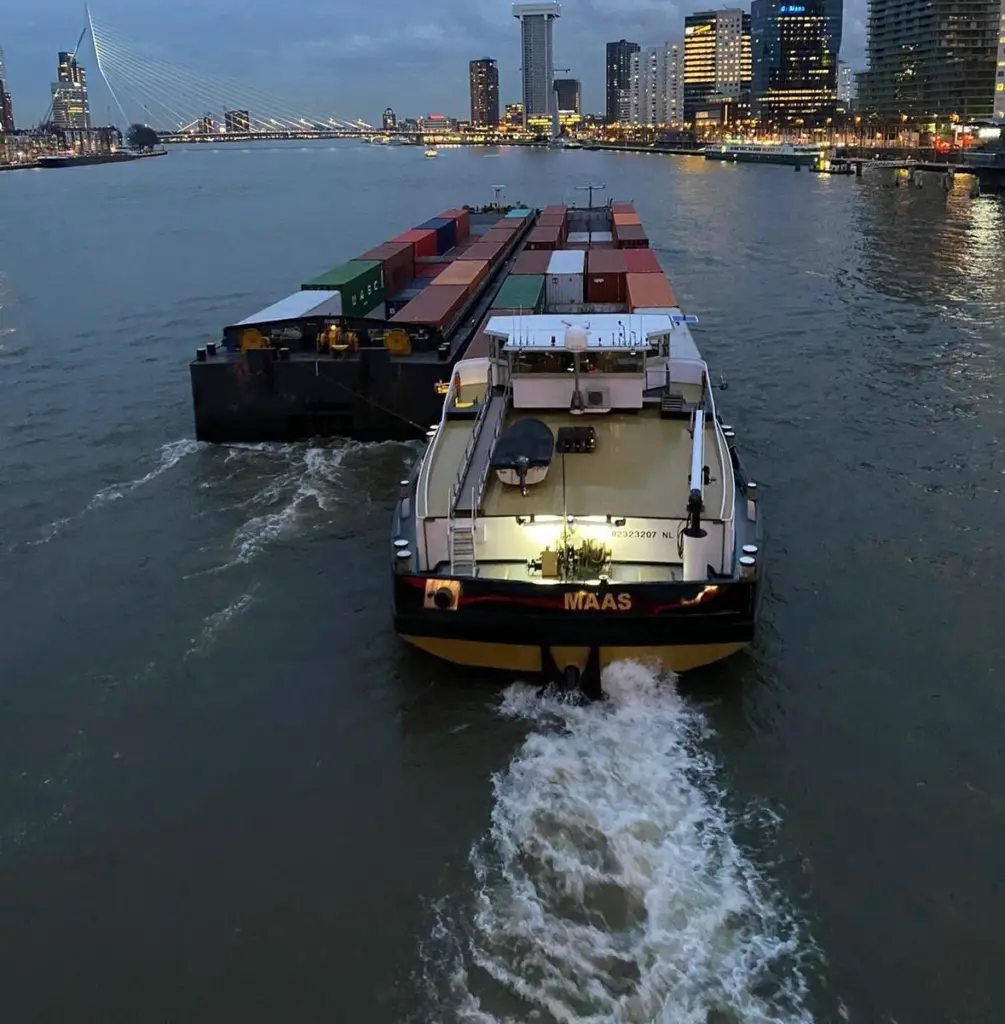
It’s not taking the easier option of retaining any kind of hydrocarbon power, a refit will soon take out both main engine and gearbox, replacing it with fuel cells. It seems ambitious, but as Prasanna Colluru of Future Proof Shipping underlined: “Zero means no GHG. Not just end-of-pipe solutions which can lead you into creating more demand for a non-sustainable fuel.”
That’s a very interesting argument, though admittedly that entails meeting technical challenges head on. However, the company is willing to put time and energy into forging a sustainable pathway for the industry.
Onboard, the shaft of this 110m vessel will pick up the power from a permanent magnet motor connected, via a thruster bearing, to the fuel cells: these will sit in a pair of repurposed, 40ft standard ISO containers “creating one large room” said FPS Senior Integration Advisor, Milinko Godjevac. He added that while “fuel cells are still not quite an off-the-shelf item” yet, the system’s basic requirements aren’t particularly onerous: additional ventilation, ducting and pipe-work with H2 leakage sensors, plus special fi-fi detection and response. However, while technically ready, configuration and energy management for this kind of operational profile “is still something we are learning about” he added.
PEM fuel cells of the kind utilised onboard Maas have one or two interesting characteristics for inland vessel applications: they can benefit from automotive developments and, as Jogchum Bruinsma of fuel cell developer Nedstack explained, unlike a combustion engine they exhibit a ‘flat’ correlation between power and efficiency, “even at low loads”. And because FC’s work electrochemically rather than by combustion, they have fewer losses and can reach around an 80% energy efficiency. Further, they run at modest, sub-80C temperatures, which means no special waste-heat recovery or shielding is necessary.
However, for economy and to yield the best stack lifetime, the fuel cells will be paired with a 504kWh battery located in a separate room. So, while the vessel can move at 17km per hour (the metric rather than knots for inland vessels) on hydrogen power, when the speed drops to about 4km, the propulsion power will come from the energy storage system, recharged from the main plant via a DC bus.
This still leaves the challenge of refuelling. Godjevac explained: “We are not going to try bunkering the vessel but swap out tanks in containers – it can come in a truck, making it a lot easier to get the project up and running.”
However, H2 isn’t anywhere near as dense as diesel, so the margins are somewhat tighter when it comes to refuelling patterns. Usefully, there are figures from Maas’ regular transit of the 200km route between Rotterdam and Belgium: the calculations show that it will need about 500kg of hydrogen for one of the 17-hour journeys. This will be accomplished with around 300bar pressurised cylinders stacked into one, road-transportable 40ft ISO standard container. This pattern also takes advantage of the lifting capability of the cranes at the ports.
While it means sacrificing four 40ft boxes in total, that still leaves the vessel with 200 teu capacity.
However, according to Godjevac, “aligning regulatory and class processes is quite challenging”. The IGF code hasn’t yet been updated for onboard hydrogen, and Bruinsma pointed out “you have to move to risk-based design approval”. While Nedstack has several years of installation and operational experience with megawatt-sized fuel cells this technology is new to the marine industry – so the burden lies with the design teams. Despite all this, the refitted Maas should be in the water by the end of this year.
It is, admittedly, a jump right into the heart of a new type of propulsion power. “You usually have people say, ‘we’ll wait for the first steps and see how it goes’,” says Bruinsma. “Future Proof Shipping are different: they really want to make this work.”
The retrofit will be performed at Holland Shipyards, and the project has received support funding from the Dutch RVO (Subsidie Duurzaam Scheepvaart scheme), Interreg North Sea Program (via the ZEM Ports NS project), and a stimulation scheme for sustainable inland shipping from the Port of Rotterdam, which is executed by the Expertise en InnovatieCentrum Binnenvaart (EICB).
By Stevie Knight