![MaritimeJournal[Seawork]](https://www.maritimejournal.com/wp-content/uploads/2026/09/MaritimeJournalSeawork.svg)




Shipyard crane alternative?
According to US-based manufacturer of Wheelift transporters, Doerfer Companies, there’s a shift happening in shipyards. The company claims that more companies are using its high-capacity transporters as an alternative or supplement to cranes.
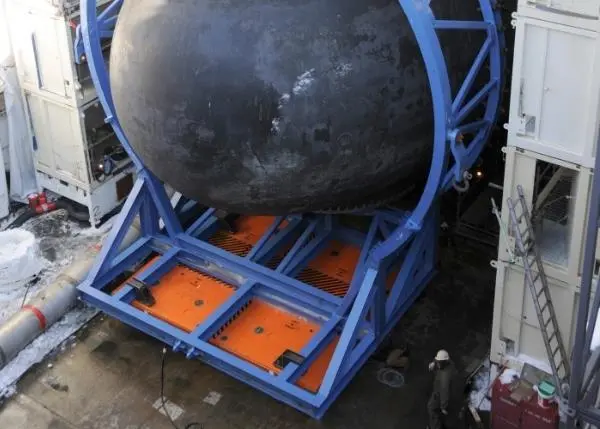
“Transporters are a safer alternative to many material handling methods,” said Roy Linden, account manager for Doerfer, “Shipyards find they are beneficial in all areas of their facilities, including fabrication processes, machine shop activities, yard material movement, and dry dock operations.
Wheelift transporters are heavy-duty transporters for tooling, assembly, and material handling movement with installations located around the world, including North America, Russia, Hong Kong, and Japan.
They can be used individually or ganged together in multi-mode for carrying the heavier and/or longer loads that come around with less frequency—providing greater use of these capital assets.
Wheelift transporters are operated by a wireless manual pendant control, or can be provided with an automatic guidance system or with the ability to self-level based on travel inclines or surface irregularities.
For normal movement, the transporter’s wheels respond as an all-wheel steering mode, meaning that as the front wheels steer in one direction, the rear wheels steer in the opposite direction. Either the long or short axis can be user-defined as the primary direction of travel.
For a centre rotation movement, all wheels align themselves to the centre of the vehicle and rotate about the transporter’s centre. For an offset rotation movement, all wheels align to pre-set user-defined rotation centre point, typically along the edge of the load or transporter. However, the centre point of rotation can be virtually anywhere.
For a crab movement, all wheels position in the same direction—driving the transporter along a path skewed from the original direction of travel. For a lateral movement, all wheels align themselves 90 degrees perpendicular to the primary direction of travel.
“People like them because they open up new capabilities within a yard’s multitude of operations, and are easy to set up and use,” said Linden.
The omni-directional capability is a big benefit to the yards—allowing travel within tight congested quarters. It also enables process innovations to traditional work standards that have been employed for decades—driving quality, cost savings, and safety improvements.
Wheelift transporters also have a real-time load monitoring feature, which protects the equipment and won’t allow an unsafe load or travel condition to exist
In the US, Naval Sea Systems Command (NAVSEA) uses Wheelift transporters in three of its four North America shipyards, including Portsmouth, Norfolk, and Pearl Harbor, to maintain fleet readiness for the United States’ submarine and battleship fleets.
Wheelift transporters are used to lift, transport, and process major propulsor and shaft components, as well as other large components within the shipyards.
The single most important benefit the Wheelift transporter provided for the home ports of the new Virginia class attack submarine fleet is facilitating repair turn-around time—returning the boat back to sea. Doerfer says the Wheelift transporters provided a meaningful dry dock time reduction.
By Jake Frith