![MaritimeJournal[Seawork]](https://www.maritimejournal.com/wp-content/uploads/2026/09/MaritimeJournalSeawork.svg)



Versatile Wildcat variation for Outer Hebrides
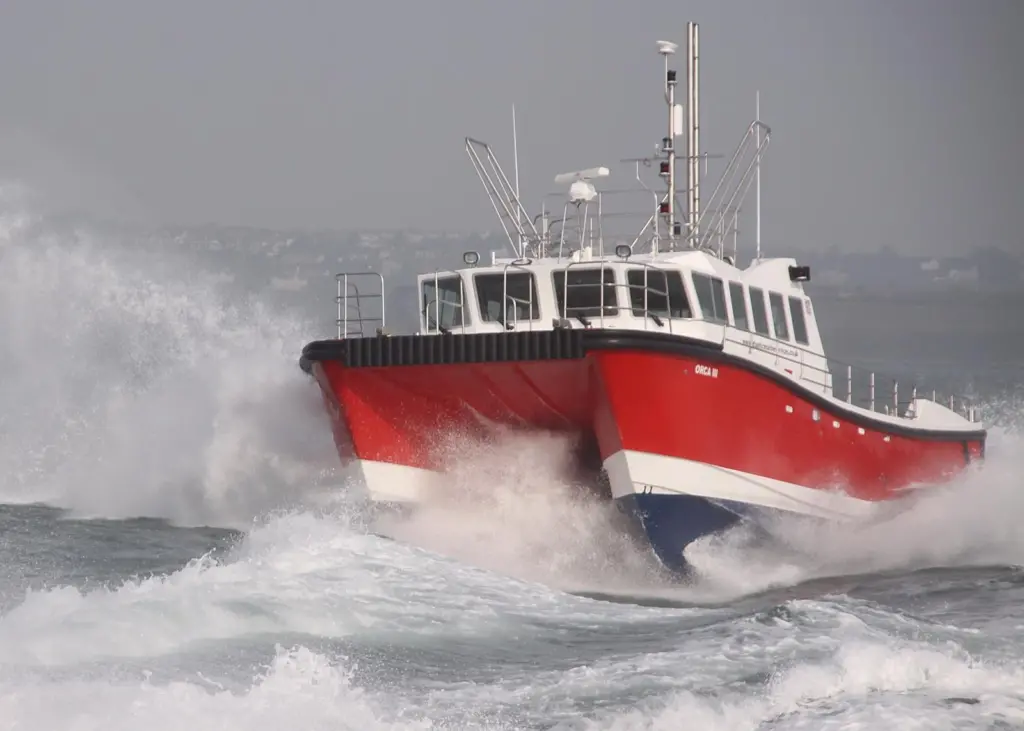
Ireland based Safehaven Marine has launched ORCA III, the third of the builder’s GRP Wildcat 53 / 16m catamarans.
The vessel has been built for Angus Campbell, who is based on the Isles of Harris in the Outer Hebrides, Scotland. This is the third vessel Angus Campbell has commissioned from Safehaven Marine. The first was an Interceptor 42 in 2004 and in 2007 he commissioned an Interceptor 55, which he has operated as a passenger vessel on the St Kilda run, a 100nm voyage from The Isles of Harris out into the North Atlantic.
The run presents the most challenging of operational roles a commercial vessel must endure. Often facing 6m seas on the voyage and regularly caught in heavy weather on the return trip, the Interceptor 55 has proven a safe and seaworthy vessel.
Angus Campbell will use ORCA III on this run, but it will also be deployed for a variety of other operational roles, including wind farm support, hydrograpic survey, long range passenger transit and dive support. The vessel has been specially adapted to undertake each of these roles.
For wind farm support duties, the vessel features a heavily reinforced and fendered bow to expedite crew transfers to wind farm structures. The cabin incorporates 12 reclining aircraft style passenger seats, each with a table in front to provide a comfortable environment for those in transit. Live aboard facilities include eight bunk berths.
For hydrographic survey work, the vessel is equipped with a moon pool and a multi-beam sonar head deployment frame which can be removed when not required. This has been developed and refined by Safehaven over several previous survey vessels the company has built. There is a dedicated survey bench for hydrographic equipment.
For her St Kilda run and for the long range offshore work the vessel will undertake, it has been built to comply with MCA Catagory 0, unrestricted service range. This incorporates 5,000 litre fuel capacity for extended range and, with eight watertight compartments providing high survivability, the vessel complies with the Cat 0 damaged stability requirements.
The hulls’ scantlings have been designed for Lloyds SSC area G1 and are substantial, with transverse framing at 500mm centres providing the strength needed when working far offshore. It is equipped with SSB radio. There is a full galley with a 240v cooker and hob as well as a large freezer, all powered by a 12kW generator providing onboard AC power.
The vessel features a hydraulic power supply driving twin 95kgf bow thrusters and a HIAB crane mounted on the aft deck. Orca III is equipped with its own 5m RIB carried on the spacious (28m2) aft deck on a cradle. It is launched by crane, allowing passenger transfers ashore from remote destinations. The vessel also has a dive platform and divers’ ladder on the transom. To assist dive operations, it is fitted with twin bow capstains/windlasses and an aft capstain on the transom.
Safehaven’s Wildcat 53 is a high buoyancy bow, twin chine symmetrical hull catamaran form, providing exceptional levels of seakeeping. The design differs from the last two Wildcat 53 wind farm support vessels supplied by Safehaven to Island Shipping in 2010 and 2011, both of which have been working successfully on UK wind farms for the past 18 months. It has a single level superstructure design as opposed to a raised bridge deck, which gives the advantage of allowing forward visibility for all passengers. Angus Campbell felt this was important for passengers on the long duration transits his passengers undertake in Cat 0 service.
Angus Campbell chose GRP again as he knew Safehaven built exceptionally strong hulls in the material. The Wildcat 53 has the same heavy duty scantlings as the builder’s pilot boats, which are often subject to severe impacts in rough weather. GRP provides other benefits. Being a homogeneous structure it is very strong and gives a high standard of external finish with the advantage of zero maintenance.
Orca III is powered by twin Scania D16 700hp engines and Twin Disc MG 5135 QuickShift gearboxes driving conventional 762mm diameter propellers on 90mm shafts and large, balanced stainless steel rudders.
Angus Campbell required the vessel to be able to run at 18 to 20 knots on the 200n/m round trip to St Kilda. Even in the heavy weather Orca III encounters it easily surpasses this, attaining a 24 knots maximum speed with its 30,000 kg displacement.
Safehaven Marine continues to prosper, with a strong order book including pilot and rescue vessels under construction for Algecerias, Liverpool, Cork, the Faroe Islands and Mozambique. The company has just launched the third and fourth Interceptor 38 pilots, the final two of a four pilot vessel order for the Azore Islands (as seen on this month’s front cover).
Technical Specification
Length: 17m
Beam:6.1m
Displacement: 30,000 kg
Power: Two Scania D16 engines rated at 700hp
Speed: 24 knots