![MaritimeJournal[Seawork]](https://www.maritimejournal.com/wp-content/uploads/2026/09/MaritimeJournalSeawork.svg)




Vessel launch: Compact but capable Blade
“Most boatbuilders step up in scale, going from a smaller design to a bigger one. We have done exactly the opposite, putting all we know about larger commercial boats into this 9m Blade,” said Steve Guyan of Catapult.
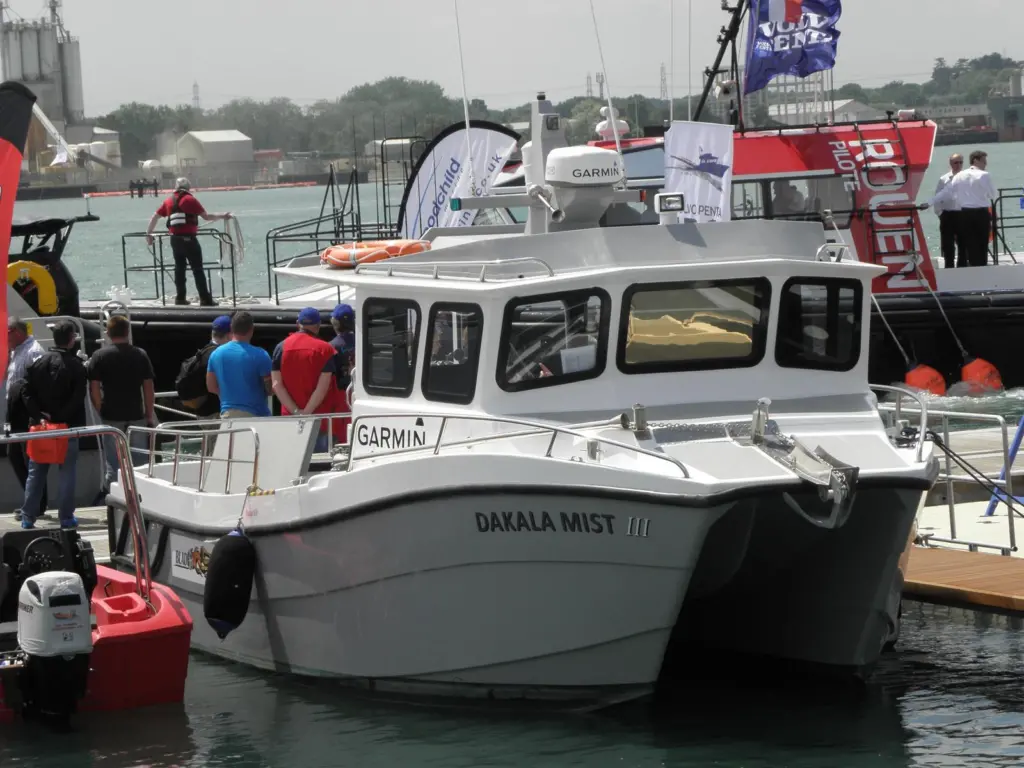
Although he admitted “it’s been a little like constructing a grand piano in a one bedroom flat”, the compact multipurpose catamaran has been worth the effort he told MJ at the vessel’s Seawork debut in June.
The first question is, why would Catapult, with its already successful 12m and 14m varieties, take on a 9m build? There are two main reasons explained Mr Guyan. First and foremost there’s a niche for smaller craft: “Take the big mothership survey vessels that need something able to deal with the closer, shallow surveys,” he said, pointing out that this version draws a mere 0.87m of water.
Secondly, “costs are a concern for a lot of people at the moment”, so he reckons that the time was ripe for a boat that comes in at a price that’s over 40% cheaper than its big sisters without actually losing much capability. He’s keen to add that while this has a good size wheelhouse with toilet and two berths below, the whole configuration can be tailored, enlarging the deck’s present 16m2 configuration or extending the superstructure.
A look around shows that Catapult has kept the many of the same features as you’d find on a larger build and despite a slightly more limited array there’s a lot of sheer ‘oomph’. For example, the Marlin Engineering supplied Iveco S30 230 diesels yield 230hp each side, pushing the boat along at a 29 knot top speed, fully loaded: “I know outboards and Z-drives are more common in a build this size, but our commercial operators insisted on the reliability of conventional drive chain,” explained Mr Guyan. Importantly, the engines draw only around 40 litres an hour at a 20 knot cruising speed, “which results in an absolutely phenomenal efficiency of about 2 litres per nautical mile”.
It also helps that these Iveco engines are also comparatively light, explained Ashley Greenall. Despite the need to retain capability, “everything has also been designed with an eye on the weight and this has been kept right down to a mere 5 tonne so the boat could be lifted on and off a mothership by a derrick or small crane with spreader bars,” he added, without needing specialised lifting gear.
There’s a distinctive element to the Blade’s outline: “We have dropped the foredeck away so it gives you increased visibility when you get up to full speed” said Mr Greenall. However, the lines have changed a little from the larger boats: because there’s no need to maximise the load bearing capacity of the deck, it’s got a much steeper dead rise behind the entry point to the catamaran’s tunnel, reducing drag and adding to fuel efficiency explained Mike Guyan, Steve’s son and another member of the team.
It all helps to keep the range: the little boat can hold enough in the tanks for a 250 mile round trip at cruising speed; more, certified to Category 2, it’s coded for working 60 miles offshore.
Further along the drive chain the same principle applies: the ZF45a gearboxes “are over-rated simply because we wanted to have the reliability” added Mr Guyan. And like a bigger boat, a power take-off supplies the Spencer Carter hydraulics which runs the anchor handling system. The prop package, from shafts running to the 19/27” propellers has come from First Marine Propulsion: even here the build has the same set up as seen on Catapult’s larger vessels: the shafts are double ended, ready to pull out and swap around, doubling their lifetime.
There were challenges: “With a bigger boat there’s more volume to play with, but this kind of scale meant we had to make sure that the weight distribution was absolutely spot on,” said Mike Guyan. The method adopted by Catapult was to build the GRP shell (resin and gellcoat from Euroresins) float it, and then place barrels of water around the boat to mimic the engines, batteries, and anything else of significant weight. “We also loaded up with half a dozen people and got them to move around,” he added. “This allowed us to check buoyancy and geometry.”
The overall build strategy has also resulted in an economy of scale: for example, the much smaller 9m Blade has the same doors as used on the bigger boats, and the helm is the same with a pretty full set of Garmin 8000 navigation and communication kit with three touch screens, and everything from autopilot to side and forward scans. Using the integrated Glass Helm series has also helped pull off another trick, “keeping the wiring under the dash simple so it’s still easy to change a fuse” said Mr Guyan.
Mr Greenall added, keeping the elements from the bigger boats “means there’s no having to find space for storing separate moulds or fittings”.
Finally, there’s another practical economy to the 9m Blade. “The boat is light enough to be moved around our yard by forklifts, we don’t need to use our cranes, and so it gives us the opportunity to slot the builds of these 9m versions in between our bigger vessel builds,” said Mr Guyan: “We won’t be building too many, maybe three or four a year even though the orders are already coming in. But we’ll keep them in demand – just like diamonds.”
By Stevie Knight