![MaritimeJournal[Seawork]](https://www.maritimejournal.com/wp-content/uploads/2026/09/MaritimeJournalSeawork.svg)



Getting to the core
A new subsea industry, mineral mining, is getting underway. But as a result, support functions are also under pressure to evolve.
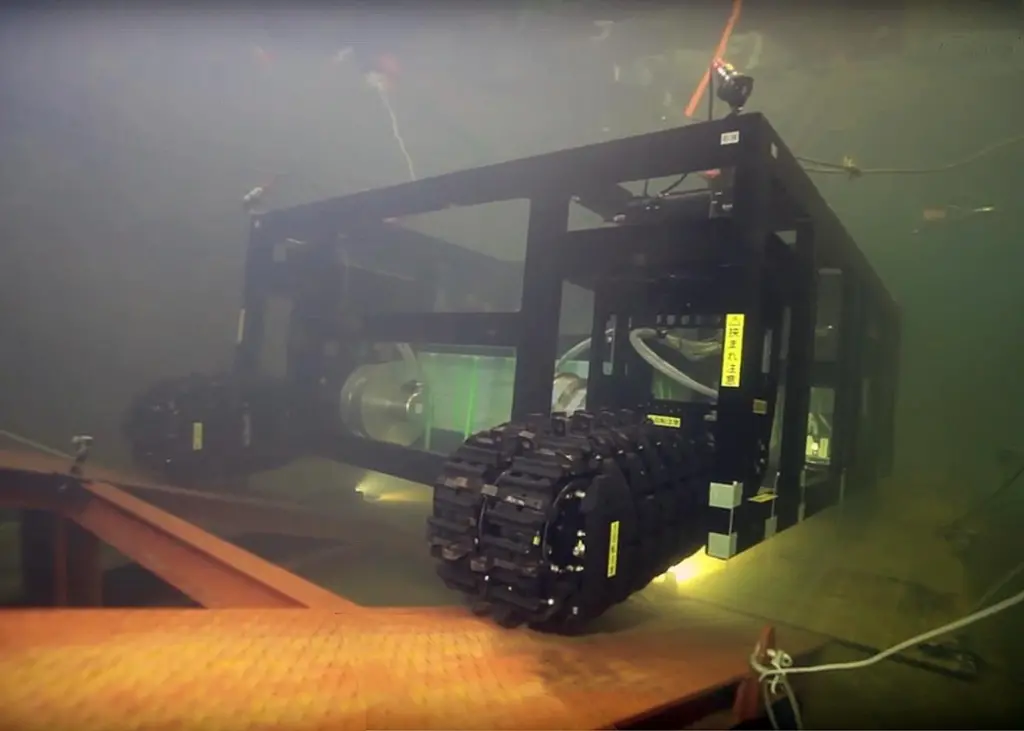
One clear demand is for commercially viable, accurate coverage of what lies beneath the seabed. The most efficient method is to utilise a work-class ROV to gather high-quality core samples, but it has to hit all the bases, including precision and cost-efficiency.
According to Tsuyoshi Miyazaki of the Japan Agency for Marine-Earth Science and Technology (JAMSTEC), rather than trying to bring a whole new beast to market, it was decided that it was better to design a small-sized and light-weight coring system that could be installed on a typical WROV.
This ‘typical’ model was a 3m long, 2m wide and 2m high model, with neutral buoyancy – plus a good power and hydraulic supply from the mothership. However, a lot of work was necessary to develop a kit that could practicably be fitted to a generic model.
Firstly, the operators need to see the terrain around the ROV to assess the suitability of the location for representative samples even on a dark seabed. “Images are taken by five wide-angle cameras, installed on four corners and the bottom of the subsea operating system,” said Mr Miyazaki. However, it wasn’t enough just to present a ‘fractured’ picture, these had to be integrated to allow evaluation by the operators.
Therefore these images “are synthesised and edited to obtain a virtual bird’s eye view”, explained Mr Miyazaki. Interestingly, the technology was first marketed by Nissan Motor Co as far back as 2007 although it has been augmented with moving object detection capabilities in 2011 – and continues to evolve even now.
Another characteristic that required attention was the ROV’s movement. To take hard rock core samples the ROV has to be able to press down on the seabed with its weight, so rather than float, it has to crawl. No conventional system would fit the bill, this element needed to retain minute control over both position and attitude, moving according to the topography of the sample location.
Therefore, four, omnidirectional crawlers extend from below the unit: these are unusual in that rather than a fixed double track extending along the length of the vehicle, these are shorter, ‘flipper-style’ units, one at each corner. It goes much further than the usual forward/backward action: these flippers can also swivel and even pivot independently, incorporating more movements into its repertoire that a modern dance troupe.
By combining these functions, “the ROV can land stably even on a rough or sloping seabed” said Mr Miyazaki, fine-tuning its position. Like the surround-view, the flipper-type mechanism was originally developed independently, this time by Topy Industries. Interestingly, Topy is also involved with demanding land-based crawler projects: the IRS Soryu, for example, aims to create a practical robot that can work alongside rescue teams in disaster areas.
Together, it makes for what Mr Miyazaki called “a highly effective” system. Further, while the additional equipment adds a certain amount to the ROVs overall dimensions, this remains well within the capabilities of standard deployment apparatus: the ROV, complete with subsea sampling apparatus, measures 4.4m in length with a width of 2.3m and a height of 3.0m while its weight-in-water comes in at 1.4 tonnes.
The technology has passed through a tank testing phase which confronted it with a number of difficult approaches and has recently successfully completed sea trials. Mounted on an SMD Quasar, medium-sized Work Class ROV and launched from the MV Kaishin, it collected a core sample from a specific test rock placed on the seabed for the trial. According to JAMSTEC, it demonstrated that it can “adjust position and attitude precisely while visually confirming the surrounding conditions on the seabed”.
The new Marine Mineral Resource Survey System is now ready for practical applications and it’s expected to be utilised for researching ocean mineral resources such as cobalt-rich, ocean floor crusts.
By Stevie Knight
Related Articles
 OFFSHORE RENEWABLES
 OTHER NEWS
 OTHER NEWS