![MaritimeJournal[Seawork]](https://www.maritimejournal.com/wp-content/uploads/2026/09/MaritimeJournalSeawork.svg)






Low energy seabed ordnance disposal trial
Scientists in the UK are trialling new methods to remove unexploded ordnance from the seabed in a less harmful way.
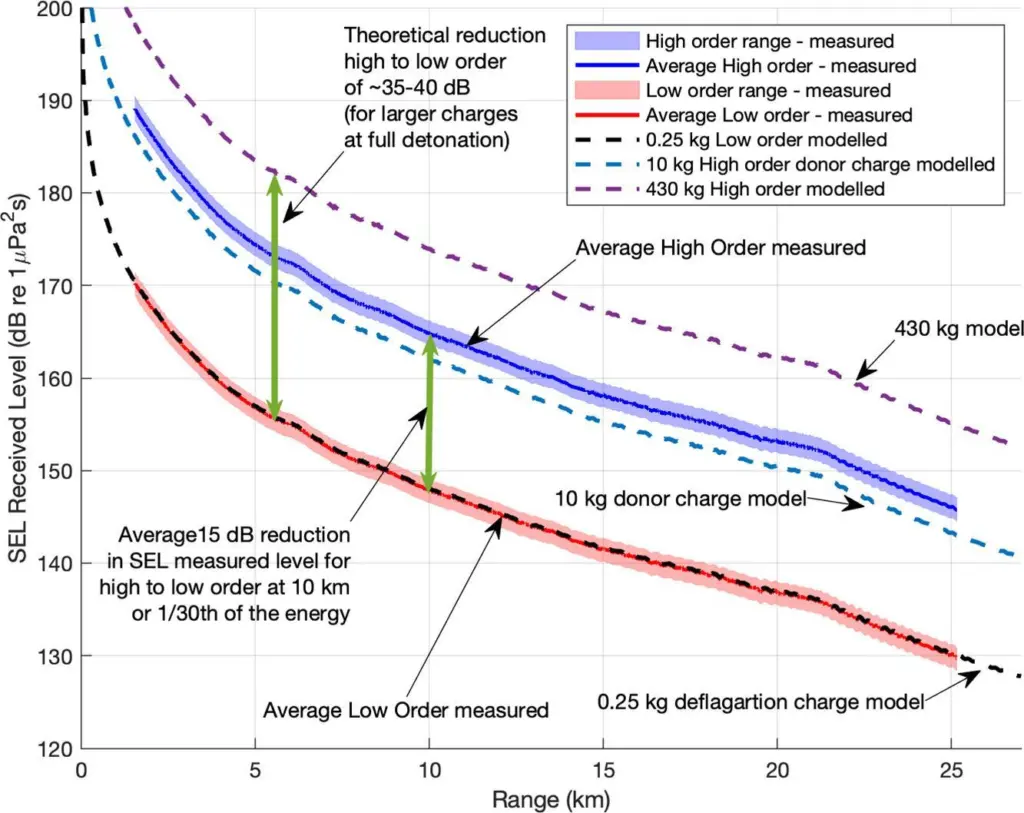
Underwater ordnance disposal is a high-profile issue and crucial to helping the UK meet its offshore wind construction targets.
Currently ordnance left over from the world wars and military exercises is removed using high order detonation – a destructive method which can mean injury or death for marine life and leaves large craters on the seabed.
Now a trial run by the National Physical Laboratory is exploring whether an alternative method called deflagration can reduce radiated acoustic noise and hence use less energy.
“This project is instrumental in addressing the UK offshore wind target,” said Sei-Him Cheong, senior scientist at NPL.
“I am thrilled to be a part of this work and it is remarkable to witness every milestone we achieved. The benefits of the numerous collaborations and hard work is bringing us closer to a clean and more sustainable future.”
Deflagration – a low order disposal method developed by UK-based Alford Technologies – has been put to the test in the Baltic Sea with results showing that it reduces underwater sound pressure level and exposure level by more than 20dB compared with existing methods, meaning a hundred times less energy released.
These results are from unexploded ordnance up to 460 kg TNT equivalent in size and researchers predict that reductions could be significantly higher for larger charge sizes.
The team has also developed a protocol for in-situ measurements of underwater sound generated during the disposal of unexploded ordnance to help ensure accurate monitoring of the sound.
Further tests are now planned on other potential new low order disposal techniques and barrier mitigations such as the use of bubble curtains.
NPL scientists have been joined by researchers from Loughborough University, Aarhus University in Denmark and staff from Aberdeen-based environmental consultancy Hartley-Anderson. The study’s findings are published in the latest edition of the journal, Marine Pollution Bulletin.
Related Articles
 OTHER NEWS
 MARINE CIVILS
 MARINE CIVILS