![MaritimeJournal[Seawork]](https://www.maritimejournal.com/wp-content/uploads/2026/09/MaritimeJournalSeawork.svg)


Ships converted to protect subsea infrastructure
The Royal Fleet Auxiliary (RFA), the support arm of the Royal Navy (RN), has dedicated a new ship drawing on the experience of the offshore oil and gas (O&G) industry to protect the UK’s underwater infrastructure.
Recent geopolitical events have highlighted the potential vulnerability of underwater infrastructure including oil and gas pipelines, communication cables and electricity inter-connectors.
In 2022 underwater gas leaks on the Nord Stream 1 and 2 gas pipelines and more recently damage to a gas pipeline and telecoms cables connecting Finland and Estonia, reportedly caused by “external forces”, have highlighted the requirement for states to have the capability to respond, capabilities that for decades have been the bread and butter of the offshore O&G industry.
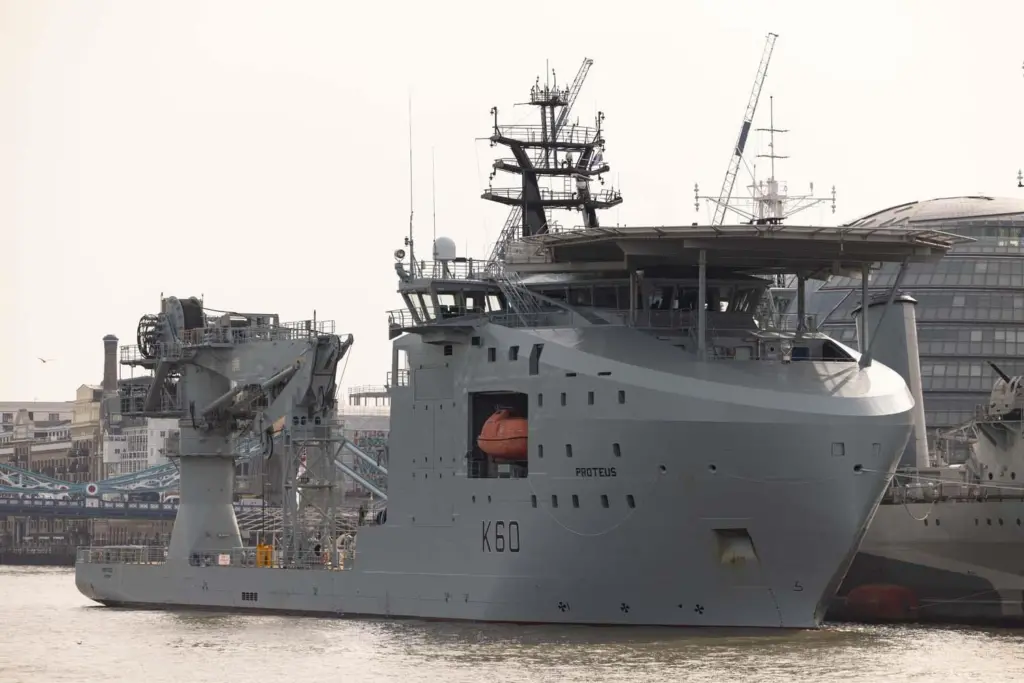
Potential disruption to states that rely on such underwater assets is huge and the UK’s response has been to acquire the former OSV Topaz Tangaroa, which has now been dedicated and renamed RFA Proteus in a ceremony on the River Thames in London.
New naval vessels, newbuilds or conversions are usually lengthy undertakings given the specialist requirements with the absence of the usual commercial urgency for completion. For Proteus, however, just 11 months after the Ministry of Defence committed to the project it was acquired and converted at Cammell Laird yard in Birkenhead for its new role.
RFA says the vessel will “serve as the launchpad for remotely operated vehicles and a home to a suite of specialist capabilities similar to those found in the oil and gas industries”. It is the first of two ships in the RN’s Multi-Role Ocean Surveillance (MROS) programme, the second project involving another former commercial OSV converted to a mine counter-measures vessel.
Dedication
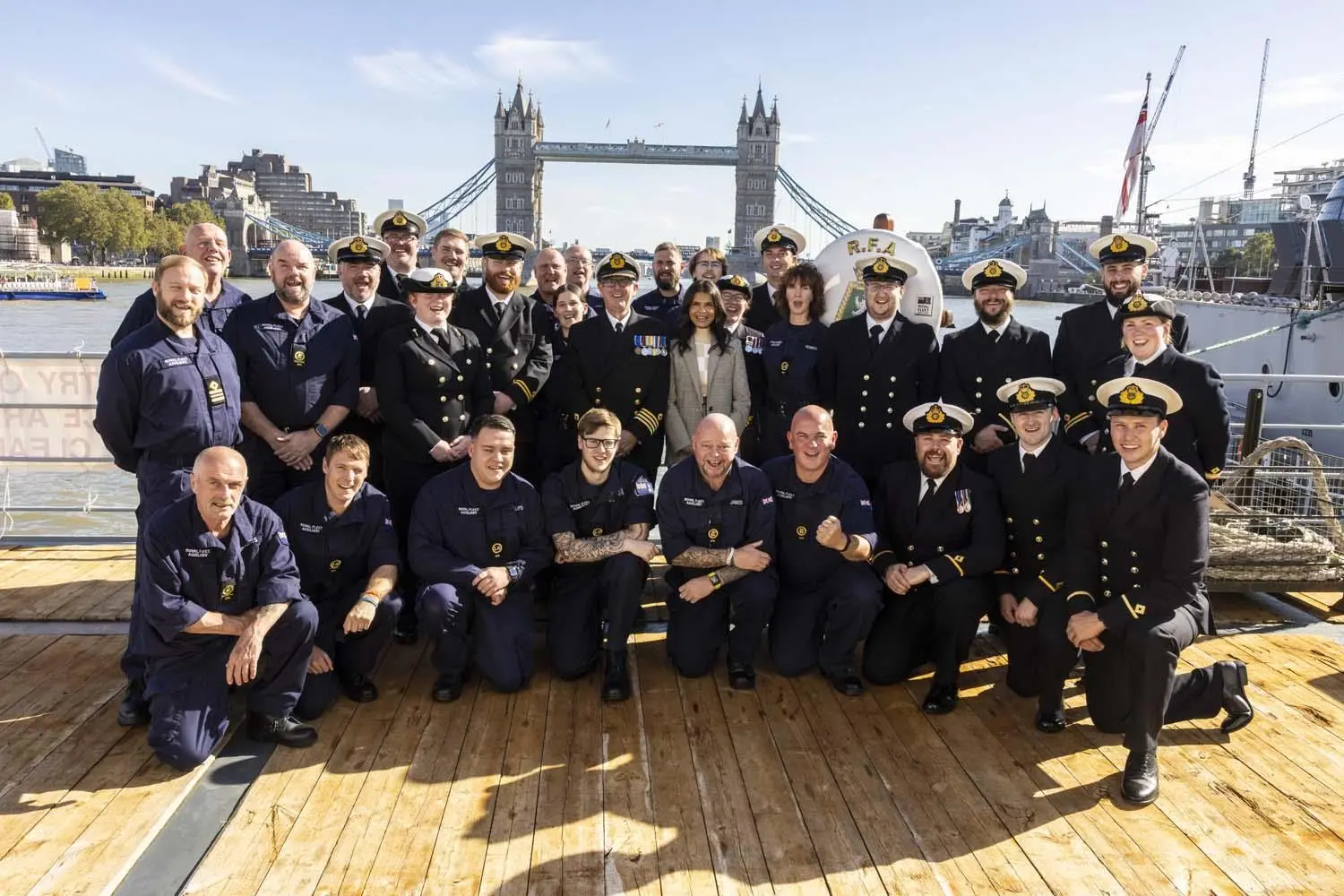
Proteus was formally dedicated on the Thames in the presence of the RFA Commodore-in-Chief, Prince Edward, the Duke of Edinburgh, and businesswoman and wife of Prime Minister Rishi Sunak Akshata Murty, who will be Proteus’ sponsor throughout the ship’s active life. A ship’s sponsor is an honorary title served to bestow good luck on a ship with the sponsor regarded as a permanent member of the ship’s crew.
The vessel will be crewed by 26 RFA officers and sailors who will operate the ship along with 60 RN specialists responsible for the underwater surveillance, survey and warfare systems.
Commodore David Eagles, head of the RFA, said: “It is a huge honour and responsibility for the Royal Fleet Auxiliary to be charged with crewing and operating RFA Proteus and delivering her unique, sovereign capability in partnership and collaboration with our Royal Navy, defence and government agency colleagues.
“Bringing a ship into service is a demanding endeavour that relies on a diverse, multi-skilled team, strong leadership, and unflinching determination. Proteus is no different and I pay tribute to the men and women in the UK, military and civilian who have contributed to this project and made today possible.”
Commanding officer Captain Martin Jones, RFA, said: “It is a huge honour to be able to bring RFA Proteus to the City of London for her official naming ceremony.
“To be berthed at such an auspicious location alongside HMS Belfast on the River Thames is a unique opportunity to present the RFA to the public eye and allow the ships company to enjoy the sights and sounds of London.”
Following conversion, the vessel now has the standard grey livery of warships and auxiliaries but its profile and appearance cannot hide its previous commercial role as a sophisticated multi-purpose offshore industry vessel.
Built by Vard Tulcea (hull) and completed by Vard Brattvaag, Norway for Topaz Energy & Marine to a standard VARD 3 08 design as Topaz Tangaroa in 2019, the vessel has a LOA of 98.1m with a breadth of 20m. When built it had a draught of 6m with gross tonnage 6,133gt and deadweight tonnage 3,277t.
It has a 120t SWL crane and under its new ownership has retained the helicopter deck forward and specification information from its Topaz days indicate it has DP2 capability and 1,000m2 of deck area. It has integrated ROV hangars and was built for subsea operations over both sides or through a 7.2m x 7.2m moonpool.
When built, five diesel electric engines powered two RR Azipull azimuth thrusters aft with manoeuvrability enhanced by two transverse thrusters and a swing-up thruster forward.
Related Articles
 OTHER NEWS
 MARINE CIVILS
 MARINE CIVILS